


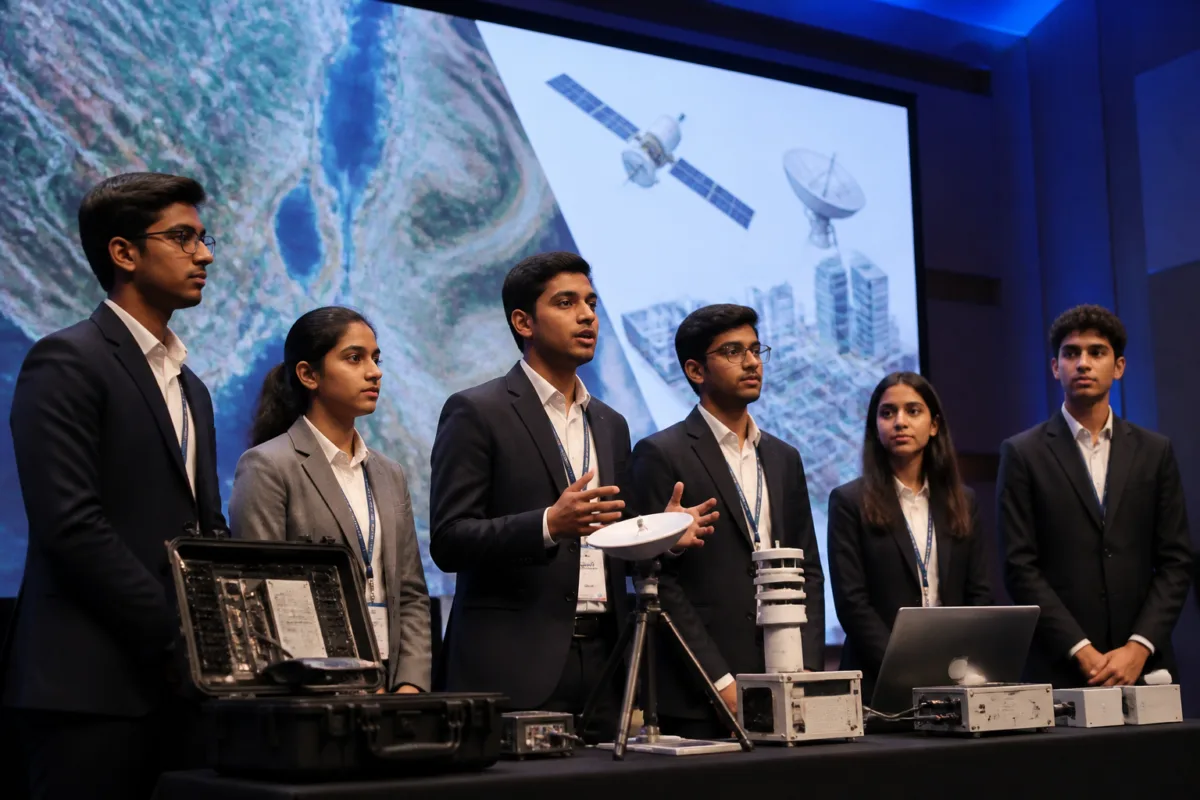
Six student innovators showcased satellite-based disaster solutions and other space technologies for building-collapse detection, emergency communication, crop stress monitoring, space-debris management and IoT security at the Viasat: Space for Good India Challenge finale in Delhi on Tuesday.
The second edition of the competition was organised by satellite communications company Viasat in strategic partnership with the Indian National Space Promotion and Authorization Centre (IN-SPACe). The finalists were selected through a multi-stage process and competed for a prize pool of Rs 11.5 lakh.
The projects were tested by a jury on whether their concepts could work beyond the drawing board. Questions included why satellite connectivity was necessary for a particular use case and how the systems would perform when cloud cover affected satellite observation.
Tanatswa Manjeya, a final-year electrical and electronics engineering student at Aditya University, presented Aegis, a proposed solar-powered communication hub for emergencies. The system is designed to allow stranded people to send SOS messages when mobile networks fail. It would also use artificial intelligence to analyse environmental data, anticipate infrastructure failures and identify safer evacuation routes.
Building safety was the focus of Bhu Kavach, developed by Parth Bhagwat Kharat, a computer engineering student at Dr D Y Patil Institute of Technology in Pune. The sensor is intended to detect a building collapse and transmit its exact GPS coordinates to response teams. Kharat said the system would prioritise local networks but switch to satellite connectivity if terrestrial infrastructure became unavailable.
Nived Krishna, a computer science PhD student at IIT Kharagpur, proposed MARK to extend emergency warnings to communities without reliable mobile coverage. The concept uses satellites to relay alerts to low-cost receivers installed at schools and panchayat offices, which would then activate local sirens. Krishna said such a system could address gaps affecting remote Himalayan valleys, tribal forest belts and coastal communities when cell towers are absent or damaged during calamities.
Agricultural monitoring featured in Chrono Sentinel, proposed by Shashank Kumar Singh, a PhD researcher at IIT Gandhinagar. The system combines satellite observations with the biological rhythms of plants. Singh said changes in these internal rhythms can appear before visible signs of disease, drought or environmental stress, potentially allowing farmers and forest managers to identify distress earlier.
The competition also included projects focused on risks to space and connected infrastructure. Adeetya Uppal, an aerospace engineering student at IIT Kharagpur, developed Drishti, an artificial intelligence-based system for preventing collisions involving space debris. Aryan Gupta of IIT Roorkee proposed Sentinel, a lightweight, battery-efficient security framework for satellite-connected sensors used in agriculture, railways and other infrastructure.
Gautam Sharma, managing director of Viasat India, said the programme provided students with technology access, mentorship and industry engagement while bringing different stakeholders together to address global challenges.
Uppal won the competition, followed by Singh in second place and Gupta in third. The finalists also received mentorship to refine their proposals after presenting them to the jury.

