


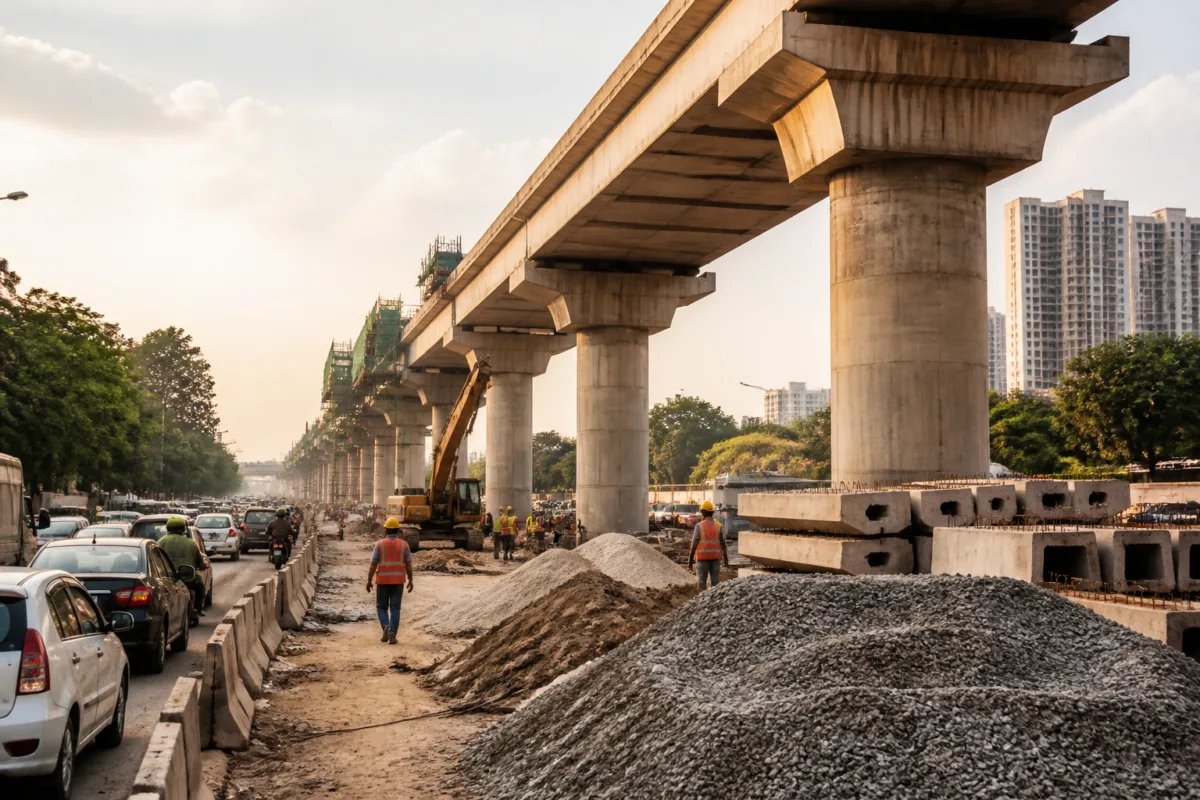
The disruption to construction-material supplies from Tamil Nadu is slowing work on Bengaluru’s Blue Line and revealing how dependent major urban infrastructure projects can be on supply chains that lie outside the city’s administrative control. The 58-km corridor from Silk Board to Kempegowda International Airport is not reported to have stopped, but contractors are facing shortages of quarry dust, crushed stone, aggregates and railway ballast after Tamil Nadu restricted the movement of stone materials to other states.
A senior Bangalore Metro Rail Corporation Limited (BMRCL) official told the Times of India that contractors had expected to source 30% to 40% of their construction materials from crushers in Tamil Nadu’s Krishnagiri district before the restriction. The shortage has affected concreting, architectural finishing and other construction activities. Depot construction has also been affected, particularly the supply of railway ballast needed for track laying.
The episode matters because metro construction is often viewed primarily as an engineering and financing exercise. In practice, it is also a logistics operation involving quarries, crusher units, transport operators, contractors, depots and multiple state administrations. A disruption at any point can alter the cost and sequencing of work, even when the civil structures themselves are progressing.
The Blue Line illustrates this dependence at several points along its alignment. The elevated section between Silk Board and KR Pura is at an advanced stage, according to the report, while work on the KR Pura–KIA stretch is continuing. Along the Outer Ring Road section, contractors are working on entry and exit structures, travelators and other associated facilities. These activities require different construction inputs, but they share the same exposure to the availability and price of aggregates.
The immediate effect has been a contraction in the number of accessible suppliers. An engineer with a construction company working on the Outer Ring Road stretch said materials had earlier been procured from Hosur, where around 14 quarry-crusher units supplied Bengaluru projects. Following the restriction, vendors shifted procurement to four or five crusher units in Bidadi. The narrower supplier base has increased pressure on both availability and prices.
The engineer said aggregate prices that were around Rs 800 per tonne had more than doubled. The report does not establish the precise effect of this increase on the Blue Line’s total project cost or whether the contract framework allows all additional costs to be passed on to the implementing agency. It does, however, show how a shortage in a basic material can create financial strain for contractors executing large public projects.
The impact extends beyond one metro corridor. GR Shanmugappa, president of the Karnataka Truck Owners’ and Agents’ Association, said the restrictions had affected several infrastructure projects in Bengaluru. He estimated that more than 40,000 tonnes of stone had been transported to the city before the ban and that 600 to 700 truck owners were affected after the restrictions disrupted that movement.
These figures point to a wider urban infrastructure supply chain rather than an isolated project problem. Bengaluru’s construction demand is supplied through a regional network that includes production sites in neighbouring districts and states. The city consumes the materials, but the permissions, environmental controls, quarry operations and transport restrictions governing those materials may be determined elsewhere. That creates a coordination challenge for projects whose timelines are managed in Bengaluru but whose inputs are not.
Tamil Nadu’s restrictions were imposed citing rising domestic demand, inadequate supplies and escalating prices of construction materials. The state also intended to curb illegal mining and unauthorised transportation of stone materials. The restrictions came into effect on July 27 for an initial three-month period and have continued, according to the report. The stated reasons therefore combine resource availability, price pressure and enforcement concerns.
This combination makes the issue more complex than a straightforward shortage. Increasing supply to Bengaluru without addressing illegal mining or unauthorised transport could undermine the regulatory objectives cited by Tamil Nadu. Conversely, maintaining restrictions without a workable arrangement for legitimate, contracted urban infrastructure demand can leave projects dependent on a smaller pool of suppliers. The supplied evidence does not indicate whether Karnataka and Tamil Nadu have reached an intergovernmental solution or whether a formal exemption or alternative transport arrangement is under consideration.
The institutional responsibilities are similarly divided. BMRCL is responsible for implementing the metro project and managing its contracts. Contractors must procure materials and organise construction activity. Transport operators move the materials across state borders. Tamil Nadu authorities regulate or restrict activity within the source region, while Karnataka authorities oversee the receiving state’s infrastructure and transport environment. No single actor appears to control the entire chain described in the report.
That division is important for understanding why a relatively basic input can affect a high-value public project. Metro systems are planned over years, but construction procurement is exposed to conditions that can change within months. The Blue Line’s contractors had built their sourcing arrangements around crusher units in Krishnagiri and Hosur. Once that route was disrupted, procurement moved to Bidadi, but the report indicates that the replacement network had fewer units and could not immediately absorb the same demand without a steep price increase.
The material involved is also not easily interchangeable in operational terms. Aggregates and quarry dust are used across concrete and construction works, while railway ballast is required for depot track laying. The disruption therefore affects more than one work package. It can influence the order in which contractors complete civil works, finishes, depot facilities and track-related activities. The report does not provide a revised Blue Line opening date or quantify the delay attributable solely to the restrictions, so the full schedule impact remains unestablished.
This is the central distinction between a construction delay and a supply-chain vulnerability. A delay describes the visible outcome. The vulnerability lies in the concentration of supply, the distance between production and consumption, the dependence on inter-state movement and the absence of clearly stated contingency arrangements in the available information. Bengaluru’s continuing infrastructure expansion increases the importance of these connections because multiple projects may compete for the same regional materials and transport capacity.
The episode also places the economics of urban construction in a less visible setting. Passengers experience a delayed corridor or unfinished station, but the underlying causes may involve crusher capacity, truck availability and regulatory decisions several hundred kilometres away. Contractors face the cost first, while the public consequences can appear later through slower progress, revised sequencing or pressure on project budgets. Whether those costs remain with contractors or affect public expenditure is not specified in the report.
For the Blue Line, the next important facts will be whether material supplies normalise, whether BMRCL or its contractors secure alternate sources at scale, and whether the continued restriction changes the project’s construction schedule. The available evidence confirms disruption, higher aggregate prices and pressure on depot and corridor works. It does not yet establish a final opening date, the total financial impact or a formal resolution between the authorities involved.
The larger urban lesson is clear but limited by the evidence: Bengaluru’s metro expansion depends not only on engineering progress within the city, but also on the resilience and governance of the regional construction-material network supporting it. Any assessment of future infrastructure timelines will need to account for that network alongside land, funding and construction capacity.

