


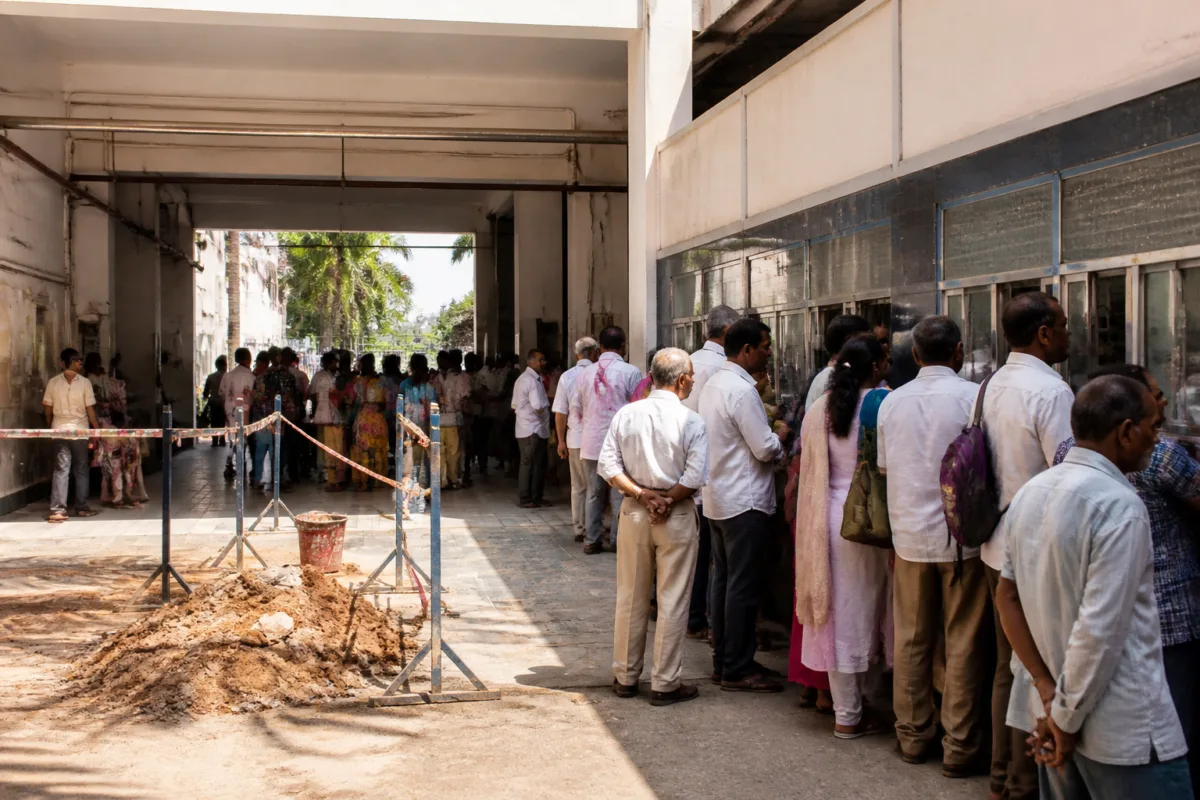
The overcrowding at Sassoon Hospital’s cardiology OPD is not only a story about patients waiting for hours. It exposes a more consequential problem in public healthcare infrastructure: a major referral hospital is concentrating cardiology consultations into a single outpatient day even as the number of patients needing cardiac investigations and treatment continues to rise.
A report by Pudhari – Pune said patients at the Pune hospital had to wait for hours on Tuesday for consultations, with the queue extending up to the entrance. Several patients were reportedly left standing in the sun. The pressure was made worse by maintenance and repair work on the ground floor outpatient department building, where crowds gathered near the case-paper counter and outpatient windows.
The immediate concern is inconvenience. The deeper concern is how a public hospital manages access to time-sensitive care when demand exceeds the available outpatient capacity. Cardiology is not a routine administrative service for many patients. A consultation may determine whether a person requires an electrocardiogram, further investigation, medication, angiography, angioplasty or another intervention. When the first point of contact is available only once a week, the queue becomes an operational bottleneck rather than merely a symptom of poor crowd management.
The report does not establish that every patient experienced a medical delay or that an adverse medical incident occurred. It does, however, describe conditions that can make the pathway to diagnosis longer and more difficult, particularly for patients who have travelled from outside Pune. Some may need to return for follow-up investigations or treatment, adding transport costs, lost workdays and the risk of abandoning care before the process is complete.
A referral hospital serving beyond its immediate city
Sassoon Hospital is an important treatment centre for poor and economically vulnerable patients from Pune and several districts in western Maharashtra. The report links this role to the high cost of private cardiac treatment, which pushes patients who cannot afford private hospitals towards the public facility.
That geography matters. The pressure on the cardiology OPD cannot be understood only as a local hospital-management issue. Patients arriving from distant districts are dependent on a sequence of services that begins with registration and consultation. If access to the specialist OPD is compressed into one day, the hospital’s effective capacity is determined not only by the number of doctors or procedure rooms, but also by how many patients can be safely registered, assessed and directed to the next stage of care.
The report says the cardiology OPD operates only one day a week. It also says that the hospital has eight sanctioned super-specialist posts, of which only some are filled. The supplied material does not provide the exact number of vacant posts, the current doctor-patient ratio, the daily appointment capacity or the waiting time for different procedures. Those missing numbers limit any precise assessment of the gap, but they do not erase the basic operational signal: demand is being channelled through a very narrow outpatient window.
The capacity problem behind the queue
The queue at the entrance is the visible part of the system. The less visible part is the accumulation of work behind it. A cardiology OPD must manage registration, case papers, clinical assessment, diagnostic referrals, reports, follow-up appointments and decisions about whether a patient needs urgent attention. These functions compete for space and staff, particularly when maintenance work is taking place in the same building.
The report says the crowding near the case-paper and OPD windows created a safety concern. It does not specify whether the hospital had introduced temporary counters, alternate access routes, shaded waiting arrangements or a separate process for patients with urgent symptoms. Those details would be central to assessing the hospital’s preparedness, but their absence also highlights the importance of publishing clear operational information when a major outpatient facility is under repair.
A functioning public hospital is not defined only by its installed equipment or sanctioned posts. It is also defined by whether patients can move through the system without unnecessary congestion. Registration, triage, consultation and follow-up are connected stages. A failure at the first stage can slow the entire chain, especially when there is no alternative specialist clinic during the week.
The available treatment data points to sustained demand
According to hospital data cited in the report, more than 6,000 patients underwent angiography, angioplasty and other cardiac treatments between 2023 and September 2026. The figure covers several years and combines different kinds of procedures, so it cannot by itself show the exact annual growth rate or the number of new OPD patients. It does, however, indicate that the cardiology department is handling a substantial volume of specialised care.
The relationship between procedures and outpatient demand is important. Patients who eventually undergo an intervention generally enter the hospital through a chain of consultations, tests and referrals. A rise in treatment volumes can therefore place pressure not only on catheterisation or procedure facilities, but also on the outpatient services that identify and prepare patients for those procedures.
The supplied report does not provide comparable figures for earlier years, the number of cardiology consultations conducted each week, or the proportion of patients who are new, follow-up or emergency cases. It is therefore not possible to conclude from the available information that treatment capacity has definitively fallen behind demand by a specific margin. What can be established is that a reported volume of more than 6,000 cardiac procedures and treatments coexists with a one-day cardiology OPD and visible patient congestion.
Why staffing and scheduling are inseparable
The shortage of specialist personnel is another part of the access problem. The report refers to eight sanctioned super-specialist posts and says that only some are filled. Without the exact sanctioned and working strength, the impact cannot be quantified. But the institutional connection is clear: the number of OPD days a hospital can operate depends partly on available specialists, supporting staff, rooms, diagnostic services and the ability to schedule follow-up care.
Increasing OPD days is therefore not simply a matter of opening a counter on another day. It may require doctors, nurses, technicians, registration staff and diagnostic capacity. It may also require a system to distinguish urgent symptoms from routine follow-up consultations. The report records demands for more OPD days, additional specialist doctors and better crowd management, but it does not report a formal hospital decision or implementation timetable on these requests.
This distinction is important for public accountability. A hospital can respond to overcrowding through short-term crowd-control measures, such as rearranging counters or staggering appointments. It can address the underlying capacity issue only through staffing, scheduling and service planning. The two responses are related but not interchangeable. A shaded waiting area may reduce exposure to the sun, but it does not create another consultation session. Similarly, an additional OPD day may expand access but will not by itself solve a shortage of diagnostic or specialist staff.
The safety question is broader than physical congestion
The reported conditions raise a patient-safety question without establishing that a specific safety incident occurred. Patients with chest pain, breathlessness or sudden sweating may require prompt medical attention, according to cardiologists cited in the report. At the same time, the article concerns a regular outpatient clinic and does not say that emergency services were unavailable or that emergency patients were placed in the general queue.
That distinction should shape the hospital’s response. Routine cardiac follow-ups, first consultations and potentially urgent symptoms cannot be managed through an undifferentiated crowd. A clear triage process would help determine which patients should be directed immediately to emergency care and which can safely wait for a scheduled consultation. The supplied report does not confirm whether such a process is operating at the affected outpatient area.
The maintenance work adds another layer. Repairs are a normal part of keeping public buildings operational, but they can reduce usable space and alter movement patterns. When repair activity overlaps with peak OPD demand, temporary arrangements become part of service delivery rather than a peripheral facilities issue. The reported crowding near entry points and service windows suggests that the hospital’s physical layout and operating schedule need to be considered together.
The larger urban infrastructure issue
Sassoon Hospital’s cardiology OPD illustrates how urban healthcare capacity is distributed unevenly. Patients from Pune and neighbouring districts rely on a central public institution because specialised private care is expensive. That makes the hospital a regional node, not merely a city facility. Its outpatient schedule consequently affects people who may have limited money, time and flexibility to make repeated journeys.
The report confirms the queue, the limited OPD frequency, maintenance-related crowding, staffing concerns and the treatment volume cited from hospital data. It does not establish the precise causes of the staffing gap, the hospital’s current appointment capacity, whether additional OPD days have been formally considered, or how many patients are turned away or rescheduled. Those are the facts that would determine whether the current problem is primarily a scheduling failure, a staffing constraint, a space shortage or a combination of all three.
For now, the evidence points to a public hospital whose visible demand is pressing against limited outpatient access. The immediate developments to monitor are whether the cardiology OPD is expanded beyond one day a week, whether additional specialists are made available, how patients are managed while repair work continues, and whether the hospital publishes a clearer system for appointments, triage and follow-up. Until those operational details change, the queue at Sassoon’s cardiology OPD will remain a measure of the gap between specialised public healthcare demand and the capacity available to receive it.

