


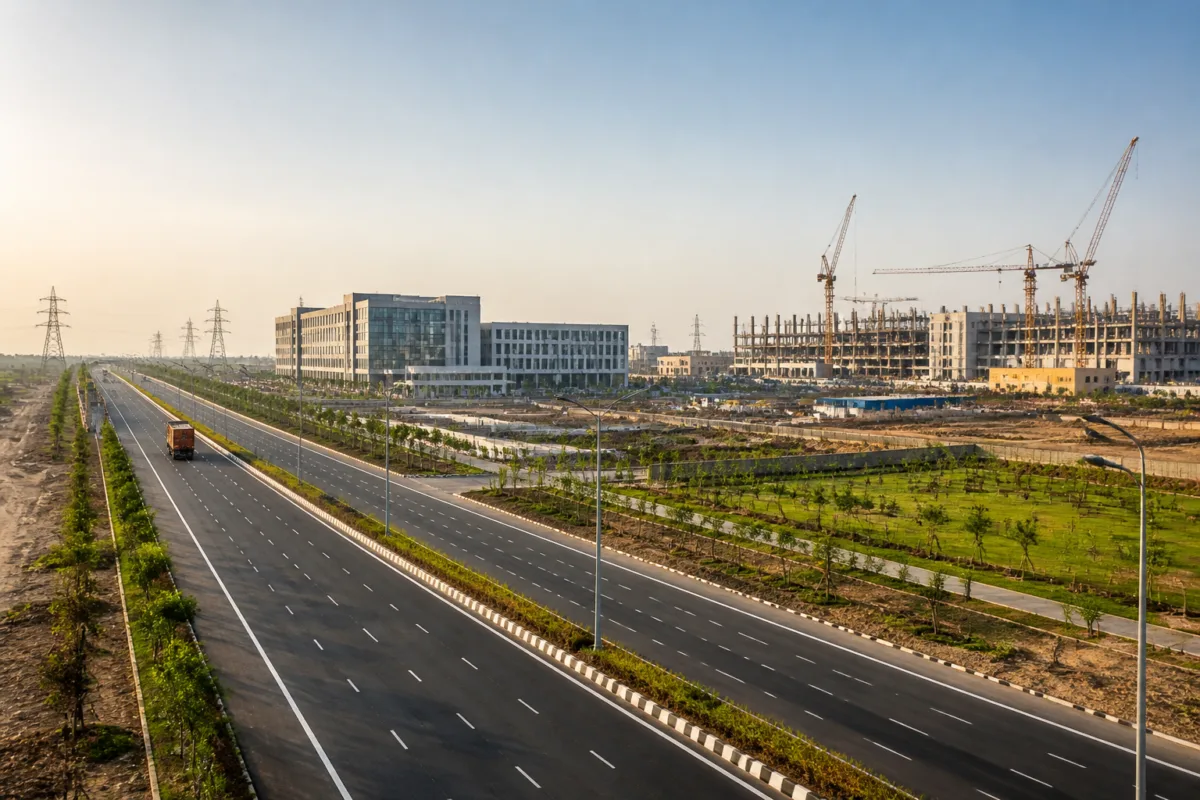
Dholera is being positioned not only as a destination for semiconductor and advanced manufacturing investment but also as a test of whether an emerging industrial region can build the hospitals, schools, housing, hospitality and transport systems needed to support a new workforce. The Gujarat government plans to make Dholera Special Investment Region a key focus of Vibrant Gujarat Global Summit 2027, with investment sought across healthcare, hospitality, education, housing and urban services.
The government’s stated approach marks a shift from treating Dholera as a project site to presenting it as an urban ecosystem. The immediate industrial anchor is the proposed Tata Electronics semiconductor fabrication facility. According to an official statement reported by the Times of India, the plant is expected to attract ancillary industries and technology enterprises, along with skilled professionals and business delegations. That expectation is driving the parallel push for social infrastructure in the region’s Activation Area.
This sequencing matters. Industrial projects create demand that is wider than factory premises. Workers and managers need healthcare, schools, accommodation, food services, emergency response and reliable connections to larger urban centres. Companies need hotels and meeting facilities, while residents need housing and everyday services. The government’s current list of projects suggests that Dholera’s development is being planned around this broader demand rather than around manufacturing capacity alone.
The projects reviewed by Chief Minister Bhupendra Patel include a 200-bed multispecialty hospital, an integrated school, a fire station, a hotel, a guesthouse, a food court and a tent city. Several hospitality facilities are nearing completion. These include a 42-room guesthouse with suites and conference facilities, a food court designed to serve around 600 people and a tent city with 50 tents. The government said these facilities are expected to become operational shortly.
These numbers provide a first indication of the scale at which Dholera’s support system is being assembled. A 200-bed hospital is a substantial institutional facility for an emerging region, while the school and fire station address two services that are central to making an industrial district function as a place of residence rather than a daytime employment zone. The guesthouse, conference facilities and food court are more directly linked to investors, officials and project visitors, but they also indicate the government’s expectation that commercial activity will increase before a mature residential market develops.
The available information does not establish the hospital’s opening date, the school’s capacity, the hotel’s room count or the operating agency for any of these facilities. It also does not specify the number of homes planned for workers and residents, the expected population of the Activation Area or the service standards that will govern water, waste management, electricity and public transport. Those details will determine whether the announced facilities become an integrated urban system or remain a collection of project-linked amenities.
Connectivity is the other essential part of the strategy. The Ahmedabad-Dholera Expressway has improved access to the region, according to the official statement. The Dholera international airport is expected to become operational by the end of 2026. Two rail projects are also under development: the Bhimnath-Dholera Logistic Hub rail line and the Ahmedabad-Dholera semi-high-speed double rail line.
Together, these links are intended to connect Dholera to passengers, freight, industrial suppliers and business visitors. Their importance is not identical. The logistic rail line is associated with movement of goods and industrial inputs, while the semi-high-speed rail project is linked more closely to passenger and regional connectivity. The airport would add another layer of access for business travel and potentially for high-value industrial activity. However, the supplied government account does not provide construction progress, commissioning schedules beyond the airport expectation, costs, ridership estimates or freight capacity for the rail projects.
That gap is important because infrastructure announcements do not automatically translate into urban accessibility. A region can have an expressway, airport and rail links while still offering limited last-mile connectivity between workplaces, housing, schools and healthcare. The current plan shows that the state is building regional connections alongside facilities inside the Activation Area, but the available evidence does not yet show how these systems will be integrated for daily users.
Dholera’s proposed semiconductor ecosystem also creates a particular type of urban demand. The government expects the Tata Electronics facility to anchor ancillary industries and technology enterprises. This could produce demand from several groups at once: technical workers, construction and service workers, business visitors, suppliers and families. Their needs will not be identical. A temporary workforce may require short-term accommodation, while skilled professionals may seek long-term housing, schools and healthcare. Industrial suppliers will require logistics facilities and dependable freight connections. The current investment pitch covers these categories broadly, but the report does not establish how the region’s land-use or housing strategy will respond to them.
The decision to seek investment in healthcare, hospitality, education, housing and urban services at VGGS 2027 indicates that the government sees private capital as part of the next phase of Dholera’s development. This is institutionally significant. The state is not only presenting industrial land or factory infrastructure to investors; it is also seeking investment in the services that make industrial expansion viable. Yet the source does not identify the investment model, land allocation process, public-private responsibilities or financial commitments for these sectors.
That leaves the delivery structure as a central question. A hospital may be publicly built, privately operated or developed through a partnership. The same applies to hotels, housing, schools and urban services. Their ability to serve residents will depend on who finances construction, who operates the facilities and whether access is designed around industrial employees, the wider population or visiting delegations. Without those details, the announcement demonstrates intent but not yet the complete governance framework.
The environmental component of the plan adds another layer. Around 1.1 lakh saplings have been planted across 53 hectares in the Activation Area in partnership with the forest department and Sadhbhavna Trust. This is a measurable green-infrastructure intervention and signals an effort to combine industrial development with landscape creation. The reported figure establishes the scale of planting, but it does not indicate survival rates, species composition, water requirements, maintenance arrangements or the relationship between the planted areas and the wider region’s climate and drainage systems.
Those implementation details matter because planting and urban resilience are not interchangeable. Trees can contribute to shade, landscape quality and ecological value, but their long-term role depends on survival and maintenance. Likewise, the report does not provide information on stormwater management, water supply, sewage treatment, waste processing or energy systems in the Activation Area. These utilities are not secondary to industrial development. They determine whether a new district can support people and production reliably.
The data currently available therefore describes a region moving from enabling infrastructure towards the early construction of an urban support system. The disclosed figures include a 200-bed hospital, a 42-room guesthouse, a food court for about 600 people, 50 tents and 1.1 lakh saplings spread across 53 hectares. The connectivity programme includes an expressway already described as improving access, an airport expected by the end of 2026 and two rail projects under development. These are concrete components, but they do not yet amount to a complete account of capacity.
What remains unestablished is just as important: the number of workers and residents expected, the volume and type of housing required, the schedule for the hospital and school, the operating plans for hospitality facilities, the status of rail construction and the funding arrangements for urban services. No population forecast, investment value or project completion timetable beyond the airport expectation is provided in the supplied material. Those figures will be necessary to assess whether infrastructure is being delivered ahead of demand or primarily in response to confirmed industrial commitments.
The larger urban question is whether Dholera can avoid becoming an industrial enclave with limited everyday life around it. The government’s project list recognises that factories alone do not create a functioning city. Hospitals, schools, emergency services, accommodation, food facilities, transport and green infrastructure are being planned alongside manufacturing. The success of that approach will depend on coordination between industrial development, land use, utilities, mobility and social services.
For now, the evidence confirms a deliberate attempt to make Dholera’s social and urban infrastructure part of its investment proposition before VGGS 2027. It also shows that the region’s next phase is being tied closely to the proposed semiconductor facility and to the delivery of expressway, airport and rail connections. The developments that require close monitoring are the actual commissioning of the hospital, school and hospitality facilities; the airport’s progress towards its end-2026 target; the status of the two rail links; and the institutional and financial arrangements that will determine how Dholera functions once industrial activity expands.

