


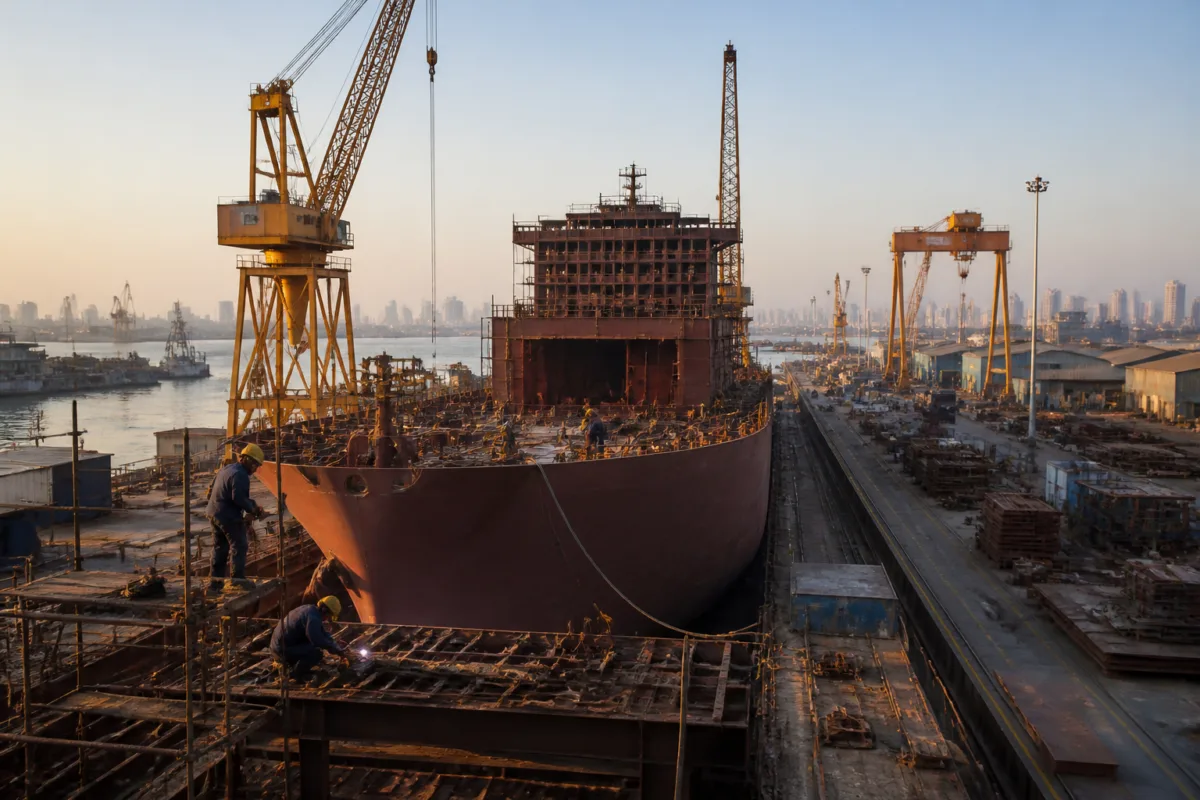
India’s shipbuilding push is moving beyond a central financial package into a competition among coastal states to assemble complete industrial ecosystems. Gujarat, Andhra Pradesh, Maharashtra, Odisha and Tamil Nadu are offering investors combinations of capital support, land facilitation, utilities, worker accommodation and skills development as the Centre seeks to attract global shipyards and maritime companies.
The competition centres on five greenfield shipbuilding clusters that have received in-principle approval from the shipping ministry: Dugarajapatnam in Andhra Pradesh, Kuchhadi in Gujarat, Dighi in Maharashtra, Kendrapara in Odisha and Thoothukudi in Tamil Nadu. At an investment conclave, the government estimated that these clusters could attract nearly $10 billion in investment.
That estimate places the announcement within a broader attempt to change the scale and geography of India’s maritime manufacturing. The country has domestic requirements for more than 400 vessels, according to Shipping Minister Sarbananda Sonowal, representing an investment opportunity of nearly $24 billion. India’s current order pipeline comprises more than 150 vessels valued at over $1.7 billion, although export orders account for more than 80% of that value.
The figures point to a sector with both a demand opportunity and a capacity problem. Domestic demand is substantial, but the existing order pipeline remains relatively small compared with the stated vessel requirement. The policy response is therefore not limited to subsidising individual shipyards. It is attempting to create locations where shipbuilding, equipment supply, worker training, research and logistics can develop together.
## India shipbuilding and the cluster strategy
The five states are not offering identical incentives. Their proposals show how states are trying to reduce the upfront cost and operational uncertainty of building large maritime facilities, where land, dredging, power, water, access and skilled labour all influence project viability.
Gujarat has offered capital assistance of up to Rs 150 crore for construction costs at the shipping building cluster in Porbandar. Its package also includes interest subvention, research and development support, skill development and dredging. The state has proposed waivers on electricity and water, as well as assistance of up to 10% for vessel development, in addition to the Centre’s shipbuilding financial assistance scheme.
Maharashtra’s Dighi cluster would offer investors capital assistance equal to 15% of project cost. Odisha has proposed a 20% capital investment subsidy without an upper limit for its Kendrapara cluster, while ancillary industries would receive 30% support without a cap. The state has also said it will bear the full cost of skilling workers and provide housing and accommodation for employees.
Tamil Nadu’s offer includes subsidies for shipyards under its shipbuilding policy, a 25% research and development subsidy and a 30% payroll subsidy for ship design. Andhra Pradesh’s Dugarajapatnam cluster is part of the same approved group, although the supplied account does not detail the state’s specific incentive structure.
Taken together, the proposals show that the competition is about more than attracting a factory. Shipyards require a supporting industrial base, and the incentives extend to ancillary industries, design, workforce training and basic services. The inclusion of housing and accommodation is particularly significant because large industrial projects depend on whether workers can live near employment sites, not simply whether land is available for construction.
## Public support is being distributed across the urban system
The Centre had announced a Rs 69,725 crore shipbuilding package last year, according to the report. The state-level offers are additional to that package and are designed to make individual locations more attractive to investors. This creates a layered funding model in which the Union government sets the broad sectoral framework while states compete through site-specific concessions and public infrastructure commitments.
That structure can accelerate investment by allowing states to address constraints that a national subsidy cannot resolve on its own. Dredging, electricity, water, access infrastructure and worker accommodation are location-specific requirements. A central financial scheme may improve the economics of shipbuilding overall, but a project still needs a functioning site and a workforce before construction can begin.
It also means that the public cost of industrial development is spread across several categories. Capital assistance and subsidies are visible components, while utility waivers, state-funded infrastructure, land facilitation, training and employee accommodation represent additional forms of support. The supplied report does not provide a consolidated estimate of the total fiscal commitment by each state, so the comparative cost of the packages cannot yet be assessed.
The competition therefore raises a basic governance question: how will states measure whether incentives produce durable industrial capacity rather than isolated facilities? The source material confirms investment estimates and proposed benefits, but it does not establish project-wise construction schedules, final investment commitments, employment targets or mechanisms for evaluating the subsidies.
## The workforce and housing challenge
Shipbuilding is a specialised industry, and the state packages recognise that physical infrastructure alone will not create capacity. Gujarat has included skill development, Odisha has committed to bearing the entire cost of worker skilling, and Tamil Nadu has offered payroll support for ship design. The Centre and states are also considering overseas training, with the report noting government-sponsored training as part of the incentives showcased at the conclave.
This creates a direct connection between industrial policy and the built environment. A new shipbuilding cluster will require workers with specialised skills, but it will also require accommodation, transport, utilities and services for employees and their families. Odisha’s proposal explicitly includes housing and accommodation, while the broader state offers include facilities for employees.
The housing component matters because industrial expansion often creates demand faster than local settlements can absorb it. If accommodation is not planned alongside the facility, workers may face long commutes, informal rental markets or pressure on existing civic services. The report does not specify the scale, tenure or location of the proposed housing, so it is not yet possible to determine whether the facilities will function as temporary worker accommodation or as part of a broader township and urban services plan.
The same uncertainty applies to training. The incentives indicate that governments recognise the need to build skills, but the supplied information does not establish how many workers will be trained, which institutions will deliver the programmes or how training will be linked to confirmed orders. Those details will determine whether the skills component becomes a lasting institutional asset or remains a project-specific subsidy.
## A market opportunity shaped by global capacity constraints
International interest is providing the immediate commercial context for the state competition. Representatives of 30 international shipyards, global shipping lines, equipment manufacturers and financial institutions participated in the meeting. Companies named in the report include Samsung Heavy Industries, HD KSOE, Hanwha Ocean, MSC, Drydocks World Dubai, Maersk, CMA CGM, MOL, DP World and Fincantieri.
Several participants described the timing as favourable because Korean and Chinese shipyards were reported to be fully booked and unable to deliver new orders until after 2031. That situation may create an opening for Indian facilities, particularly if investors are looking for additional capacity. However, the reported interest should be distinguished from confirmed investment. The supplied account records interest and opportunity discussions, but it does not identify signed contracts or final project approvals for the five clusters.
The existing order pipeline also indicates the scale of the challenge. More than 150 vessels valued at over $1.7 billion are currently in the pipeline, with exports representing more than 80% of the value. The government’s estimate of more than 400 vessels in domestic requirements is considerably larger than the current pipeline, but the report does not explain how much of that requirement is immediately fundable, how orders are distributed across vessel types or how quickly the proposed clusters could become operational.
These distinctions are important for planning. A pipeline of orders can support investment decisions, while a broad requirement indicates potential demand. The conversion from potential demand to operating shipyards will depend on financing, land, infrastructure, technical capability and confirmed customers. The incentives announced by the states address several of these conditions, but the available information does not yet show whether they have produced binding commitments.
## The bigger coastal planning question
The five proposed clusters could become more than industrial sites. They may generate new employment centres and reshape demand for housing, transport, utilities and public services in coastal regions. That makes their planning relevant to state governments and local authorities beyond the departments handling industry or shipping.
The location of each cluster will influence how workers and materials move, how industrial water and power are supplied, and how nearby settlements absorb growth. The report identifies dredging and utilities as components of at least one state package and housing as a component of another, but it does not provide details on regional transport links, environmental approvals, municipal capacity or the integration of the clusters with existing ports.
The policy architecture is therefore pointing towards cluster-based development, while the implementation architecture remains to be detailed. The Union package, state incentives, private investment and local infrastructure will need to operate together. Without coordination, states could compete successfully for announcements while duplicating facilities or committing public resources without achieving the intended industrial scale.
The evidence currently confirms a serious national effort to expand shipbuilding through five coastal clusters and a wide range of incentives. It also confirms a substantial stated market opportunity, international industry interest and a recognition that skills and housing are part of industrial capacity. What remains unclear is the timeline for construction, the size of confirmed private investment, the fiscal cost of each state package and the arrangements for integrating the clusters with surrounding urban systems. Those will be the key milestones to monitor as the proposals move from in-principle approval to implementation.

