


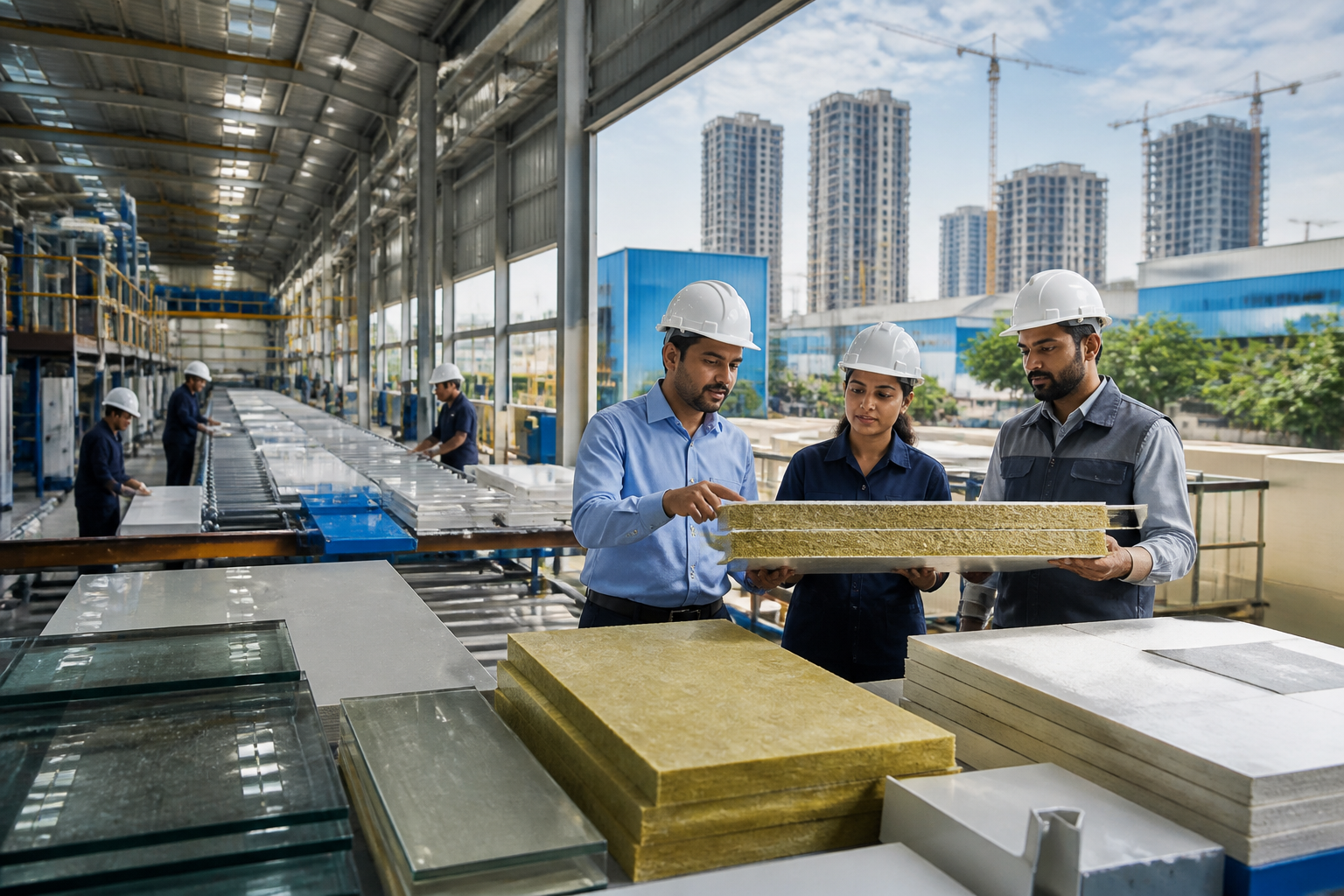
Saint-Gobain’s plan to invest ₹11,000 crore in India over the next five years is more than an expansion of manufacturing capacity. It signals a shift in how one of the world’s largest building-materials companies intends to compete in India: by selling combinations of insulation, construction chemicals, glass, gypsum board and other materials as solutions for lower energy use and improved indoor comfort.
The strategy, outlined by Sreedhar N, Saint-Gobain’s Senior Vice-President and CEO for Asia-Pacific and India, comes as the company seeks to triple the size of its Indian business over the coming decade. India is already among Saint-Gobain’s five most profitable markets and its fastest-growing country, according to Sreedhar. The company’s latest shareholder disclosures put India sales at €1.7 billion in 2025, with an EBITDA margin above 20 per cent.
That combination of growth ambition and profitability explains why India is becoming a larger allocation of the group’s capital. Saint-Gobain invested ₹9,900 crore in the country during the previous decade. The new programme would take average annual investment from approximately ₹990 crore to ₹2,200 crore, an increase of about 122 per cent. The size of the proposed investment is therefore not simply a continuation of the existing programme; it represents a significant acceleration.
The central question is what the company intends to build with that capital. Saint-Gobain entered the Indian market with a strong association with glass, but its Indian portfolio now includes a broader range of construction products. Sreedhar told The Hindu BusinessLine that he was not seeking to sell builders “just another construction product”. Instead, he said the company wanted to offer solutions that could reduce energy bills and noise, arguing that Saint-Gobain now had “the full solution”.
That pitch reflects a structural change in the construction-materials market. Builders and building owners typically procure materials in separate categories, with glass, insulation, boards and chemicals often treated as distinct purchases. Saint-Gobain’s strategy is to connect these categories and sell their combined performance: thermal comfort, acoustic insulation, construction efficiency and reduced energy consumption. The company’s commercial opportunity depends on whether Indian developers and contractors are willing to buy that integrated proposition rather than continue to select materials primarily by upfront cost.
The company’s acquisition strategy is central to this repositioning. Sreedhar said he was willing to acquire businesses that were meaningful for the organisation, while stressing the importance of preparation, speed and certainty that a transaction would close. He also pointed to locally driven integration, saying that local chief executives across Saint-Gobain’s operations had helped the company.
His experience includes the transformation of approximately 40 per cent of Saint-Gobain’s global portfolio during his time as global CFO. The group completed its $1.025-billion acquisition of Fosroc in February 2025. That transaction brought 20 manufacturing plants and a significant Indian construction-chemicals business into the group. Along with Chryso, GCP and OVNIVER, the acquisition helped Saint-Gobain build a global construction-chemicals platform valued at €6.5 billion, according to the report.
For India, the significance of this portfolio is that construction chemicals are becoming a major route into the building process beyond the visible structure. They are used in applications connected with concrete performance, repair, waterproofing and construction quality. The supplied report does not establish how much of Saint-Gobain’s proposed ₹11,000 crore will go into acquisitions or individual product segments. It does, however, identify construction chemicals and insulation as areas that Sreedhar expects to grow particularly quickly.
Insulation is especially important to Saint-Gobain’s stated value proposition because it connects building materials with the operation of completed buildings. The company’s pitch is not limited to putting up walls or installing windows; it is to reduce the amount of energy required to maintain indoor conditions and to improve acoustic performance. The commercial test will be whether these benefits are sufficiently valued during design, procurement and construction to offset any higher initial material cost. The report does not provide a comparative cost analysis, but it makes clear that the company is trying to move the conversation from product price to building performance.
Gypsum board represents another potential area of expansion. Sreedhar said its use could grow from commercial buildings into homes. That would give Saint-Gobain access to a wider residential market, but it would also require a change in construction practice and consumer acceptance. The report does not specify a target for gypsum-board penetration or identify a national adoption rate. Its importance in the company’s strategy lies in the possibility of extending a material more strongly associated with commercial construction into housing.
Saint-Gobain already has 82 plants in India, giving the proposed investment an existing industrial base rather than a standing start. Its Chennai innovation hub has 300 scientists developing products and solutions for the Indian market, and Sreedhar said the team had generated 275 patents. These details show that the company is combining production, research and acquisitions in India. The country is not being treated only as a sales market; it is also being used as a location for product development and regional supply.
The regional role is visible in the company’s export activity. Stone wool manufactured in India has been qualified for Australia, while higher-value glass is supplied to Australia, Southeast Asia and the Middle East. This gives Indian operations a function beyond meeting domestic demand. It also means that investment decisions in India can support Saint-Gobain’s wider Asia-Pacific business, although the report does not quantify the share of Indian production that is exported.
Tamil Nadu is set to receive a substantial part of the company’s announced investment. Saint-Gobain has committed ₹5,400 crore across projects in the state, comprising an initial ₹3,400 crore and a further ₹2,000 crore. The additional commitment is described as a longer-term investment over the coming decade. The distinction between the five-year national programme and the longer-term Tamil Nadu commitment is important: the figures indicate the scale of the company’s presence in the state, but they should not automatically be treated as spending that will occur within the same period.
The institutional and market implications extend beyond one company. Saint-Gobain’s expansion is taking place in a construction sector where material choices influence energy use, building durability, labour requirements and the amount of heavy material transported to sites. Sreedhar said he wanted lighter building materials to displace some of the bricks, cement and other heavy materials that dominate Indian construction. He described completely replacing sand, cement and brick as a dream and acknowledged that India remained a long way from that outcome.
That statement is an ambition, not an established shift in construction practice. The report provides no evidence that lightweight materials are already replacing these conventional materials at scale. It does, however, identify the direction in which Saint-Gobain wants to take its business: from supplying individual inputs to changing the material mix of buildings. The company’s future growth would therefore depend not only on factories and acquisitions, but also on how architects, contractors, developers and households make technical and cost decisions.
The policy landscape is not detailed in the supplied material, and the report does not attribute specific changes in building codes, public procurement rules or energy standards to the company’s expansion. That limitation matters. Lower-energy buildings are influenced by design, construction quality, operating behaviour and regulation, not by materials alone. Saint-Gobain’s stated proposition can affect that system, but the company’s investment announcement does not by itself establish a broader transformation in India’s building performance.
What the evidence does establish is a clear corporate strategy. Saint-Gobain is increasing capital allocation to India, using acquisitions to broaden its portfolio, expanding construction-chemical and insulation capabilities, developing products through a substantial local research operation, and using Indian plants to serve overseas markets. Its leadership is also presenting energy reduction, noise control and lighter construction as part of the value proposition.
The larger urban question is whether India’s building industry can shift from a volume-led model towards one that gives greater weight to operational performance and material efficiency. Saint-Gobain’s plan does not answer that question. It places a large corporate bet on the possibility that the market is moving in that direction. The investment, acquisitions and product expansion will show over time whether that bet changes how buildings are designed and made, or simply creates a larger, more diversified materials business.
For now, the confirmed milestones are the proposed ₹11,000 crore India investment over five years, the company’s ambition to triple its Indian business over the coming decade, continued acquisition scouting, and the longer-term ₹5,400 crore commitment in Tamil Nadu. The next evidence will come from the acquisitions Saint-Gobain completes, the facilities and product lines it funds, and the extent to which insulation, construction chemicals, gypsum board and lighter materials move beyond specialist applications into mainstream Indian construction.
