


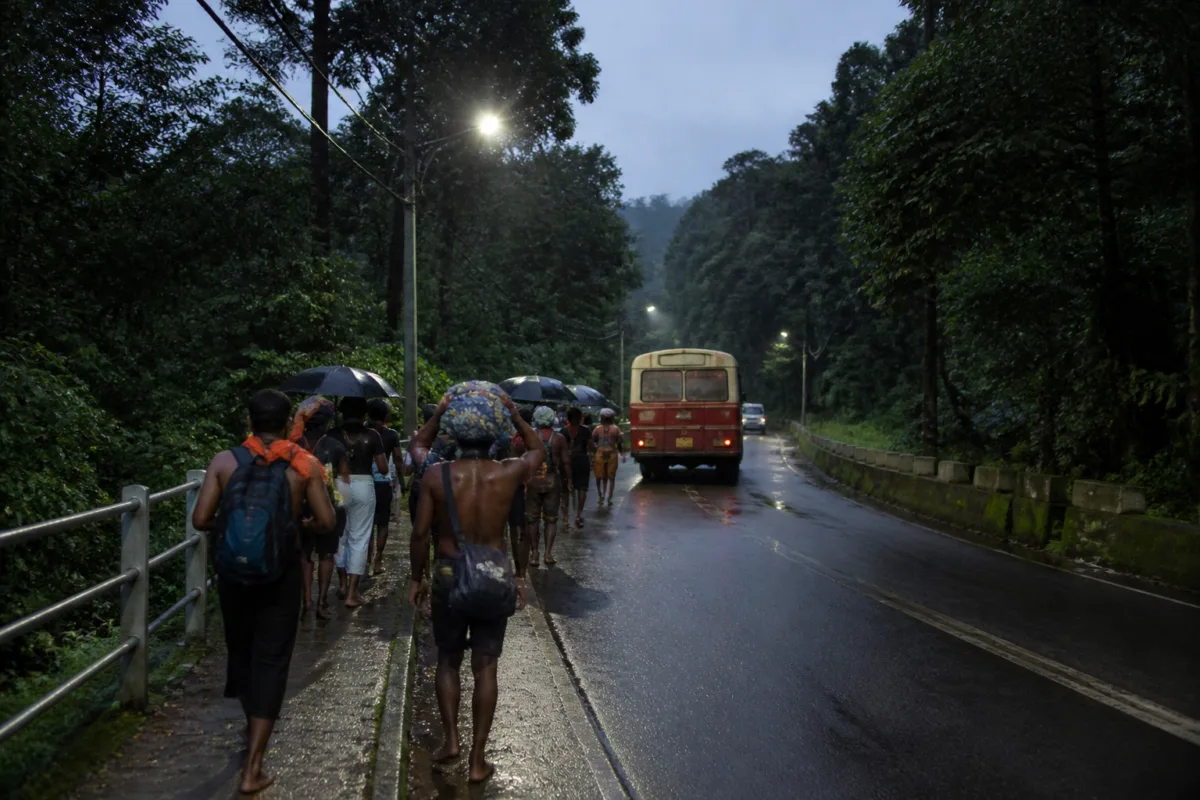
The Sabarimala pilgrimage season is exposing a sharp contrast in public infrastructure: sanitation at the hill shrine has improved, while bus operations and street lighting along key approach roads remain under strain, according to a report published by Malayala Manorama on November 27.
The Kerala State Road Transport Corporation’s (KSRTC) special services recorded a 40% fall in revenue during the first eight days compared with the previous year. The report attributed the decline partly to a shortage of new buses, which meant that revenue-generating services were withdrawn for pilgrimage operations, increasing the corporation’s financial burden. The reported shortfall over the eight-day period was ₹1.80 crore.
KSRTC has planned its Sabarimala operations in two stages. The first stage has 461 buses and the second, for the Makaravilakku pilgrimage, has 561 buses. A total of 1,456 employees have been assigned across the two stages, including drivers, conductors, inspectors, mechanics, office staff and security personnel.
During the first stage, 222 buses were allocated to the Pamba depot. Of these, 191 were assigned to the Pamba–Nilakkal chain service and 31 to long-distance routes. Additional buses were allocated from depots including Chengannur, Kottayam, Ernakulam, Pathanamthitta, Erumeli, Kumily, Kottarakkara, Punalur and Thiruvananthapuram. The report said 325 drivers and 225 conductors had been brought in from depots across Kerala.
However, lower pilgrim numbers have made it difficult to maintain two duties a day on the Pamba–Nilakkal chain service, the report said. Interstate permits have also been obtained for services from Pamba to destinations including Tenkasi, Palani, Chennai, Bengaluru, Kanyakumari, Madurai, Theni and Coimbatore, but these services had not started because of the lack of sufficient passenger demand. A new daily night service from Nedumkandam to Pamba, via Kumily and Erumeli, has also been approved.
The report presents a more positive picture of sanitation at Sannidhanam, Pamba and Nilakkal. A cleaning drive that began a month before the start of the pilgrimage involved 200 workers and removed about 1.25 tonnes of waste, according to the report. Around 150 workers were assigned specifically to toilet cleaning, while 25 sanitation supervisors were appointed under the Devaswom public works wing.
A ride-on floor scrubber buggy was introduced on an experimental basis at the lower courtyard. Toilet cleaning was outsourced to a private agency, and the report said the facilities were being cleaned at regular intervals, reducing visible waste and foul odours. The account also credited the expanded workforce and advance cleaning drive with the improved conditions.
The sanitation measures stand in contrast to persistent lighting deficiencies on pilgrimage routes. The report said several stretches remained unlit even 10 days after the beginning of the pilgrimage, including busy sections of the MC Road and the safety corridor. Street lights installed by the Kerala State Transport Project, municipalities and panchayats were reportedly not functioning at multiple locations.
On the Punalur–Muvattupuzha road, dark stretches were reported at Chethonkara Junction, between Chethonkara and Plachery, and near Chellakkad Junction. The report also identified inadequate lighting at the Champoon curve on the Mannarakulanji–Plappally road, a location described as a recurring accident-prone area. At Banglamkadavu bridge, where pilgrims staying near Vadasserikkara reportedly walk to reach bathing facilities, lighting work was still incomplete.
Other reported gaps included the MC Road near Enathu, where overgrown vegetation, waste and a lack of directional signage were said to affect arriving pilgrims; the Adoor bypass, where darkness and speeding vehicles increased the difficulty of pedestrian movement; and the TK Road between Kumbanad and Maramon bridge. The report said the Thottappuzhassery panchayat area had no functioning street lights along the stretch, while annual maintenance arrangements were yet to be completed.
The lighting problem was also reported at the Periyapalam bridge near the Valiyakoikkal temple in Pandalam. Although lights had been installed on both sides, they had reportedly remained non-functional for months. The bridge is used by pilgrims who park at Kaipuzha and walk to the temple, but it has no dedicated footpath and requires pedestrians to move close to the railings. The report said repeated assurances had been given at review meetings involving Pandalam municipality and Kulanada panchayat, without the problem being resolved before the pilgrimage season.
The account illustrates the operational complexity of a pilgrimage transport network spread across state highways, local roads, bridges, parking areas and foot routes. Bus allocation and sanitation staffing have received advance planning, but lighting maintenance remains divided among multiple agencies, including the KSRTC, local bodies, road authorities and contractors. That fragmentation is most visible at locations where installed infrastructure exists but is not operational.
The report also noted that heavy rain on the previous day temporarily intensified pressure on the pilgrimage system. Rain began at Sannidhanam at about 3.45pm and continued for around three hours, filling the walkway and forcing pilgrims to wait in exposed conditions. By 7pm, 64,355 people had reportedly completed darshan, including 6,676 through spot booking. At 8.45pm, the walkway was described as densely occupied.
For pilgrims, the immediate concern is not only the availability of buses but the continuity of the entire access chain: illuminated roads, visible crossings, safe bridges, usable walking routes, clear signs, functioning parking connections and clean public facilities. The reported improvements in sanitation show the effect of advance preparation, staffing and supervision. The continuing lighting failures suggest that seasonal infrastructure planning also requires clear ownership, pre-season inspections and rapid fault-repair arrangements across jurisdictional boundaries.

