


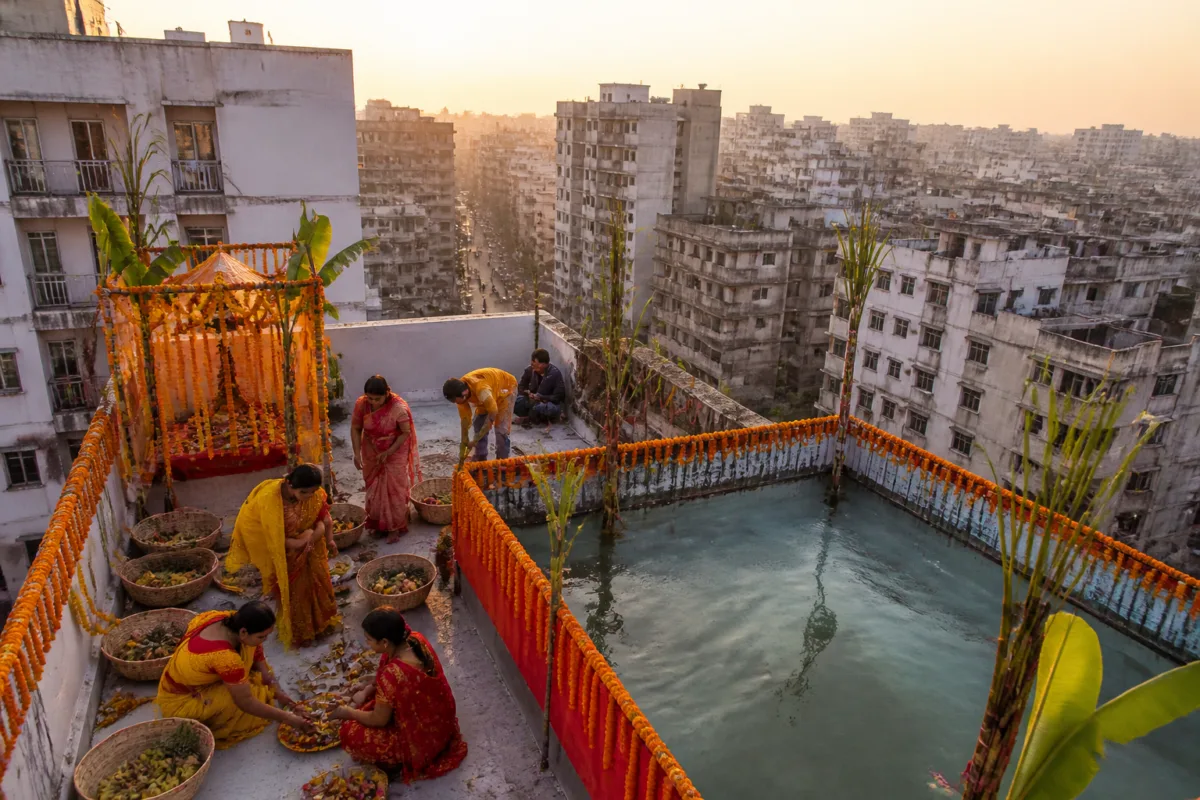
Rooftop Chhath is becoming a practical urban response for families in Patna who want to preserve the festival ritual while avoiding crowded riverbanks, congested roads and difficult journeys with children and elderly relatives. In Danapur, Khagaul and Anisabad, residents are preparing temporary water bodies, puja spaces and other facilities inside apartment buildings and housing complexes ahead of the rituals scheduled for November 15 and 16.
The shift is more than a household convenience. It shows how a traditional public festival is adapting to a city where access to open space, safe movement and manageable crowd conditions can determine how residents participate. When large numbers of people gather at ghats at the same time, the journey to the riverbank becomes part of the difficulty. Families must travel with पूजा materials, negotiate crowded roads and pathways, and manage bathing and prayer arrangements in heavily used public areas. For some households, especially those living in multi-storey buildings, the rooftop is becoming an alternative ceremonial space.
Residents quoted in the report describe safety and accessibility as the main reasons for choosing home-based arrangements. Sudha Devi of Danapur said that performing the rituals at home would help her family avoid overcrowded ghats, traffic congestion and the difficulties of travelling with family members. Archana Ray, also from Danapur, said that rooftop arrangements allowed devotees to observe the rituals without travelling to crowded ghats.
These decisions place the experience of older residents at the centre of the urban question. Pradeep Priyadarshi, a social activist from Khagaul, said many senior citizens find it difficult to walk long distances, navigate crowded roads and carry puja materials to riverbanks. A home-based arrangement reduces those physical demands without requiring elderly family members to give up participation in the festival.
The same arrangement is also being viewed as a way of reducing risks for children. Priyadarshi said parents were concerned about children during the evening and morning arghya, when thousands of devotees gather at the ghats. Crowded pathways and congested bathing areas can make movement difficult for young children. Within a housing complex or on a rooftop, families can keep the ritual closer to their homes and maintain greater control over the immediate surroundings.
The available report does not establish the total number of families choosing rooftops, nor does it compare the scale of home-based observance with attendance at public ghats. It does, however, identify the same pattern across three Patna localities—Danapur, Khagaul and Anisabad—and records similar reasons from residents: convenience, safety, reduced travel and easier access for vulnerable family members. That consistency suggests that the change is connected to the way residents experience the city, rather than being limited to a single household.
Rooftop Chhath also exposes the dependence of festival participation on the design and management of urban housing. Apartment rooftops are ordinarily service or shared spaces, but during the festival they can become temporary public rooms for residents of a building. Families are creating small water bodies and artificial ponds where devotees can stand and offer prayers to the setting and rising Sun. This converts a built surface into a ritual landscape, allowing residents to reproduce some of the essential elements of a ghat within a controlled residential setting.
Preparations reported in several households include whitewashing, painting and cleaning, along with the arrangement of temporary water bodies, puja spaces and other facilities. These activities show that the adaptation is not simply an informal decision to pray indoors. Families are modifying their surroundings to meet the physical requirements of the ritual. In multi-storey housing, that may involve coordinating shared areas, ensuring that the rooftop is accessible and preparing enough space for participating households.
The change also illustrates the difference between a city’s formal public infrastructure and the spaces residents can mobilise themselves. Ghats remain the principal public setting associated with Chhath, but access to them depends on roads, traffic conditions, pedestrian routes, crowd management and the ability of public areas to accommodate large gatherings. The source report does not provide details of the civic arrangements at Patna’s ghats, including crowd capacity, emergency access or traffic plans. It does show that some residents are responding to the pressure on public spaces by relying on private or semi-private residential infrastructure.
That distinction matters for urban administration. A festival such as Chhath is experienced across several systems at once: riverfront access, roads, housing, sanitation, pedestrian movement and public safety. A household that shifts its observance to a rooftop may reduce one journey, but the arrangement still depends on the safety and suitability of the building. The reported preparations focus on cleaning, painting, water bodies and puja areas; the article does not specify whether housing societies or local authorities have issued formal guidance for rooftop use. That remains an important institutional gap in the available evidence.
The timing makes the adaptation particularly visible. The rituals are expected on November 15 and 16, and families were already preparing their homes and apartment spaces before the festival. The short preparation window means that residents are using facilities already available within their buildings rather than waiting for new public infrastructure. This is a familiar feature of urban life: when formal systems are difficult to access at peak demand, households reorganise existing space to meet immediate needs.
Yet the shift should not be read as evidence that public ghats have become unnecessary. The report records a choice made by some families, not a replacement of the city’s traditional festival spaces. Riverbanks remain important sites for collective observance, and the source does not indicate any decline in attendance there. Rooftop arrangements instead appear to provide an additional option for households whose members face mobility, safety or travel constraints.
The urban significance lies in that widening range of participation. A public festival becomes more inclusive when people who cannot comfortably manage long walks, dense crowds or difficult travel still have a way to take part. At the same time, the emergence of rooftop rituals raises practical questions about how apartment buildings are designed and governed. The report identifies the use of shared residential spaces but does not establish how permissions, structural suitability, water use, waste management or emergency access are being handled.
Ashutosh Sinha of Saket Vihar in Anisabad described the growing preference for rooftop and in-house arrangements as an adaptation by urban families to changing residential conditions and increasing crowds at public ghats. That observation links the household decision to a broader change in the built environment. As more families live in multi-storey apartments and as public festival spaces face intense short-duration demand, the boundary between private housing and communal urban life becomes less fixed.
What the evidence confirms is limited but significant: families in three Patna areas are preparing rooftop or in-house Chhath arrangements to avoid crowded ghats and difficult travel, with elderly people and children among the main beneficiaries. What remains unclear is the scale of the trend, the formal role of housing societies and civic agencies, and whether similar arrangements are being supported or regulated elsewhere in the city. Those questions will determine whether rooftop Chhath remains an individual household adaptation or becomes a recurring feature of how Patna manages major public festivals.

