


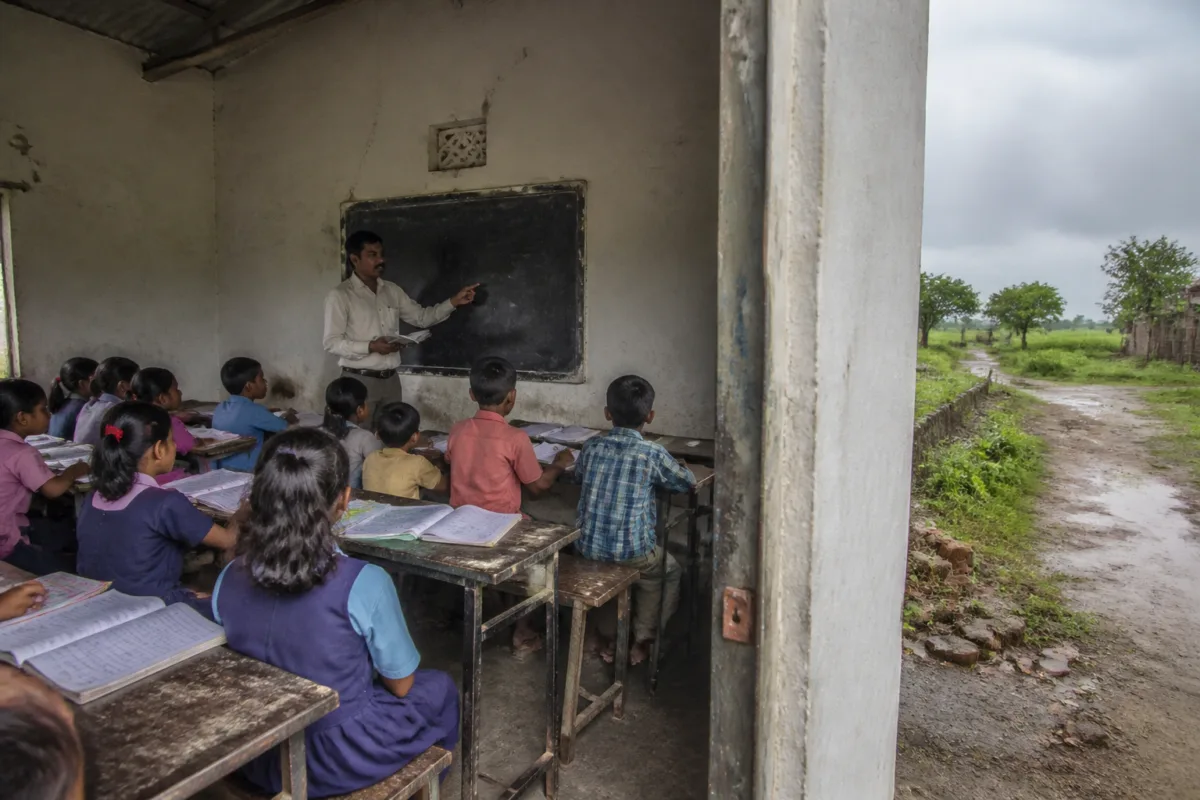
The crisis at Kaupa government primary school in Rohtas is not only a story about one teacher handling 61 children. It is a compact picture of how rural public infrastructure fails when staffing, classrooms, sanitation, drinking water and access roads are treated as separate administrative problems rather than parts of one school system.
The school in Karakat block has one teacher, one classroom and students from Classes I to V. The children study in shifts because there is no room to accommodate all of them together. Teacher Ajay Kumar is responsible for teaching every class while also managing the midday meal programme and administrative work. The result is a school that remains open, but cannot provide the conditions normally associated with functioning primary education.
The report also records the school’s physical isolation. It has no proper approach road, leaving children to use narrow footpaths through agricultural fields. During the rainy season, the route becomes muddy, and students sometimes carry their slippers and walk barefoot through the slush. Inside the premises, there is no proper urinal or washroom, no drinking-water facility and no hand pump.
These details matter because access and basic services determine whether a school is usable in practice. A classroom without adequate teaching capacity limits learning time. A school without toilets or water creates a daily sanitation problem. A school reached through muddy agricultural paths becomes harder to access during the monsoon. The deficiencies reinforce one another, leaving children dependent on a public institution that is physically present but functionally incomplete.
Kaupa’s enrolment is spread across five classes, from six students in Class I to 18 in Class IV. The distribution illustrates the administrative challenge confronting the school: a single teacher must manage children at different levels of learning in the same building and within the same school day. The report does not provide the number of teaching periods conducted for each class, but the teacher’s account makes clear that all five classes cannot be taught simultaneously in the single available room.
The teacher’s workload extends beyond classroom instruction. Alongside teaching, Ajay Kumar handles the midday meal programme and administrative responsibilities. That combination turns a staffing shortage into a capacity shortage. The issue is not simply that one post is vacant; it is that the only teacher is also required to perform non-teaching duties, reducing the time and attention available for instruction across five grades.
The official response points to a deployment problem rather than an absence of personnel across the entire block. Block education officer Arvind Kumar said additional teachers would be deputed to the school soon. He added that surplus staff from other schools would be redeployed to institutions facing shortages in the block.
That statement is significant because the report identifies other schools in the block with surplus teachers. If some institutions have more teachers than required while Kaupa operates with one teacher for 61 students, the central administrative question is how staffing is assessed and monitored across the block. The available information does not establish why the imbalance occurred or how long it has continued. It does, however, show that the problem cannot be understood only as a shortage of teachers in the abstract.
The distinction between total staffing and deployment is important for public administration. A department may have teachers on its rolls, but children experience the distribution of those teachers at the school level. Where staff allocation is not aligned with enrolment and grade requirements, the existence of personnel elsewhere does not solve the shortage faced by a particular school.
Kaupa also raises the question of what counts as school infrastructure. The school’s deficiencies include the classroom itself, but extend to the route leading to the campus, sanitation facilities and drinking water. Each lies within a different operational responsibility or budgetary process, yet children experience them together. The absence of a hand pump is not separate from attendance, hygiene or the usability of the school premises. The lack of an approach road is not separate from access to education when the route becomes difficult during the rainy season.
The report provides no evidence that a new classroom, toilet, water point or road improvement has been sanctioned. Nor does it specify a deadline for the promised teacher deployment. That makes the official assurance an immediate administrative response, not yet a demonstrated correction of the underlying conditions. The next step will depend on whether additional staff are actually posted and whether the school’s physical deficiencies receive a corresponding response.
The protest by CPI(ML) MLA Arun Kumar on October 23 adds a local political and institutional dimension. The legislator staged a dharna on the block premises, described the education department’s approach as apathetic and demanded action on teacher shortages and inadequate infrastructure. The protest indicates that the condition of government schools has become a matter of public contestation at the block level, but the report does not establish the department’s response to the demonstration beyond the education officer’s statement on staff redeployment.
The comparison with another primary school in Kochas broadens the issue beyond Kaupa. At that school, 91 students from Classes I to V reportedly share one blackboard in one room. The second example suggests that the shortage of teachers, classrooms and basic facilities may be recurring across rural schools in the district rather than an isolated failure at a single institution. The supplied report does not provide a district-wide audit, so the scale of the problem cannot be quantified from this evidence alone. It does show, however, that the same combination of overcrowding, inadequate space and limited facilities appears in more than one location.
The numbers in the two cases also reveal different forms of pressure. Kaupa has 61 students and one teacher, while the Kochas school has 91 students sharing one room and one blackboard. The report does not state the teacher count at Kochas, so the two cases cannot be directly compared on staffing. But both demonstrate that enrolment figures alone do not describe whether a school can provide usable education. Classroom capacity, teaching allocation and basic services determine how that enrolment is accommodated.
For rural governance, the key issue is therefore coordination. Teacher deployment must correspond with school-level enrolment and grade structure. Building capacity must match the number of children using the institution. Water and sanitation must be available on the premises. Access routes must remain usable in the conditions residents face. When these functions are monitored separately, a school can appear operational in departmental records while remaining inadequate for children on the ground.
The available evidence does not establish whether Kaupa has previously requested additional staff, whether infrastructure works were sanctioned, or how many schools in Karakat block have surplus teachers. It also does not state how soon the redeployment promised by the BEO will occur. Those details are essential for judging whether the announced intervention addresses a temporary vacancy or a longer-standing planning failure.
What is established is narrower but still consequential: one government primary school in Rohtas is serving 61 children with one teacher and one classroom; the school lacks proper sanitation and drinking water; its approach path becomes difficult during the rainy season; and the block education officer has promised additional teachers through redeployment. A second school in the district reportedly faces severe classroom constraints as well.
The next measure of the system will not be the assurance itself, but its execution. The immediate milestones are the posting of additional teachers and any action on the school’s classroom, water, sanitation and access-road deficiencies. Until those changes are recorded, Kaupa will continue to illustrate the gap between a school being listed as functional and children receiving a fully usable public education facility.

