


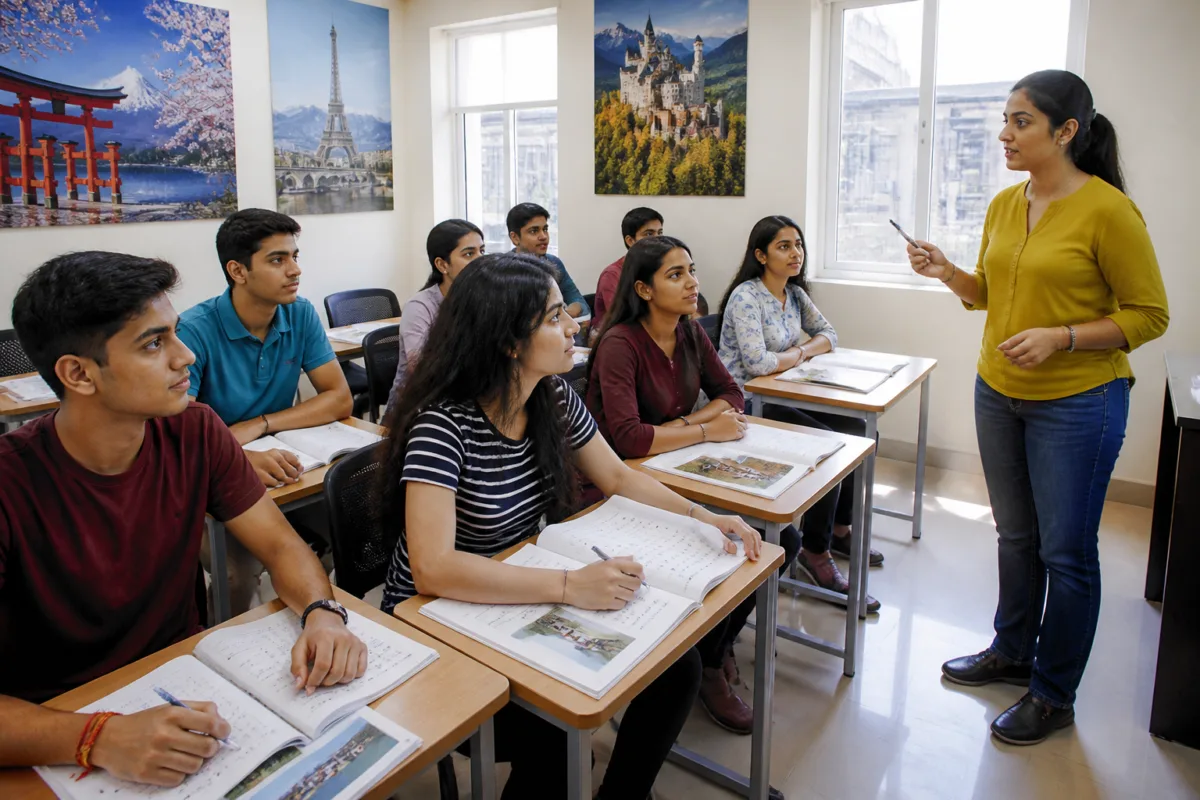
Lucknow study abroad students are increasingly looking beyond the United States and the United Kingdom, with Japanese, French and German language classes recording a marked rise in enrolment as families assess the cost, visa uncertainty and safety concerns associated with traditional destinations. The shift is not only changing where students hope to study; it is also expanding the city’s own ecosystem of language centres, counselling and early-stage preparation.
The trend is visible in the choices being made by students at different stages of school. Class XII student Ashmita Sinha is preparing to pursue automobile engineering in Japan and is learning Japanese alongside her school studies. She said Japan’s automobile industry and technological advancement attracted her, while the weakening rupee and rising costs of studying in the US and UK encouraged her family to examine alternatives that would place less financial pressure on them.
That calculation brings household economics directly into the geography of higher education. The decision to study abroad is no longer being shaped only by the reputation of a university or the popularity of a destination. Students and families are also comparing tuition fees, living expenses, visa conditions, safety and the possibility of finding internships or employment after graduation. In Lucknow, language coaching centres are becoming one of the first visible points where those calculations take institutional form.
Japanese-language coaching centres in Indira Nagar, Vikas Bhawan Road, Chandganj Garden Road and Aliganj recorded 426 registrations during 2025-26, according to Ritika Maheshwari, manager of a Japanese language centre. Enrolment rose from 202 in 2025 to 224 in 2026, an increase of 10.9%. Around 170 of the 224 students enrolled in 2026 were school students. Before 2024, enrolment had not crossed 50.
The figures suggest that the preparation cycle is moving earlier. Japanese is no longer being taken up only by students who have already selected a university or received an offer. School students are beginning language training while they are still evaluating countries, courses and career paths. That gives coaching centres a larger role in the education decision-making process, although the supplied figures do not establish how many enrolled students eventually travel abroad or secure admission.
France has also gained ground in the city’s education choices. Enrolment at Alliance Française de Lucknow stood at 601 in 2025 and increased to 675 in 2026, a rise of 12.3%. Prof Nishi Pandey, president of Alliance Française de Lucknow, described the increase as a positive sign and said students were exploring higher education opportunities in France because of the range of courses, internship possibilities and employment opportunities available there. She also said language learning could help students adapt better and widen their academic and career prospects.
For students, the attraction is tied to specific courses rather than to a general preference for Europe. Class XI student Raghav Mishra is considering France for culinary arts and fashion. He also cited concerns about anti-immigrant protests and the safety of international students in the US and UK as factors in his thinking. His account shows how destination decisions are being shaped by a combination of academic fit, perceived social conditions and future employment prospects.
Germany presents another distinct proposition. German-language coaching centres on IIM Road, near Mithaiwala Chauraha and in Viram Khand recorded around 150 students in 2024, rising to 229 in 2025 and 256 in 2026, according to Atharv Gupta, manager of a German-language coaching centre near Mithaiwala Chauraha. A total of 485 students enrolled during 2025 and 2026, based on the figures provided in the report.
The German-language numbers indicate sustained growth rather than a single-year spike. Class X student Aditi Verma has begun learning German while considering engineering courses in Germany. She is attracted by the country’s engineering and manufacturing programmes and by relatively low tuition fees at many public universities. The report does not provide a complete comparison of tuition or living costs between countries, but the students’ accounts show that affordability is central to the new destination search.
The city-level pattern matters because it reveals how global education trends are translated into local urban activity. International study decisions create demand before a student leaves India. Language institutes, counselling services and preparatory classes become part of the support infrastructure around migration for education. In Lucknow, the reported growth is distributed across neighbourhood-based centres rather than concentrated in a single institutional campus, placing the trend within the ordinary commercial geography of the city.
The locations mentioned in the report—Indira Nagar, Vikas Bhawan Road, Chandganj Garden Road, Aliganj, IIM Road and Viram Khand—also indicate how education-related services are embedded in established urban areas. These are not abstract online preferences; they are reflected in physical classrooms and recurring enrolment at local centres. The available evidence does not quantify employment created by these institutes, their revenues or the number of students they serve across all destinations, but it does establish a visible increase in demand for language preparation.
The institutional structure behind the trend is mixed. Private or independently managed coaching centres are reporting Japanese and German enrolments, while Alliance Française de Lucknow is providing a formal French-language platform. The students’ decisions, meanwhile, remain individual and exploratory. Some are in Class X, XI or XII and have not yet finalised a country or course. This means the enrolment figures measure interest and preparation, not completed international mobility.
That distinction is important for interpreting the data. Japanese registrations increased from 202 to 224 between 2025 and 2026, while French enrolment rose from 601 to 675 over the same period. German-centre enrolment rose from 229 to 256 between 2025 and 2026, after reaching around 150 in 2024. These figures point in the same direction, but they come from different institutions and centre groups. They should therefore be read as indicators of changing interest in Lucknow, not as a city-wide survey of all students or a direct measure of departures for Japan, France or Germany.
The early age of several students is another important feature. Around 170 of the 224 Japanese students enrolled in 2026 were school students. A Class X student has begun German, while Class XI and Class XII students are exploring France and Japan. The preparation horizon is consequently extending well before the formal application stage. Students are using school years to compare destinations, understand language requirements and consider the connection between a course and a future occupation.
This changes the role of language learning in the study-abroad process. It is not simply an additional skill taken after a destination has been chosen. For the students cited, the language is part of the evaluation itself: Japanese is connected to automobile engineering, German to engineering and manufacturing, and French to culinary arts, fashion and broader higher education opportunities. The choice of language reflects the student’s understanding of the economic and academic identity of each destination.
At the same time, the report records concerns that are pushing students away from the US and UK rather than only attractions pulling them towards Japan, France and Germany. Rising education costs, a weakening rupee, visa uncertainty and safety concerns are repeatedly present in the accounts. These factors show that international education decisions are being made within a wider environment of financial and administrative risk. The supplied material does not establish how visa policies or safety conditions have changed, but it does show that students and families perceive them as relevant to destination selection.
For Lucknow, the larger urban question is how the city supports households making increasingly complex mobility decisions. The language centres documented in the report provide one layer of that support. They help students prepare for possible study in countries where language ability may influence adaptation, academic participation and future employment. Whether that support produces better admission outcomes, lower household costs or stronger post-study opportunities is not established by the available evidence.
What the figures confirm is a shift in preparation and interest. Japanese, French and German classes have all reported growth, and school students form a significant share of at least one set of enrolments. What remains uncertain is the conversion of that interest into applications, admissions and migration, as well as the total financial burden faced by families across destinations. Those are the next measures needed to understand whether Lucknow’s language-class boom represents a durable change in international education patterns or an early response to uncertainty around the US and UK.

