


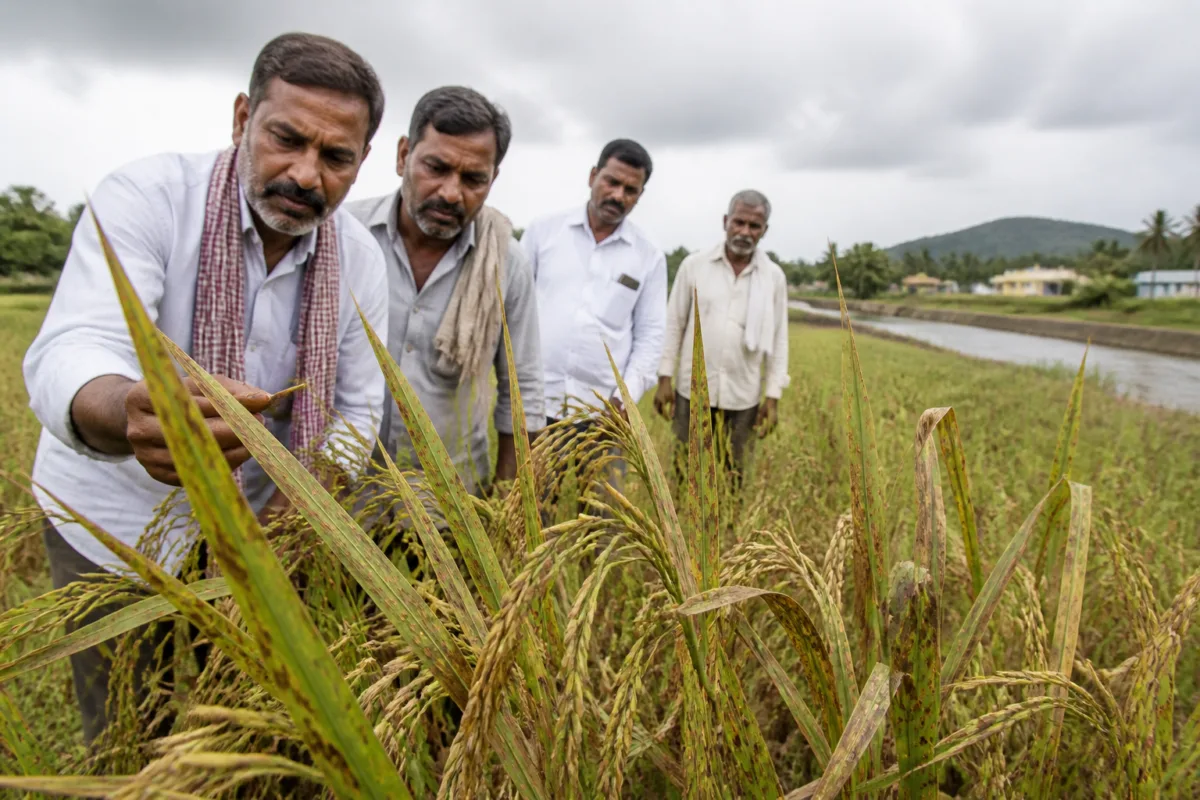
Rice crop disease has affected fields across parts of Hunsur’s Lakshmanatirtha and Harangi canal command areas, leaving farmers worried about losses at the grain-forming stage. The outbreak follows a season in which rainfall was inadequate and the agriculture department had advised farmers not to cultivate rice in the command area.
Rice cultivation was usually carried out across about 7,000 hectares in the Lakshmanatirtha and Harangi command areas. This season, farmers cultivated rice on around 3,900 hectares despite the advisory, according to the report published by Prajavani – Mysuru. The department had also stopped selling rice seeds after rice cultivation was prohibited for the 2026-27 agricultural year.
The disease has been reported in fields in Gavadegere, AsHospital Kaval and Uddur Kaval, which fall within the two command areas. Farmers have grown hybrid varieties, including Sona Masuri, 2233 and Small Madhu, after purchasing seeds from private shops, said agriculture assistant director Anil Kumar. The department had not supplied seeds for the season because of the cultivation restriction.
Agriculture officials said the affected crop is showing symptoms associated with rice blast, described locally in the report as fire disease. Early signs include round or water-soaked green spots on the leaves. These spots can later become larger, with grey centres and dark brown edges, taking a spindle- or eye-shaped form. As the infection intensifies, the leaves may appear scorched and eventually dry out.
A separate neck rot or neck blast infection has also been reported. The disease affects the portion below the rice panicle, which may turn dark brown or black and rot. According to the agriculture department’s explanation, this can interrupt the supply of water and nutrients to the panicle, causing the crop to dry before the grains develop and resulting in losses.
The department has advised farmers to take control measures when symptoms appear. For neck rot, it has recommended spraying carbendazim at two grams per litre of water, or a mixture of hexaconazole and tricyclazole at one gram per litre. For rice blast, propiconazole at one millilitre per litre has been recommended. The report also said that applying 15 kilograms of muriate of potash, or MOP, to the soil could help control the disease.
Officials said farmers should watch for yellow or white, milk-like bacterial fluid droplets on the leaves, which may appear as small yellow beads after drying. Such symptoms should prompt immediate control measures, according to assistant director Anil Kumar.
The agriculture department’s account links the outbreak to weather variation affecting hybrid rice varieties. Farmers had cultivated the crop despite the seasonal restriction, hoping for higher yields. Farmer Papayya said the disease had emerged when the crop was at the grain-milk stage and appealed to the agriculture department to support affected cultivators. The report did not specify any announced compensation or relief package, leaving assistance for the affected farmers to be clarified by the authorities.

