


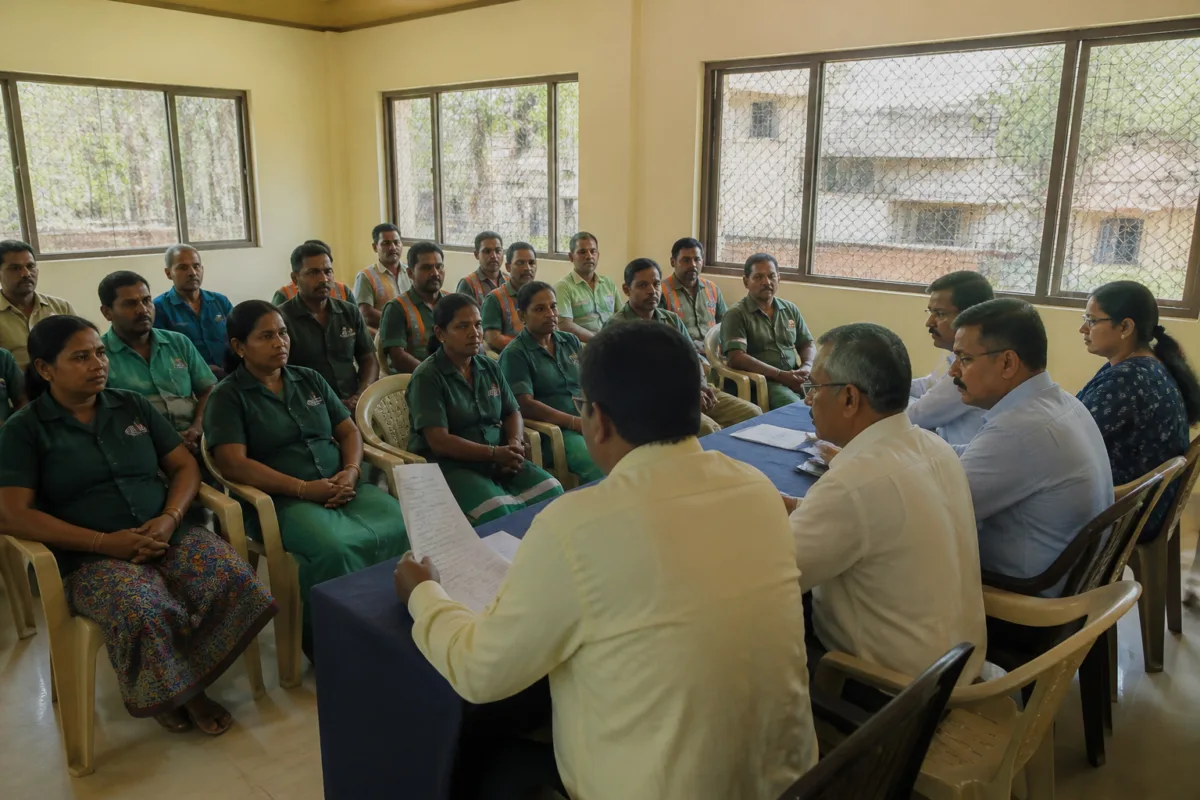
Sanitation workers in Hunsur have sought health protection for their families, saying the health cards issued through the city municipal council currently cover only employees working directly for the urban local body and do not help when their dependants require medical treatment.
The issue was raised by sanitation workers’ leader Perumal during an interaction with sanitation workers conducted by C. Shankar Ankanashettipura, a member of the Safai Karmachari Commission, at Rotary Bhavan in Hunsur. Perumal said sanitation workers’ families were also facing financial hardship and did not have access to Ayushman cards, according to the report.
He urged the commission to take up the matter with the government and secure a health protection mechanism for sanitation workers’ families. Responding to the demand, Shankar said the government had a responsibility to protect the health of safai karmacharis and that a Jyothi Sanjeevini health card had been prepared for this purpose. He said the card would support healthcare access for the families of sanitation workers.
Housing was another issue discussed at the meeting. The commission member questioned Hunsur City Municipal Council officials about the delay in distributing sites that had previously been reserved for sanitation workers. The reported direction requires five acres to be reserved in urban and town areas for housing sanitation workers, while gram panchayat areas are expected to reserve land according to local need.
Municipal council in-charge commissioner Sowmya told the meeting that two acres had been reserved for permanent sanitation workers. She said steps would be taken to distribute the sites by the end of November, based on an assurance given by the local legislator.
Workers also raised concerns over unequal access to municipal benefits. According to the report, some benefits are limited to employees receiving direct payments from the municipal council, while workers in other categories allegedly face difficulty even when applying for facilities. Local officials were said to have rejected applications from some workers.
The meeting also discussed employment for families of manual scavenging workers. Workers said a government order providing employment to members of such families had not been implemented in Hunsur and stated that 63 people had worked in the relevant category. Sowmya said a person working on a contract basis could apply for direct recruitment after completing one year of service, while direct-payment workers needed at least two years of service to apply for permanent posts. Several applications had been received and were under scrutiny, she said.
The condition of the workers’ rest facility was also raised. Taluk Scheduled Caste and Scheduled Tribe Vigilance Committee member Lakshman said a building constructed in 2016-17 had been converted into a warehouse even though a rest house had been provided for sanitation workers. The commission member directed officials to provide a proper toilet at the facility within 15 days.
Lakshman also said the municipal council had failed to recognise children of sanitation workers who had completed degrees and entered professional education. The meeting was attended by Social Welfare Department official Bharat Kumar, municipal revenue officials Siddaraju and Chandru, and other representatives. The next recorded milestones are the provision of toilet facilities within 15 days and proposed site distribution by the end of November.

