


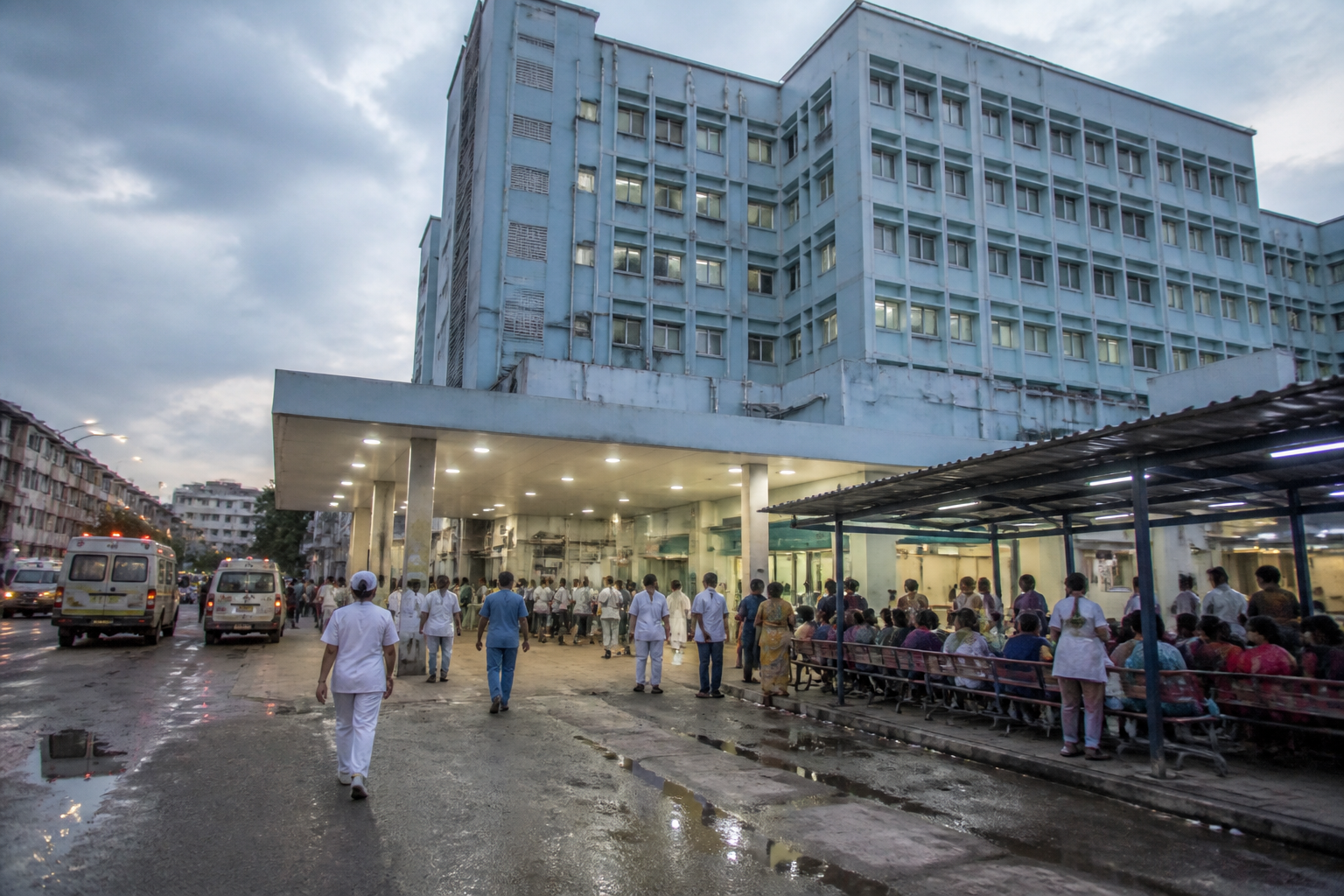
A report on RG Kar Medical College and Hospital has brought attention to a serious administrative gap in public healthcare infrastructure: the hospital’s 217-bed trauma centre reportedly has no financial or administrative approval, while nearly 500 other beds across the institution may also lack formal government sanction. The issue is not simply whether the beds exist physically. It raises a larger question about how public hospitals record, staff, fund and legally recognise capacity that is already being used by patients.
According to a report by Bartaman Patrika, the hospital has 2,003 beds in total, of which 1,500 have government approval. The unapproved capacity reportedly includes the trauma centre’s beds as well as beds in critical and emergency care units such as the neonatal intensive care unit, paediatric intensive care unit and hybrid critical care unit. The report attributes this information to sources in the state health department.
The distinction between a building and its beds is central to the issue. A former health department official, who held an important position during the Trinamool Congress government, was quoted as saying that the building may have approval, but that it would still be necessary to determine whether the beds themselves had been sanctioned. That distinction points to two separate layers of public infrastructure administration: the creation or occupation of a physical facility, and the formal approval of the services and capacity operating within it.
RG Kar’s superintendent and vice-principal, Dr Saptarshi Chattopadhyay, told the publication that the trauma centre did not have financial or administrative approval. He said the hospital had repeatedly requested the health department to provide legal recognition to the beds, but that no action had followed. The report also said that the hospital had raised the issue through electronic files on several occasions.
The account indicates that the problem has persisted even as the facility has continued to function. The trauma centre’s ground floor currently houses trauma and general emergency services. Other parts of the building accommodate neurology, neurosurgery, orthopaedics, surgery and anaesthesiology. Wards are located on the fifth, seventh and eighth floors, while the sixth floor houses a high-dependency unit, according to the report.
This arrangement creates an institutional mismatch. A hospital may have the rooms, equipment and clinical departments needed to treat patients, but without sanctioned beds it may not have an officially recognised establishment against which permanent doctors, nurses and support personnel can be appointed. The result, as described in the report, is that staff working in the trauma centre are being brought in from other departments because no doctors or employees can be recruited specifically for the building’s beds.
That staffing arrangement is important because sanctioned bed capacity is not merely a paperwork category. It normally forms part of the administrative basis for allocating personnel, budgets and operational responsibility. In the case described by the report, the absence of financial approval for even one trauma-centre bed means the hospital cannot make appointments specifically for the facility. The infrastructure is therefore functioning, but the institutional system around it remains incomplete.
The report does not establish when the trauma centre began operating or provide the full administrative history of its construction. It says the foundation stone was laid during the Left Front period and suggests that the facility has continued through successive political administrations. The available account therefore presents the issue as a long-running administrative carryover rather than a problem attributable to a single recent decision.
The health department’s own response, as reported, reflects that uncertainty. Principal Secretary Narayan Swarup Nigam said he would examine the matter and questioned how the building could have been constructed if administrative and financial approval did not exist. His response identifies the central institutional puzzle: whether the building, the services inside it and the beds being used were processed through separate approval channels, or whether one stage was completed without the others being regularised.
The report also says that former Minister of State for Health Chandrima Bhattacharya declined to comment. No final decision, order or timetable for regularising the beds is identified in the supplied material. The issue therefore remains at the stage of official examination rather than resolution.
The numbers make the gap more consequential. Of 2,003 beds at the hospital, 1,500 are reportedly approved, leaving approximately 503 without approval if the figures are read arithmetically. The 217 trauma beds form the clearest identified component of that unapproved capacity. The remaining beds reportedly include facilities such as neonatal, paediatric and hybrid critical care units, although the report does not provide a department-wise breakdown.
This is also why the matter extends beyond the trauma centre’s building. Emergency and critical-care capacity is closely tied to how a public hospital responds to demand. Yet the supplied report does not provide patient-load figures, occupancy rates, staffing numbers, budget allocations or outcome data for the affected units. What it does establish is that the hospital has been treating patients in beds whose formal administrative and financial status is being questioned.
The report raises a further record-keeping concern. It asks how patients treated over the years can be considered part of an apparently unrecognised capacity when their names and medical details are recorded in government systems. That question should not be read as suggesting that patients themselves lack legal existence or entitlement to treatment. Rather, it exposes the difference between the recognition of a patient in a clinical record and the recognition of the bed, department or facility within the government’s administrative structure.
That difference matters for accountability. Clinical records show that treatment occurred. Administrative approval determines which institution, budget head, staffing structure and sanctioned capacity are responsible for providing it. When those systems do not match, it becomes harder to determine how resources are allocated and who is answerable for shortages or service failures. The report does not allege that treatment records are invalid; it highlights the unusual position of services being delivered through infrastructure whose formal status remains unresolved.
The staffing issue provides the most direct citizen-facing consequence identified in the report. Doctors and other employees are reportedly being shifted from existing departments to work in the trauma centre. The material supplied does not establish whether this has reduced staffing elsewhere, nor does it quantify the number of personnel involved. It does, however, show that the absence of sanctioned posts has not prevented the centre from operating; instead, the hospital has relied on internal redeployment.
This creates a form of hidden capacity. From the patient’s perspective, a bed in an emergency or trauma facility may appear to be part of the hospital’s available service. From the government’s administrative perspective, that same bed may not yet exist as an approved unit. The city can therefore have infrastructure that is visible and operational but not fully represented in its official capacity calculations.
The case also illustrates why construction approval alone cannot be treated as equivalent to service readiness. The health department official quoted in the report distinguished between approval for the building and approval for the beds. That distinction brings together construction, public finance and healthcare administration. A completed structure may still require separate decisions on staffing, recurring expenditure, departmental control and sanctioned capacity before it becomes a fully recognised public facility.
At present, the evidence supports three conclusions. First, RG Kar’s trauma centre is operating with 217 beds that the hospital superintendent says lack financial and administrative approval. Second, the reported gap may extend to nearly 500 beds across the hospital, including critical and emergency care units. Third, the health department has acknowledged that the matter requires examination but has not, according to the supplied report, announced a resolution.
What remains unclear is the precise approval history of the building and its services, the number of posts and budget allocations required for regularisation, and whether any formal order has since been issued. Those questions will determine whether the problem is resolved through retrospective approval, administrative restructuring or another process. Until the health department completes its review, RG Kar’s trauma centre remains an example of how physical public infrastructure can outpace the administrative systems meant to legitimise, fund and staff it.
