


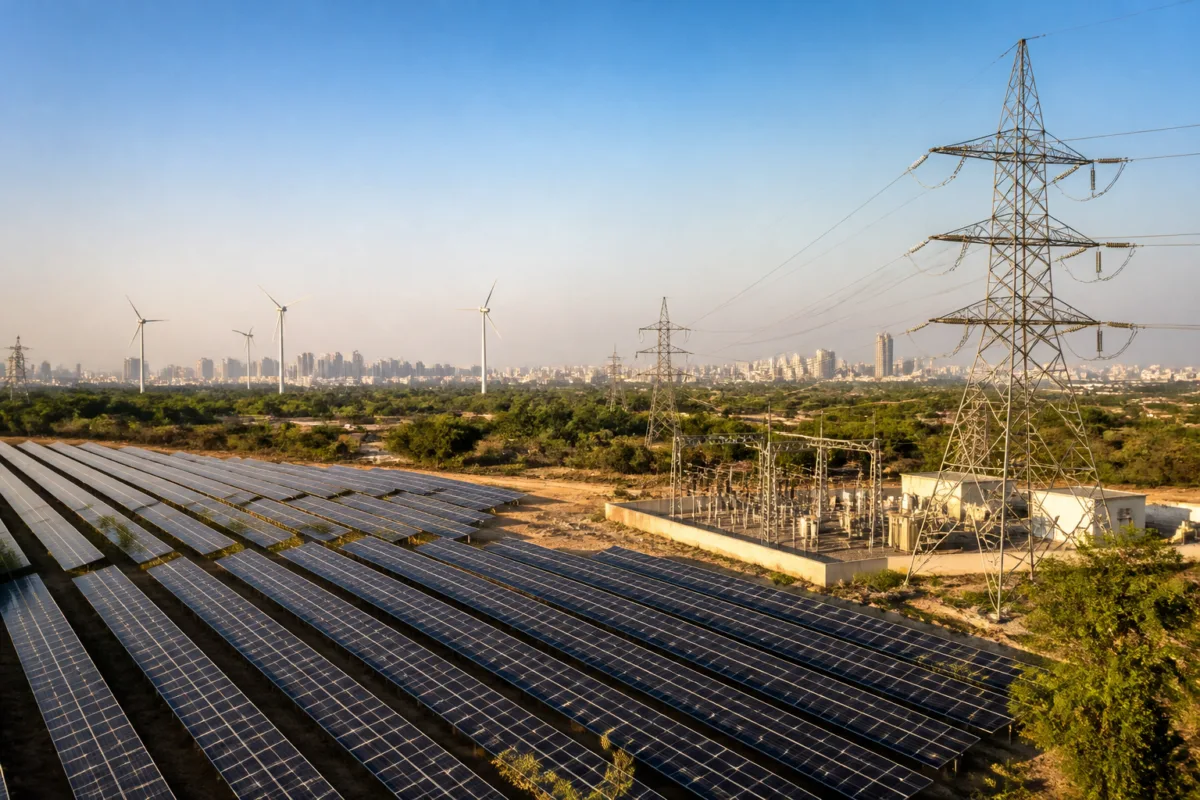
India’s renewable energy expansion is becoming more than a climate or power-generation story. According to the International Energy Agency, it could help the country avoid nearly USD 240 billion in cumulative coal and natural gas import expenditure by 2030, while reducing exposure to international fuel-price volatility. The projection places renewable energy at the centre of a larger urban and national infrastructure question: whether India can build the transmission, storage and operational systems needed to convert generation capacity into dependable electricity.
The IEA’s India Renewable Energy Market Report 2026 estimates that renewable electricity has already reduced India’s cumulative spending on coal and natural gas imports by more than USD 100 billion between 2011 and 2025. If fuel prices remain broadly consistent with average levels observed during 2024 and 2025, cumulative savings could approach USD 240 billion by 2030.
The projected annual benefit is also significant. Fossil-fuel import savings could reach approximately USD 35 billion a year by 2030, exceeding India’s actual non-coking coal and natural gas import bill in financial year 2024-25, the report said. The comparison shows how the value of renewable capacity is being measured not only through electricity produced, but also through imports avoided and exposure to external price shocks reduced.
Solar photovoltaic power is expected to contribute the largest share of the savings, accounting for approximately 60 per cent of the projected total. Wind power is expected to contribute almost 30 per cent. This distribution reflects the central role of solar and wind in India’s planned renewable capacity growth, while also highlighting the operational challenge created by sources whose output varies with sunlight and wind conditions.
The IEA said renewable expansion has already affected India’s coal-import requirement. Without the solar photovoltaic, wind and bioenergy capacity added since 2010, coal imports in 2025 would have been around 110 million tonnes higher. Electricity-generation import dependence would have exceeded 30 per cent, approximately twice the actual level, the agency said.
That estimate gives the renewable-energy transition a direct infrastructure dimension. It indicates that capacity added over the past 15 years has not simply increased the supply of lower-carbon electricity. It has also reduced the amount of imported fuel required to operate the power system. For a country exposed to changes in global commodity prices, that substitution creates a form of energy security, although the scale of the benefit remains linked to future fuel prices and the ability of the grid to absorb renewable output.
The IEA expects India’s renewable power capacity to reach around 530 gigawatts by 2030. Solar photovoltaic capacity is projected to account for more than 350 GW, while wind capacity could approach 90 GW and hydropower capacity could reach 75 GW. Renewable energy is expected to account for 35 per cent of India’s electricity generation by 2030, with output approaching 950 terawatt-hours, nearly double current levels.
These figures describe a substantial change in the physical scale of India’s power system. They also show why generation capacity alone cannot determine whether the projected import savings will be realised. Solar and wind installations must be connected to demand centres, their output must be managed across different times of day and weather conditions, and electricity must remain available when renewable generation falls.
The IEA specifically identified continued investment in transmission infrastructure, energy storage and power-system flexibility as important for accommodating the growing share of variable renewable energy. In practical terms, the transition therefore involves more than adding solar parks or wind farms. It requires grid infrastructure capable of moving electricity across regions, storage systems that can shift supply over time and operating arrangements that can balance changing output.
This requirement is particularly relevant to India’s cities and industrial corridors, where electricity demand is concentrated and increasingly dependent on reliable supply. The source material does not provide a city-by-city assessment of transmission congestion, storage deployment or distribution-company performance. It does, however, establish that the national renewable target will require supporting infrastructure beyond generation assets.
The report’s projections also reveal a distinction between energy independence and energy-system resilience. Avoiding coal and gas imports can reduce exposure to international fuel prices, but renewable generation remains dependent on the availability of transmission and balancing capacity. The IEA said storage and flexibility become especially valuable when supply disruptions and price spikes put fossil-fuel markets under strain. This means the economic benefit of renewables depends partly on whether the power system can use them when they are available and manage their variability when they are not.
The expected capacity mix reinforces that point. Solar is projected to provide the largest contribution to both capacity and import savings, but solar generation is concentrated in daylight hours. Wind output follows different patterns, while hydropower can provide another form of system support. The supplied report does not quantify the amount of storage required or specify the transmission projects needed by 2030. It does show that the supporting network will be a decisive part of implementation.
There is also an institutional issue behind the headline savings. Import expenditure is influenced by fuel prices, generation demand, domestic production, power-sector operations and the timing of capacity additions. The IEA’s USD 240 billion estimate is based on fuel prices remaining broadly consistent with average 2024-25 levels. It is therefore a projection under a stated price assumption, not a guaranteed fiscal saving. The underlying direction is clear, but the final value will depend on how the market and infrastructure develop.
For policymakers, the report shifts attention from renewable-energy targets to delivery capacity. A target of around 530 GW of renewable power capacity by 2030 implies that approvals, construction, grid connection, transmission investment and system operation must progress together. Delays in any one of these areas could limit the amount of renewable electricity that can be integrated effectively, even if installed capacity continues to rise.
For cities, the issue is closely connected to the reliability and cost of essential services. Water pumping, public transport, hospitals, housing, commercial buildings and digital infrastructure all depend on electricity systems that can respond to demand. The supplied evidence does not establish how the projected savings would be distributed across consumers or sectors. It does establish that the energy transition has consequences for the infrastructure supporting urban economies.
The larger significance of the IEA projection is that renewable energy is increasingly being evaluated through several linked measures: generation capacity, electricity output, fuel imports avoided and resilience to international price shocks. India’s renewable power capacity is expected to expand sharply, with solar providing the largest share and renewables accounting for 35 per cent of electricity generation by 2030. But the same projection makes transmission, storage and flexibility central to the outcome.
The evidence confirms that renewable energy has already reduced India’s coal and gas import exposure and could deliver much larger savings by 2030. What remains less clear from the supplied report is how quickly the required grid and storage infrastructure will be built, and how the benefits will be passed through the power system. Those implementation questions will determine whether the projected import savings become a durable feature of India’s energy and urban infrastructure landscape.

