


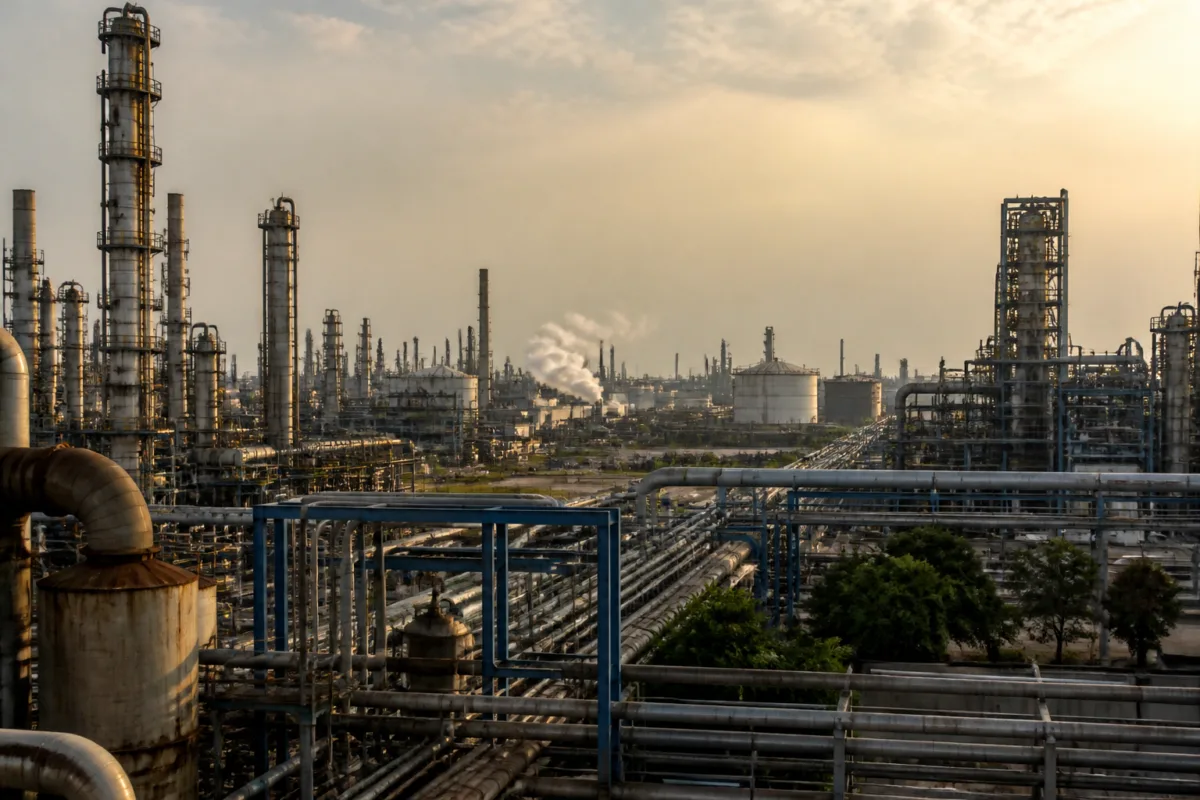
US Secretary of State Marco Rubio’s planned visit to Reliance Industries’ Jamnagar refinery places India’s largest private refining complex at the centre of a broader American effort to reshape oil flows, deepen energy ties with India and expand Venezuela’s petroleum market. The immediate discussion concerns whether Reliance will process more Venezuelan crude in India and possibly return to oil production in Venezuela. The larger question is how far a private Indian refiner can become an instrument of Washington’s geopolitical and commercial energy priorities.
Rubio met External Affairs Minister S. Jaishankar in Mumbai before travelling to Jamnagar, where he is expected to meet Reliance chairman Mukesh Ambani. The visit is significant because it moves the conversation beyond government-to-government diplomacy. Reliance is not only a major buyer of crude; its refining system gives it the technical capacity to process feedstocks that many refineries cannot handle economically.
That capacity explains why Jamnagar matters to the Venezuelan proposal. The complex has combined capacity of around 1.4 million barrels per day and is configured to process a wide range of crude grades, including heavy, high-sulphur oil. Venezuelan crude is particularly difficult to handle because of its density and sulphur content. Jamnagar’s scale and flexibility allow Reliance to convert such crude into fuels that can be sold into international markets.
Rubio has described India as a “refining superpower” and said the United States would encourage Reliance to refine more Venezuelan crude at its Indian facilities. He also raised the possibility of Reliance participating in Venezuelan oil production. These are two distinct propositions. The first involves expanding a refining and trading channel that has already resumed under US-approved arrangements. The second would require an upstream investment decision involving production assets, capital, legal protections and the sanctions framework governing Venezuelan oil.
No new production agreement has been confirmed. Nor is there public evidence that Reliance’s possible involvement in Venezuela is part of a formal package linking crude purchases, upstream investment, the proposed Texas refinery and a US-India trade agreement. That distinction is important because diplomatic signalling can move faster than commercial commitments. The Jamnagar visit may indicate that Washington wants a deeper relationship with Reliance, but it does not by itself establish a settled energy bargain.
### Why Jamnagar gives India negotiating leverage
India’s refining advantage comes from the ability to buy different grades of crude and process them into products for domestic and export markets. The commercial value of this flexibility is especially visible when geopolitical changes disrupt traditional supply chains. A refinery that can process heavy, high-sulphur crude has more options than a facility designed around a narrower feedstock range, although the final decision still depends on price, freight and refining margins.
Reliance has been a significant buyer of discounted Russian oil since Western sanctions disrupted established trading patterns after Russia’s invasion of Ukraine. Washington has sought to reduce those purchases through tariff threats and sanctions pressure. At the same time, the Trump administration recently waived potential additional tariffs on major buyers of Russian oil, including India. The concession was criticised by some American lawmakers but may have removed an obstacle in the wider trade discussions between the two countries.
More Venezuelan oil could give Reliance another source of heavy crude and reduce its dependence on Russian supplies at the margin. But diversification is not the same as a political replacement of one supplier with another. Venezuelan barrels would have to compete with Russian grades on delivered cost, shipping expenses, sanctions exposure and the value of the refined products produced from them.
This is where the commercial and geopolitical objectives may diverge. Washington wants to expand Venezuela’s oil production and create additional demand for its crude. India has an interest in preserving the widest possible range of supply options. Reliance’s decision will therefore be shaped less by diplomatic language than by whether Venezuelan oil can be delivered and processed competitively under an acceptable legal and sanctions regime.
### The Texas refinery has a different logic
The proposed Texas refinery represents another part of the relationship but has a different technical rationale. Announced by Donald Trump in March, the planned facility near Brownsville is intended to process American shale oil and supply petroleum products to the market. Its proposed location and feedstock orientation link it to US domestic energy and investment priorities rather than to the heavy crude processing role of Jamnagar.
The $300 billion figure associated with the project also requires careful interpretation. The available report indicates that the number appears to include projected commercial activity and oil purchases rather than capital that Reliance itself would commit to constructing a refinery. Reliance’s role is therefore better understood as a potential commercial foothold in an American energy project, with the prospect of buying output under a long-term arrangement, rather than as a confirmed commitment to invest $300 billion in a new facility.
The two refineries would expose Reliance to different parts of the oil value chain. Jamnagar can process a broad range of crude grades in India, while the Texas project is intended to process lighter American shale oil. For the United States, Reliance’s participation could support a domestic investment narrative and expand the market for American production. For Reliance, the project could deepen its presence in the US market while complementing, rather than duplicating, its Indian refining operations.
That difference also means the projects should not automatically be treated as one integrated arrangement. There is no public evidence in the supplied report that Reliance’s Texas participation is conditional on buying Venezuelan crude, or that either arrangement is a formal requirement of a trade agreement. The commercial connections may become stronger, but they remain unconfirmed.
### The institutional mechanics behind the proposal
The proposed arrangement involves at least three layers of decision-making. The first is diplomatic: the US administration must determine how Venezuelan oil fits within its sanctions policy and broader relationship with India. The second is corporate: Reliance must assess crude economics, refinery utilisation, compliance risks and the terms of any possible upstream investment. The third is operational: Venezuelan production must be available in sufficient volumes, transported reliably and sold under rules that give buyers confidence.
These layers explain why a refinery visit can be politically important without producing an immediate contract. A senior US official visiting Jamnagar signals that Washington sees Reliance as a potential partner in implementing its energy strategy. It also gives the company direct visibility in a negotiation that includes oil supply, investment, trade and sanctions. But a signal is not the same as a procurement commitment or a production agreement.
For India, the episode illustrates how refining capacity can create strategic importance even when the country remains dependent on imported crude. The value of a refinery is not limited to the volume it processes. Configuration, feedstock flexibility and access to export markets can influence how much room the country has to manage supply disruptions and changing diplomatic relationships.
For the United States, Reliance offers a way to connect several objectives: increasing demand for Western Hemisphere crude, encouraging Indian capital into American energy infrastructure and reducing the pressure created by India’s purchases of Russian oil. Whether these objectives can be aligned depends on the economics of each transaction. Political preference alone cannot guarantee that Venezuelan crude will displace Russian barrels or that a Texas project will proceed at the scale announced.
The immediate evidence confirms a significant diplomatic and commercial signal, not a completed energy deal. The developments to monitor are concrete: whether Reliance announces larger Venezuelan crude purchases, whether a new Venezuelan production agreement is signed, and whether the Texas refinery receives a clearer financing, ownership or operating structure. Those milestones will determine whether Rubio’s Jamnagar visit becomes the beginning of a durable energy partnership or remains an important statement of intent.

