


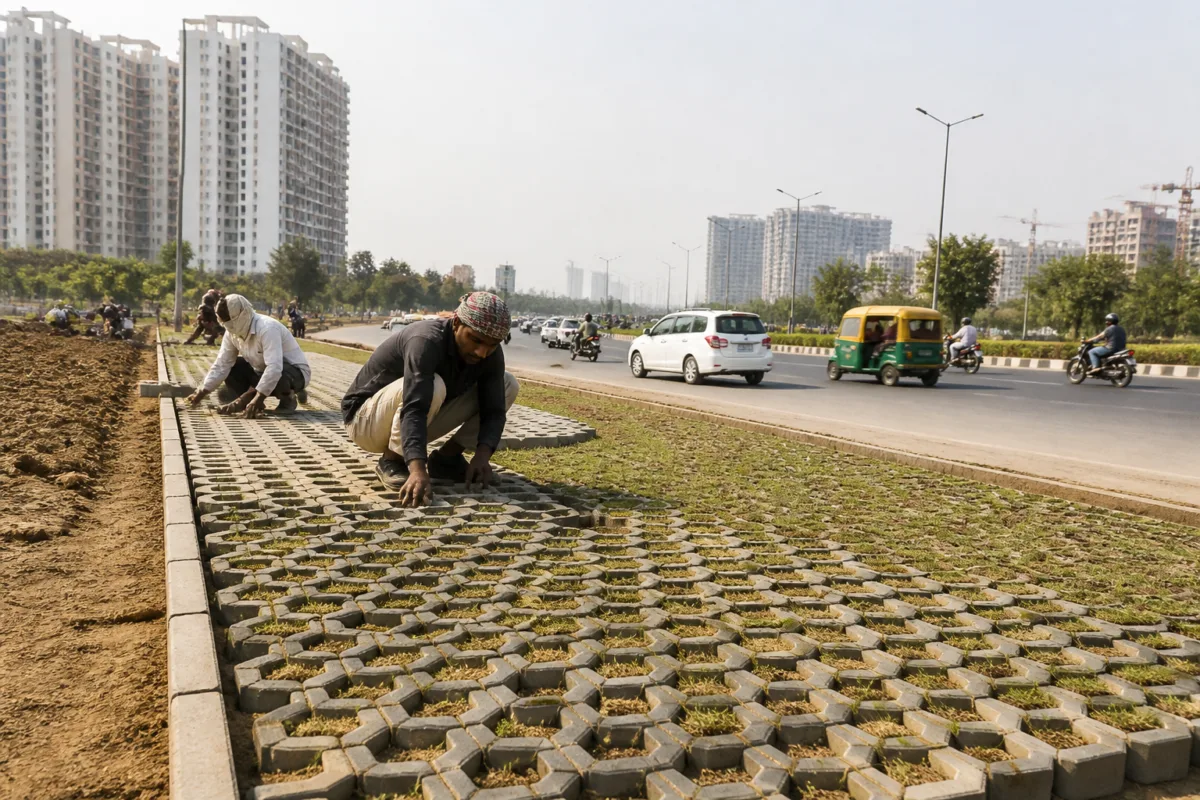
The Greater Noida Authority has begun installing grass grids along the 130-metre road to reduce dust from exposed roadside areas and increase greenery, starting with the stretch between Gaur Chowk in Greater Noida West and Sirsa.
The initiative involves laying interlocking blocks on footpaths and vacant spaces beside the road. The blocks have openings that can support grass growth while allowing rainwater to pass through the surface and enter the ground, according to a report by Navbharat Times – Noida.
The Authority said the work is intended to address dust generated from open soil along roadsides. Vehicles moving nearby and strong winds can disturb exposed soil, allowing dust to spread into surrounding areas. By covering and organising these spaces with grass grids, the project aims to limit the amount of loose soil available to become airborne.
The interlocking blocks are designed with gaps between them. These spaces can be used to grow grass, creating a partially green surface instead of a fully paved or bare-soil edge. The design also allows rainwater to move below the surface rather than remain entirely on top of the pavement.
The arrangement may support local drainage and groundwater recharge, although the supplied report does not provide figures on the area covered, the project cost, the number of grass grids planned or the expected reduction in airborne dust. Details of the grass species and the maintenance system have also not been disclosed in the report.
The 130-metre road is being considered for development as a model road, and the grass-grid work forms part of that planning. The route begins at Gaur Chowk in Greater Noida West and extends to Sirsa, making its roadside treatment relevant to areas experiencing traffic movement, construction activity and undeveloped plots along the corridor.
Greater Noida Authority CEO N. G. Ravi Kumar said development works would also give special attention to the environment. He said grass grids were being used for this reason, linking the roadside intervention to both environmental protection and the improvement of the road’s appearance.
The project reflects a common urban challenge: roadside spaces that are neither fully landscaped nor formally paved can become recurring sources of dust. Their treatment also affects how quickly rainwater leaves the road surface and whether hard urban edges prevent water from entering the ground. The Authority has begun the work on the 130-metre road, with further implementation details yet to be specified.

