


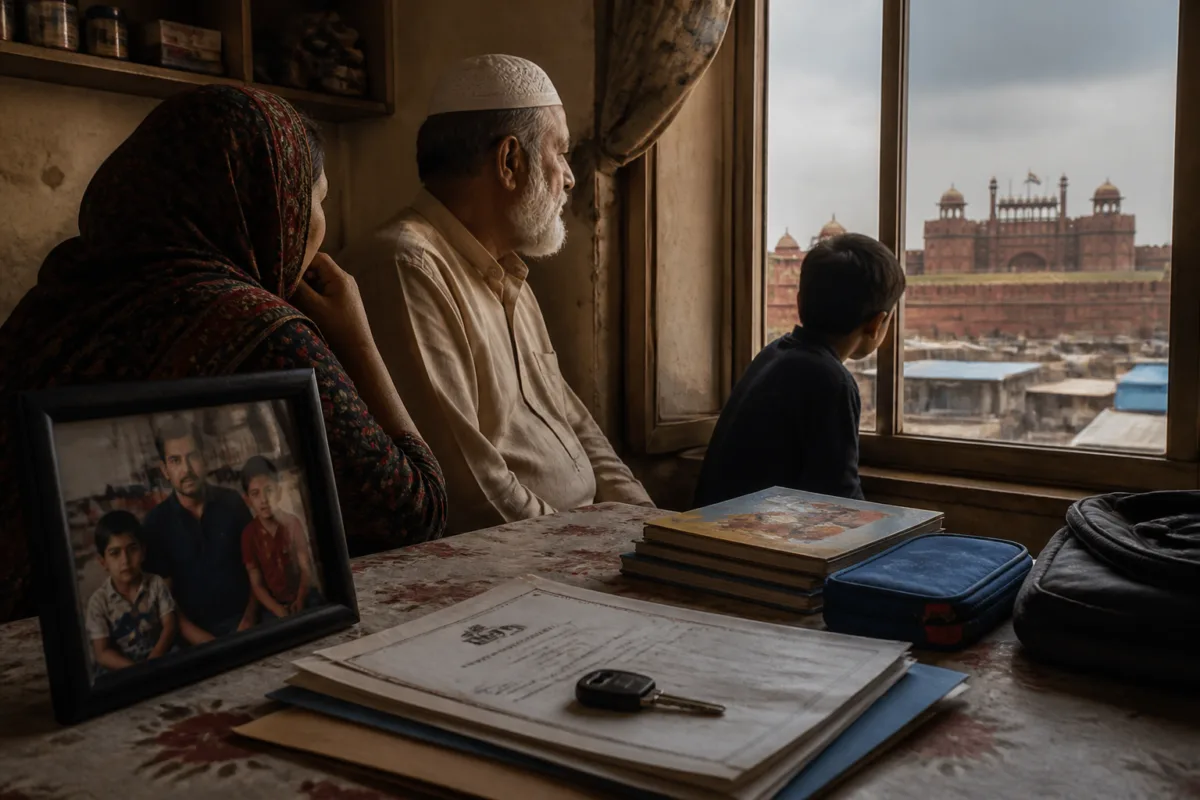
A year after the Red Fort blast, the families of those killed in Delhi are still dealing with two losses at once: the personal absence of a husband, brother or son, and the collapse of the household economy that person supported. Their accounts, reported by The Times of India, show how a one-time compensation payment can acknowledge a death without restoring the livelihood, care and stability that disappeared with it.
The blast occurred near the Red Fort on November 10, 2025. The people described in the report were not only victims at the site; they were workers, drivers, shopkeepers and family providers whose incomes connected several other lives to the city’s economy. Their deaths therefore created consequences that extended beyond the immediate incident and into rent, food, healthcare, education, debt repayment and childcare.
The Delhi government announced compensation of Rs 10 lakh for the kin of each deceased person on November 11, 2025, according to the report. Families said the amount was inadequate and alleged that requests for a government job for the next of kin had not been addressed. The distinction is important. Compensation is a one-time transfer, while the loss described by the families is an enduring reduction in household income and support.
For Kriti Kataria, whose husband Amar was killed, the financial pressure has become part of daily life alongside grief. Amar, 34, was described as the father of their three-year-old son, Viaan. Kriti said she now has to raise the family alone. The child has understood that his father will not return, and sometimes asks to hug him when he sees classmates playing with their fathers.
That account makes the economic dimension concrete. The loss is not represented only by the value of a life or the cost of a funeral. It also involves years of care that would have been provided by the deceased, the income that would have supported the household and the practical responsibilities that must now be absorbed by another family member. In Kriti’s case, that adjustment includes raising a young child without his father while managing the household’s financial strain.
The families profiled in the report also reveal how varied the consequences can be. Numan Ansari, 22, had opened a cosmetics shop to support his father, pay for his brother’s kidney treatment and save for the weddings of two sisters. Dinesh Mishra, 32, worked at a printing press and sent money home for his three children. Md Luqman, 73, continued working to sustain himself despite his age. Pankaj Sahni, 21, had taken up his asthmatic father’s work as a cab driver.
These cases show why a standard compensation amount may not correspond to a standard loss. A young worker supporting medical treatment has a different set of obligations from an older person working for his own subsistence. A driver’s death can also leave behind an unusable vehicle, outstanding loans and a family without an income source. The payment may be the same, but the liabilities and dependants are not.
Pankaj’s family told the newspaper that the compensation was spent on funeral expenses and repayment of the loan for the car, which had become unusable after the blast. This account shows how quickly a seemingly substantial payment can be absorbed by immediate costs. Funeral expenditure and debt repayment do not create a continuing income stream, nor do they replace the work that the deceased was doing.
The case also illustrates the fragile nature of many urban livelihoods. Pankaj had driven from Ghevra in northwest Delhi to Old Delhi station to drop off a neighbour. Numan was building a small business. Dinesh worked long hours at a printing press. Mohsin, whose wife Sultana was later left to care for their two children, worked as an e-rickshaw driver. These were forms of employment that supported families but appear, from the accounts published, to have had little financial cushion when the workers died.
Delhi’s urban economy depends heavily on such everyday mobility and labour. People travel across the city to drive, print, sell, tailor and provide services. The blast’s victims were using or contributing to this network when their lives were cut short. The aftermath therefore raises a governance question beyond the immediate security incident: how does the city support households when an urban disaster removes the person on whom their economy depends?
Sultana’s experience captures the uncertainty that follows a one-time payment. She works seven hours a day at a tailoring shop to feed her children after her husband Mohsin’s death. She is unsure whether the Rs 10 lakh should be used to buy a house, meet everyday expenses, save for her children’s marriages or pay for their education. Each choice protects one need while leaving another exposed.
That uncertainty is not simply a matter of personal financial planning. It reflects the absence, in the accounts provided, of a clearly described long-term support framework. The report records the government’s compensation announcement and the families’ claims about employment assistance, but it does not establish that the affected households received continuing livelihood support, education assistance, healthcare coverage or structured financial counselling. Those limits are significant because the families’ needs extend across several institutions rather than belonging to one department.
A compensation policy can identify who qualifies as a victim’s kin and determine the amount payable. It may not, by itself, address the different administrative problems that follow: replacing lost income, supporting children, dealing with medical debt, settling vehicle loans or helping a surviving spouse enter more secure employment. The experiences in the report suggest that these questions matter as much after the payment as the payment itself.
The families’ demand for a government job for the next of kin points to another gap between relief and rehabilitation. Employment is not interchangeable with compensation. A job can provide recurring income, while a lump-sum payment must be divided between immediate costs and future needs. The report does not state whether such employment requests were assessed under a formal policy, which authority considered them or what criteria governed the response. That missing institutional detail is part of the larger problem: families are left to negotiate long-term security through individual appeals after a collective disaster.
The burden also falls unevenly within households. Kriti is raising a young son alone. Sultana has had to combine paid work with responsibility for two children. Their accounts show that bereavement can move unpaid care work onto surviving women while simultaneously reducing household income. The consequences are therefore not confined to the person who receives compensation; they affect children’s routines, education choices, housing decisions and the survivor’s ability to remain in paid employment.
The report also records the continuing emotional effects of the blast. Nazma Khatun identified and conducted the last rites of her brother Jumman after, she said, only his torso was recovered. She described the grief as unchanged a year later. For Kriti, memories of her husband remain tied to the task of explaining his absence to their child. These accounts matter to the urban policy discussion because financial rehabilitation cannot be separated entirely from the conditions in which families mourn, care for children and rebuild daily life.
There is no evidence in the supplied report to establish a citywide system for tracking the long-term condition of families affected by the blast. Nor does it provide a breakdown of how many households received compensation, how payments were calculated or whether any additional assistance was sanctioned. Those facts would be necessary to assess the overall reach and effectiveness of the government response. What the report does establish is that several families consider the one-time payment insufficient and that at least some of them continue to face substantial financial and emotional pressure.
The broader urban question is how public authorities define responsibility after a disaster. The immediate response may involve security, emergency medical care, identification of victims and compensation. The longer response involves the social infrastructure of the city: schools, hospitals, livelihood programmes, housing support, employment offices and municipal or state agencies that help households manage a sudden loss. If these functions remain disconnected, families may receive an announced benefit without receiving a pathway back to stability.
The Red Fort blast families’ experiences do not provide enough evidence to judge every part of the official response. They do, however, demonstrate the limits of treating compensation as the endpoint of responsibility. A year later, the central unresolved issue is not only how much money was paid, but whether the families have been able to replace income, protect children’s futures and secure a sustainable life after the loss. The next measure of the response will lie in whether those longer-term needs are formally recognised and addressed.

