


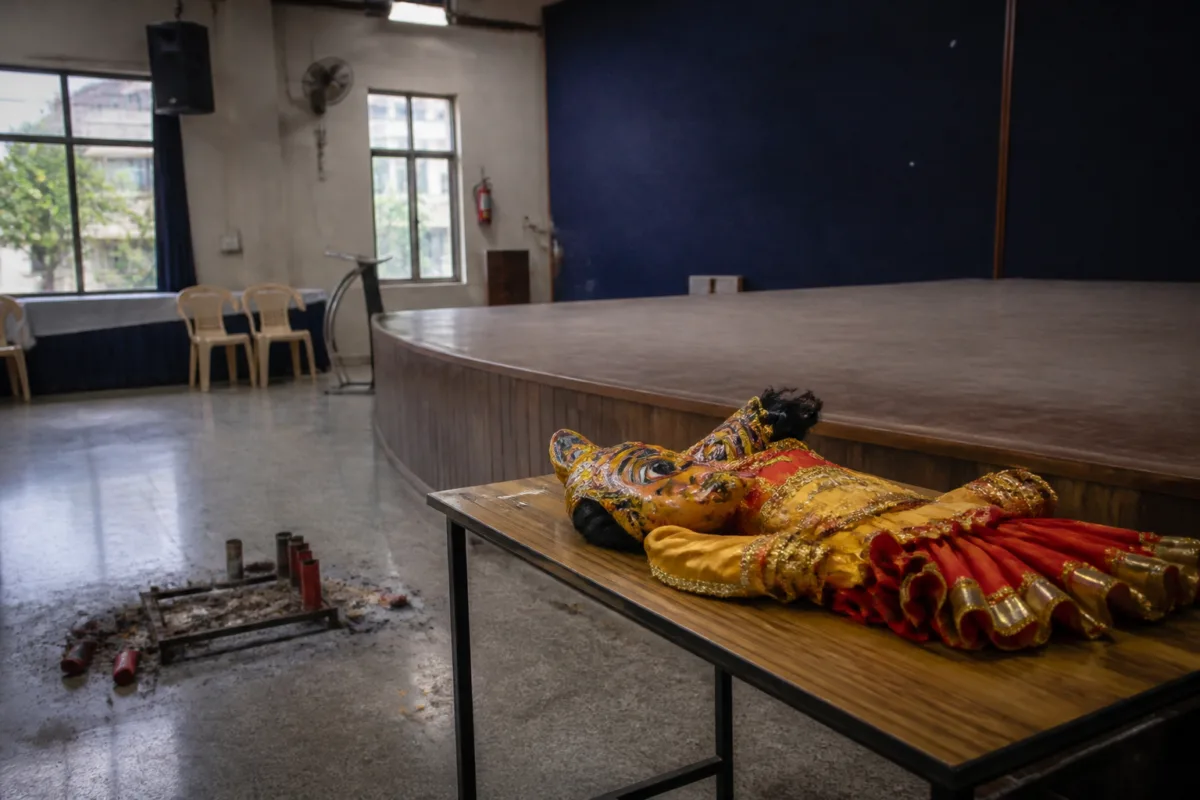
A child’s burns during a school cultural programme in Bengaluru have turned a routine celebration into a question of institutional safety. An eight-year-old Class III student was injured after a spark from a firecracker arrangement reportedly ignited a costume mask at a school in Anandapura, near TC Palya, on November 4. Police registered a case the following day against the school’s management under provisions concerning acts that endanger personal safety and the Juvenile Justice Act.
The incident, reported by the Times of India, is significant not only because of the injuries but also because it places responsibility for a school event under scrutiny. The child was participating in a programme linked to Karnataka Rajyotsava celebrations. He was dressed as Lord Narasimha Swamy and had brought a mask in his bag. According to a complaint filed by his father, the student entered the school at about 8.30am. Around 10am, a spark from a flowerpot and cracker arrangement landed on the hair of the mask while the child was on stage.
The reported sequence shows how several ordinary event decisions can combine into a serious safety incident. A firecracker display was part of a school programme. A child was wearing a costume with a mask and hair-like material. The arrangement was located close enough for a spark to reach the costume. The fire then spread rapidly, according to the complaint. The report does not establish whether the school had a written risk assessment, a designated safety officer, fire-control equipment at the stage or a prior approval process for the use of fireworks. Those unanswered questions are central to determining whether the episode was an isolated accident or a failure of event planning.
The child suffered burns to his face, ears, nose and hands. The school took him to hospital, but after a preliminary examination, the hospital advised his parents to shift him to another facility with better facilities. He later underwent plastic surgery and was discharged. The injuries therefore extended beyond a momentary stage mishap and required specialised medical treatment.
For families, the case highlights a basic distinction in school safety: supervision is not limited to classroom hours or ordinary campus movement. Cultural programmes, annual days and commemorative events also bring together crowds, stages, costumes, electrical equipment, decorations and, in this case, fireworks. The risks are different from those of a normal school day, which means the institution’s duty of care must also cover the way an event is designed and conducted.
The police complaint filed by the boy’s father accuses the school management of gross negligence and names the principal and teachers responsible for the programme. The father, who works at an architectural firm, also told the Times of India that police allegedly delayed registering a first information report. The report does not provide the police response to that allegation, but it records that a case was registered on November 5.
A senior police officer said notices would be issued to the school principal and teachers and that necessary action would be taken. The case was registered under Section 125, concerning an act endangering the life or personal safety of others, and under the Juvenile Justice Act. These provisions indicate that the investigation is examining both the immediate safety failure and the responsibilities owed to a child in the school’s care. Registration of a case, however, is not a finding of guilt. The facts will have to be established through the investigation and any subsequent legal process.
The institutional question is how responsibility is distributed during school events. A principal may have overall administrative authority, while teachers may supervise students and an organising team may manage the programme. The report identifies the principal and teachers in charge as the subjects of the complaint, but it does not specify who selected the firecracker arrangement, who positioned it near the stage, who approved the costumes or who was assigned to respond if something caught fire. Establishing that chain of responsibility will be important to understanding what happened.
The same question applies to emergency response. The school reportedly took the child to hospital, which was the immediate step described in the report. But the supplied account does not say whether the school had a first-aid team, whether staff used fire-suppression equipment, how quickly the child received treatment or whether other children were moved away from the stage. These details matter because safety is not only about preventing an incident; it also concerns the ability to contain harm once an incident occurs.
The case also exposes the difficulty of treating cultural performances as harmless activities. Costumes are often made from synthetic fabrics, paper, thermocol, artificial hair or other decorative materials, though the supplied report does not identify the material used in this child’s mask. A spark that might be manageable in an open outdoor setting can become dangerous when it reaches a costume worn on a child’s face. The fact that the fire reportedly spread rapidly makes the proximity between the ignition source and the costume a crucial issue for investigators.
No broader data on school-event fires or similar incidents in Bengaluru is provided in the report, so it would be inappropriate to describe this case as evidence of a citywide trend. What can be established is narrower but still important: one school event involved a child, a firecracker arrangement and a costume mask; the child sustained multiple facial and hand burns; and the police opened a case after a complaint by his father. That combination is sufficient to raise questions about how individual schools assess risks for public programmes.
The governance structure behind such events is often less visible than the event itself. Schools may be responsible for internal planning, staff deployment and student supervision, while police, fire services or education authorities may have separate roles depending on the nature and scale of the programme. The supplied material does not state whether any external authority had been informed about the firecracker arrangement or whether the school obtained permission. That gap should be clarified through the investigation rather than assumed.
The case also shows why accountability cannot end with identifying the person closest to the hazard. If a school permits a potentially dangerous activity, the investigation must examine the approval process, the instructions given to staff, the safeguards in place and the response after the child was injured. This is particularly important when participants are young children who cannot assess the risk posed by a stage arrangement or refuse participation on equal terms.
For parents, the episode may change how school events are viewed. A programme presented as a celebration can involve hazards that are not apparent in invitations or costume instructions. The report does not indicate whether other parents had been informed that fireworks would be used, whether safety protocols were communicated or whether the family knew how the mask would be used on stage. Those are factual questions for the school and investigating authorities.
The immediate outcome is now tied to the police process. Notices are expected to be issued to the principal and teachers, and the senior police officer has said necessary action will be taken. The child has been discharged after surgery, but the reported injuries and treatment show that the consequences of an event-safety failure can continue after the programme ends. The investigation will determine whether negligence can be established and how responsibility should be assigned.
The Bengaluru incident therefore remains more than a case of a firecracker spark causing a costume to catch fire. It is a test of whether school authorities treat cultural programmes as controlled public events with identifiable risks and accountable decision-making. The supplied facts establish the injury, the reported sequence and the police case. They do not yet establish the school’s safety arrangements, the precise cause of the rapid spread or the eventual legal outcome. Those are the facts that the investigation and the school’s response must now clarify.

