


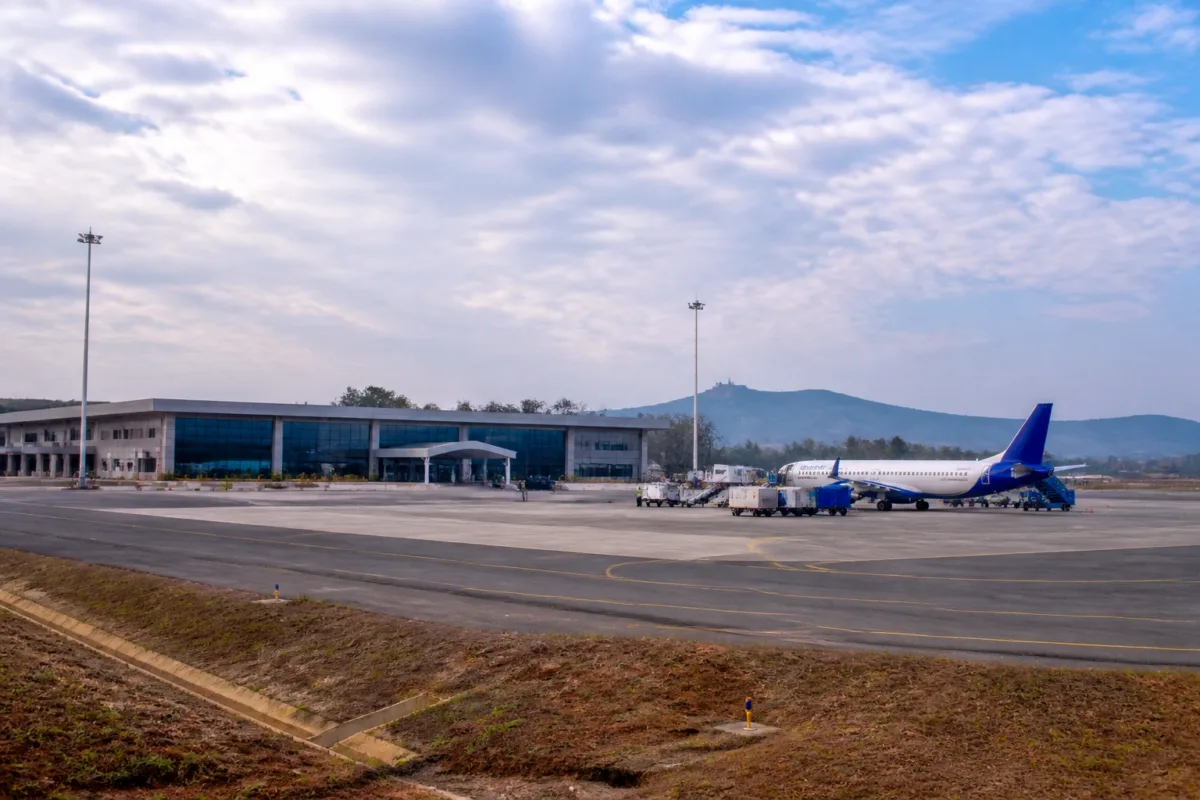
Karnataka’s proposed comprehensive aviation policy is aimed at resolving a problem that has repeatedly weakened regional airport connectivity: the mismatch between who pays for airports, who operates them and who carries the financial risk when flights stop. Infrastructure Development Minister MB Patil said the policy will be placed before the state Cabinet at its next meeting, with funding arrangements, viability gap funding and operational mechanisms for state-managed airports among its central subjects.
The proposal comes after the state’s experience with airports at Shivamogga, Raichur and Vijayapura, and amid continuing disagreement over the future of facilities developed with public money. Patil’s account presents regional aviation not simply as a question of adding routes, but as an institutional problem involving capital expenditure, operating subsidies, airport ownership and the terms on which the Centre and states share responsibility.
That distinction matters because an airport can be physically complete without becoming a reliable transport service. Building a runway and terminal is only the first stage. Airlines must find routes commercially viable, passengers must use them consistently, and public authorities may need to support operations until demand becomes stable. Karnataka’s proposed policy is therefore being framed around the period after construction, when the more difficult question of sustaining services begins.
Patil said the policy would address financial support and efficient airport operations and could become a model for other states. The statement does not provide the proposed policy’s final financial structure, eligibility conditions or implementation timeline. Those details will be important because viability gap funding can take several forms, including support for airline operations, route guarantees or direct contributions towards airport-related costs. The material available does not establish which model Karnataka will adopt.
The minister’s criticism of the Centre’s UDAN-2 scheme provides the immediate policy background. According to Patil, flight services from Shivamogga airport were suspended because the existing arrangement did not adequately support the regional route. He said Karnataka had proposed extending the scheme’s initial three-year period to five years, followed by another five years during which the Centre and the state would share expenditure equally. The Centre did not accept that proposal, he said.
The proposed structure would have created a longer support period than the arrangement described by the minister. Its first phase would have extended assistance from three years to five, while the second phase would have added five years of shared expenditure. Whether such a system would improve route viability cannot be determined from the supplied evidence, but the proposal identifies a key weakness in short-duration support: airport infrastructure and passenger habits often require more time to develop than an initial subsidy period allows.
Patil also said that 17 airports across the country had stopped operations. The statement links those closures to shortcomings in the current approach to regional aviation, but it does not identify the airports, the dates of suspension or whether all closures had the same cause. That limitation is significant. Airport shutdowns can result from weak demand, airline decisions, financial support ending, operational constraints or other factors. The figure establishes the scale of the concern raised by the minister, but not a complete explanation for every case.
Karnataka’s own airport investments illustrate the tension between infrastructure creation and long-term institutional control. Patil said the state spent Rs 1,000 crore on developing Kalaburagi Airport and later handed it over to the Centre without receiving any payment in return. He questioned whether state governments should invest thousands of crores in airports only to transfer the facilities to the Union Government.
This is a question of public asset governance as much as aviation policy. When one government funds construction and another controls the facility, the arrangement must clarify who benefits from the asset, who pays for future expansion and maintenance, and who is accountable for service delivery. The minister’s remarks indicate that Karnataka wants those responsibilities addressed before it commits to a similar pattern of investment and transfer elsewhere.
The Kalaburagi example also shows that ownership and operation are not identical. Patil said flight services at the previously non-operational airport were restored with 80 per cent of the funding provided by the Kalyana Karnataka Region Development Board and the remaining 20 per cent by the state government. The airport’s operations were therefore supported through a regional development institution and the state budget, rather than relying only on an airline-led commercial model.
The 80:20 funding split offers a concrete example of how regional connectivity may be financed when passenger demand is insufficient to sustain services on its own. It also raises questions that the proposed policy will need to answer: whether such support is temporary or recurring, which authority decides when funding should continue, and what performance indicators are used to assess the route. The supplied report does not provide those criteria.
Patil said Karnataka is managing airports at Shivamogga, Raichur and Vijayapura itself. This approach gives the state greater control over operational decisions and financial support, but it also places more responsibility on the state administration. A state-managed airport requires an institutional mechanism for contracting services, monitoring performance and deciding how public funds should be deployed when passenger numbers or airline participation are weak.
The policy’s reference to operational mechanisms is therefore potentially as important as its funding provisions. A capital grant can deliver a terminal or runway, but it cannot by itself guarantee regular flights. The proposed policy will have greater significance if it defines the relationship between airport operators, airlines, state departments, regional development bodies and the Union government. At present, the minister’s remarks establish the problem and the direction of reform, but not the final administrative design.
The political disagreement surrounding Shivamogga and Kalaburagi also shows how airport infrastructure becomes embedded in regional development debates. Patil criticised MP BY Raghavendra over the discussion on Shivamogga Airport and challenged him to arrange similar funding for the facility. That exchange reflects competing claims about responsibility, but it does not alter the underlying administrative issue: regional airports need a predictable financing and operating framework rather than case-by-case political negotiation.
The state’s position is also shaped by the broader question of airport privatisation. Patil referred to the handover of Mangaluru Airport to the Adani Group and the proposed movement towards privatising Hubballi Airport. These examples were cited to support his argument that Karnataka should reconsider investing heavily in airports that are later transferred to another authority or operator. The supplied material does not provide the terms of either arrangement, so their financial or operational outcomes cannot be assessed here.
What can be established is that Karnataka is considering a differentiated approach. Instead of assuming that every airport should follow the same ownership or operating model, the state appears to be examining direct management, shared funding and longer-term viability support as possible tools. Whether that becomes a coherent policy will depend on the document placed before the Cabinet and on the decisions that follow its approval.
The numbers in the minister’s account point to the scale of the challenge. Kalaburagi involved Rs 1,000 crore in state investment, its service restoration was supported through an 80:20 funding arrangement, the proposed support model extends across a possible 10-year period, and 17 airports were cited as having stopped operations. Together, these figures show why regional aviation cannot be judged only by the number of airports built. The more useful measure is whether public investment produces sustained connectivity and whether the funding responsibility remains transparent after construction.
For Karnataka, the immediate test is whether the proposed policy converts these disputes into clear rules. The Cabinet document will need to show how viability gap funding is calculated, how long it can continue, what happens when routes fail, and whether state-funded airports are retained, transferred or operated through other arrangements. It will also need to clarify how regional institutions such as the Kalyana Karnataka Region Development Board fit into the financing structure.
The larger urban and regional planning question is whether airports are being treated as standalone projects or as parts of a wider connectivity system. The supplied material does not provide passenger volumes, route-level demand, airline operating costs or detailed economic impact assessments. Without such information, it is not possible to determine which airports are commercially viable or whether longer subsidies would deliver better outcomes. But the policy debate makes clear that infrastructure creation alone has not resolved the connectivity problem.
Karnataka’s proposed aviation policy could therefore become important beyond the state if it sets out a transparent model for sharing capital costs, operating support and ownership responsibilities. The evidence currently confirms the government’s concerns and its intention to bring a policy before the next Cabinet meeting. The next substantive milestone will be the policy document itself, which will show whether the state’s proposed reset is a financing proposal, an operating framework or a broader reorganisation of regional airport governance.

