


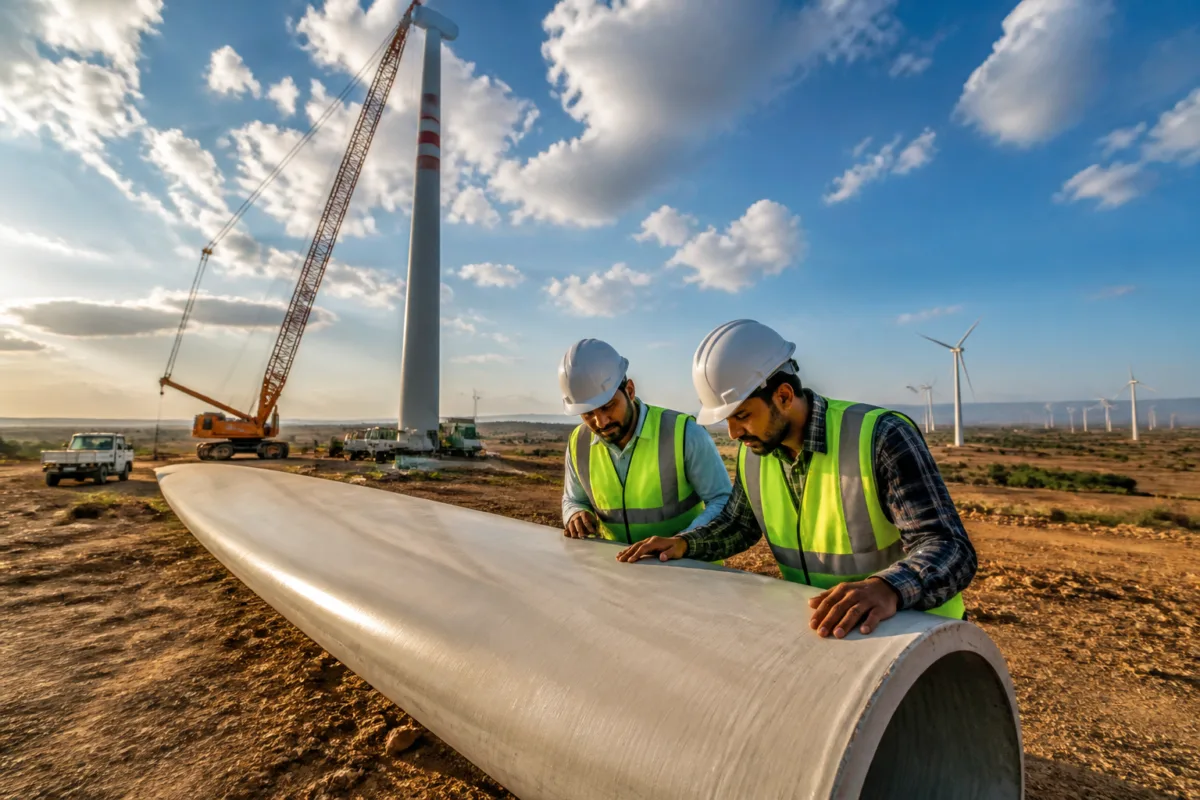
Grasim Industries, Suzlon Energy and Aditya Birla Renewables have signed a memorandum of understanding to develop and commercialise wind turbines equipped with recyclable blades, putting a difficult end-of-life problem at the centre of India’s renewable-energy expansion. The partnership will begin with a pilot project at a selected renewable-energy site of Aditya Birla Renewables, or ABRen, where a turbine fitted with the technology will be assessed under real-world operating conditions.
The announcement is significant because the sustainability of wind power is usually discussed through the electricity generated during a turbine’s operating life. The companies’ collaboration shifts attention to what happens after that period. Conventional wind-turbine blades are largely made from thermoset composite materials. According to the information released through The Hindu BusinessLine, these materials are difficult to recycle and are often sent to landfills or disposed of through incineration.
That creates a structural challenge for a sector whose environmental case depends not only on generating low-carbon electricity, but also on managing the materials and equipment associated with that generation. As wind capacity expands and older machines eventually reach the end of their operating lives, blade disposal becomes an infrastructure and materials-management issue rather than a narrow manufacturing concern.
The proposed arrangement divides the pilot into three linked responsibilities. Grasim’s Advanced Materials Division will supply its Recyclamine epoxy technology, which is designed to enable the chemical recycling of composite materials and the recovery of valuable constituents for reuse in other applications. Suzlon will integrate the technology into blade manufacturing. ABRen will deploy a turbine fitted with recyclable blades and evaluate how the system performs in operating conditions.
This structure matters because recyclable blades cannot be assessed only as a material innovation. Their commercial relevance depends on whether they can be manufactured reliably, installed in a functioning turbine, perform under operating conditions and eventually yield recoverable material. The pilot therefore connects the laboratory and factory stages to an actual renewable-energy project, although the companies have not disclosed the project location, turbine capacity, testing period or performance criteria in the information supplied.
The partnership also illustrates how circularity in infrastructure depends on coordination across the value chain. A blade manufacturer can develop a different material system, but the technology must be compatible with turbine design and manufacturing processes. A renewable-energy operator, meanwhile, provides the operating environment in which durability and performance can be assessed. Recycling at the end of the blade’s useful life would also require a pathway for collecting, processing and reusing recovered constituents.
The companies have said they will explore wider adoption of the technology across India and other markets. That ambition remains at the exploration stage: the current agreement is for a pilot collaboration, not a disclosed nationwide deployment programme. The next evidence will therefore come from the demonstration itself and from any subsequent information on technical performance, recycling yields, cost, maintenance and commercial scale-up.
Grasim’s Recyclamine technology is central to the proposed approach. The company said the epoxy system enables chemical recycling of composite materials and the recovery of valuable constituents for use in other applications. In practical terms, the claimed benefit is not simply that a blade can be labelled recyclable. It is that parts of a complex composite product can be separated or recovered in a way that preserves value beyond the first use.
That distinction is important for wind infrastructure. Composite blades are designed to be strong and durable, which makes them suitable for large rotating structures but also makes them difficult to process at the end of their service life. The source material does not provide figures for the volume of blade waste in India, the operating life of the affected turbines or the proportion of material expected to be recovered. It does, however, identify the basic mismatch: a technology that supports long service life can create an end-of-life challenge when conventional recycling systems cannot easily process it.
Suzlon’s role places the issue inside the design and manufacturing process. Girish Tanti, co-founder of Suzlon Group, said the company was working towards making all its future wind turbines recyclable within the next three to four years. He also said the company’s S144 platform already had one of the lowest carbon footprints among wind turbines globally. The statement establishes a company target and a claim about the platform, but the supplied report does not include the methodology, baseline or independent assessment behind the carbon-footprint comparison.
ABRen’s role brings the issue into project operations. Amit Jain, its chief executive officer, said the partnership would help address end-of-life challenges associated with wind-turbine blades and strengthen sustainability across the renewable-energy sector. The company will provide the selected project site and operate the turbine used for the pilot, allowing the recyclable blade technology to be examined outside a purely controlled manufacturing setting.
Rajesh Balakrishnan, chief executive officer of Grasim’s Advanced Materials business, said the collaboration could help build a circular wind-energy ecosystem by combining Recyclamine technology with Suzlon’s manufacturing expertise and ABRen’s renewable-energy capabilities. That description captures the institutional question raised by the agreement: circular infrastructure requires not one solution, but a chain linking product design, procurement, operation, recovery and reuse.
The policy and governance implications are also broader than the individual MoU. Renewable-energy projects are typically evaluated on generation capacity, cost, land, grid connectivity and construction timelines. The recyclable-blade proposal introduces another performance dimension: the material pathway after decommissioning. For that dimension to influence the wider market, project owners and manufacturers would need reliable information on technical life, recycling processes, recovered outputs and the costs associated with handling old blades.
The supplied announcement does not state whether the pilot is connected to a government programme, a public procurement requirement or a regulatory mandate. It also does not specify whether the recovered materials will be used in new blades or in other applications. These details will determine how far the technology moves from a corporate sustainability initiative towards a repeatable industry model.
The immediate data story is therefore limited but clear. Three companies have formed a pilot partnership. One will provide the recyclable epoxy technology, one will integrate it into blade manufacturing, and one will deploy the resulting turbine at a renewable-energy project site. The companies are also discussing adoption in India and other markets, while Suzlon has stated a three-to-four-year goal for making its future wind turbines recyclable.
What is not yet established is equally important. There are no disclosed figures in the supplied material on the pilot turbine’s capacity, the expected quantity of recovered material, the cost difference compared with conventional blades, the blade’s operating performance or the time required for chemical recycling. Without those measures, the partnership demonstrates direction rather than scale.
That distinction should shape how the development is understood. The agreement does not resolve the blade-waste challenge immediately, nor does it establish that recyclable blades are already commercially competitive across the market. It does show that the issue is being addressed jointly by an advanced-materials producer, a turbine manufacturer and a renewable-energy developer. Such coordination is necessary if circularity is to move beyond an end-of-life disposal promise and become part of infrastructure design from the beginning.
For India’s clean-energy build-out, the larger urban and industrial question is whether new infrastructure can avoid transferring environmental costs to a later stage. Wind turbines occupy rural and industrial landscapes, connect to transmission systems and support wider economic activity, but their material footprint extends beyond the period in which they generate electricity. The pilot announced by Grasim, Suzlon and ABRen places that complete life cycle under examination.
The next meaningful milestone will be the demonstration at ABRen’s selected project site and the evidence it produces on performance and material recovery. Until those results are disclosed, the collaboration confirms a promising direction for recyclable wind-turbine blades, while leaving its technical, financial and commercial viability to be tested.

