


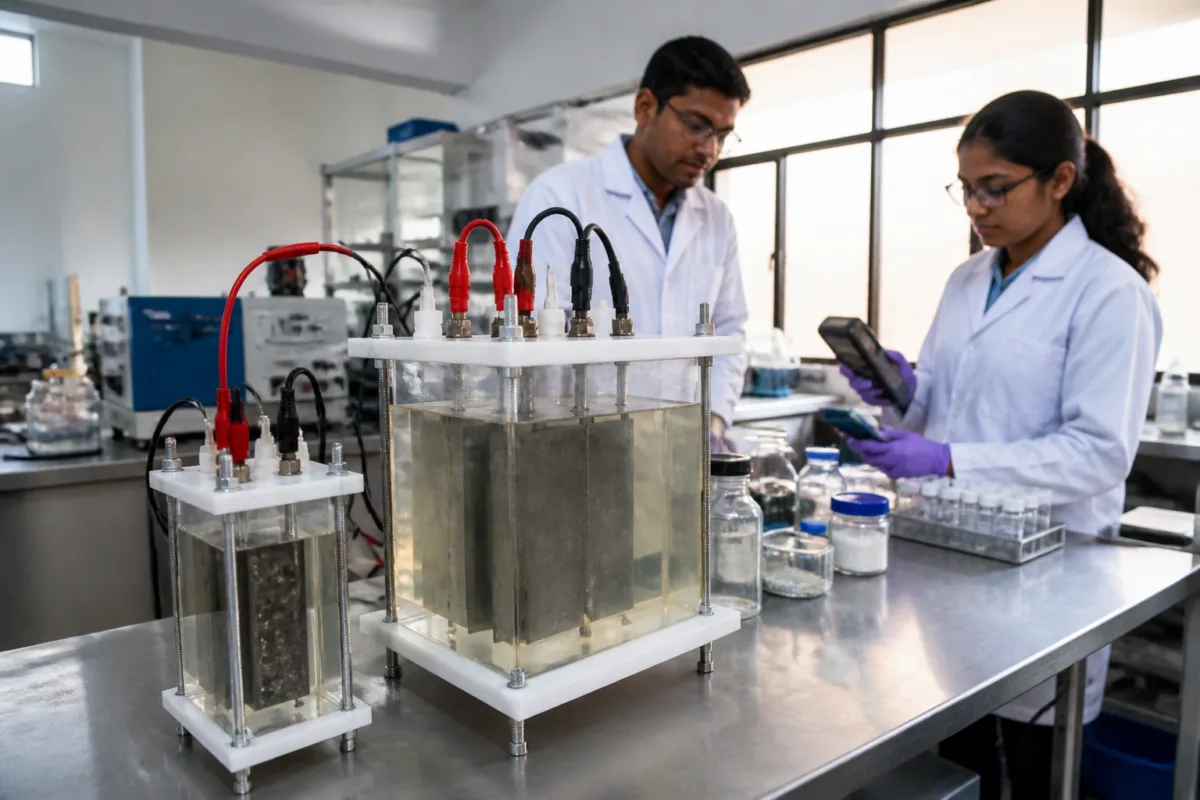
Researchers at the National Institute of Technology, Rourkela, have developed an electrochemical process to recover nutrients from human urine and produce struvite fertiliser, according to a report published by Dharitri on November 24, 2026. The work has been published in the Journal of Water Process Engineering, the report said.
The research is relevant to urban sanitation because it treats urine not only as a waste stream but also as a source of recoverable nutrients. The process developed by the NIT Rourkela team uses a magnesium electrode and an electric current instead of repeatedly adding alkaline chemicals and magnesium salts to separate nutrients from urine.
When electricity is passed through the urine, the magnesium electrode gradually dissolves and releases magnesium ions. These ions combine with nutrients in the urine to form struvite, a phosphorus-containing fertiliser. The researchers said the method can reduce the need for externally added chemicals and can be adapted to small, modular treatment systems.
The team tested the process in two reactors with capacities of five litres and 35 litres. The urine used in the experiments was collected from men’s urinals. The smaller reactor achieved phosphorus recovery of more than 98 per cent, while the 35-litre reactor recorded recovery of more than 91 per cent, according to Dharitri.
The researchers used X-ray diffraction and Fourier-transform infrared spectroscopy to verify the composition of the recovered fertiliser. In plant-growth tests, the product reportedly produced results comparable with commercially available NPK fertiliser when used on tulsi, cowpea and okra plants.
The research involved P. Balasubramanyam and J. Shivraman, associate professors in NIT Rourkela’s biotechnology and medical engineering departments, assistant professor Bikash Chandra Maharaj and researcher Alisha Jafar, the report said.
The approach addresses two linked urban challenges: managing concentrated liquid waste and recovering nutrients that would otherwise enter wastewater flows. Conventional wastewater systems generally handle urine after dilution with other household wastewater, which can make nutrient recovery more difficult. The reported method instead relies on a separated urine stream collected from urinals.
The researchers described the electrochemical process as a sustainable, chemical-free alternative for nutrient recovery because the magnesium ions required for struvite formation are generated by the magnesium anode within the process. However, the system still requires electricity and magnesium electrodes, and the report does not provide data on energy consumption, electrode replacement, operating costs or long-term maintenance.
The team also reported that an integrated pilot plant with a capacity of 500 litres could be economically viable. This remains a research-stage assessment rather than a confirmed commercial outcome. The available report does not specify whether the pilot plant has been built or operated, nor does it provide details on the treatment of pathogens, pharmaceutical residues or other contaminants before the recovered product is used in agriculture.
For municipalities, institutions and large buildings, the research points to the potential of decentralised nutrient-recovery systems linked to source-separated sanitation. Its practical value will depend on how reliably urine can be collected, how the process performs at larger volumes and what safety and regulatory requirements apply to the resulting fertiliser. The reported reactor tests establish a promising technical result, but further pilot-scale evidence is needed before the method can be assessed as an urban sanitation solution.

