


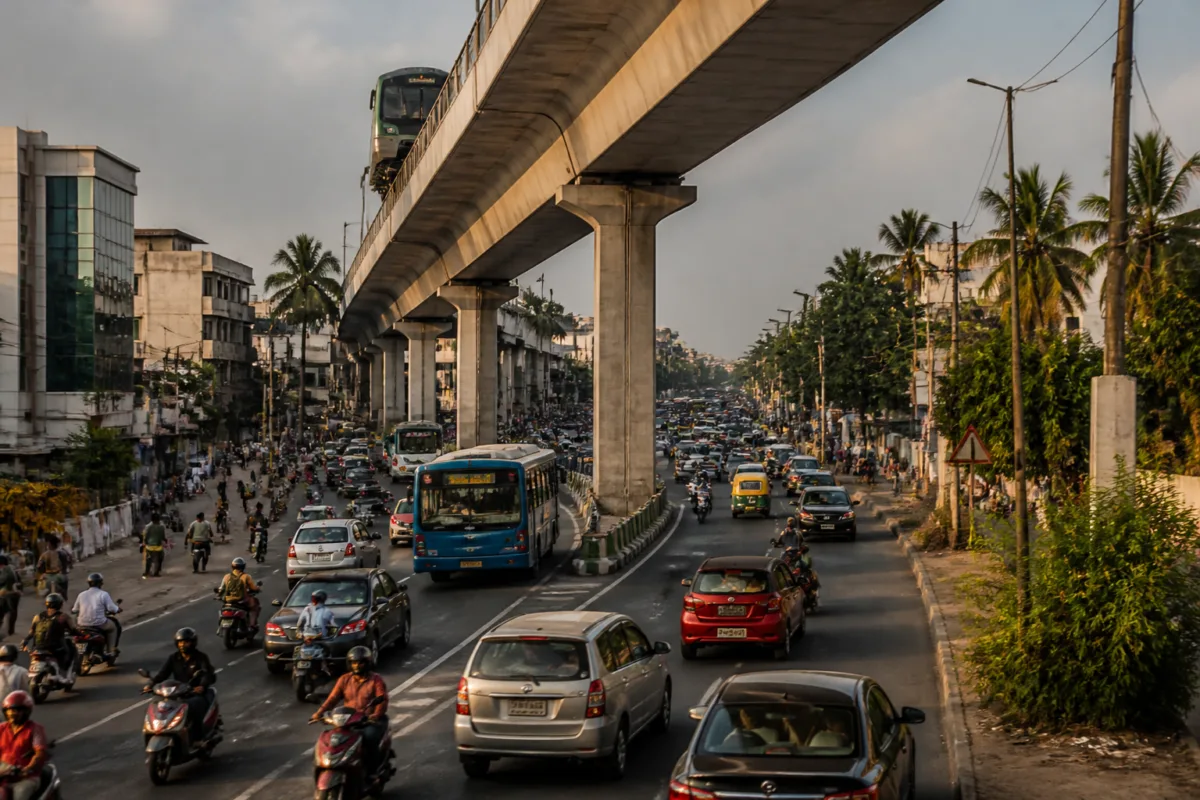
The proposed Kanakapura Road twin flyovers in Bengaluru would target two closely spaced junctions near Konanakunte Cross, where more than 2.7 lakh vehicles are reported to move each day. The Rs 291-crore project has completed tendering but is still awaiting government approval, with no confirmed construction start or completion date.
The flyovers are planned at the Kanakapura Road–Vasanthapura Road junction and Konanakunte Cross, which are around 125 metres apart. The Namma Metro Green Line would remain between the two elevated structures. According to a report by MagicBricks, Greater Bengaluru development minister Krishna Byre Gowda has said construction will begin after the government approves the project.
The proposal is intended to separate through-traffic from vehicles entering the adjoining roads. Vehicles travelling between Kanakapura Road and Banashankari would be able to use the elevated routes, while local traffic would continue on the existing road network. This means the project is designed primarily to improve movement along the corridor rather than remove congestion from every approach road in the area.
Traffic data cited in the project report indicates the scale of pressure at the two junctions. A count conducted on April 2, 2025, recorded about 1.3 lakh vehicles at one junction and 1.4 lakh at the other over 24 hours. Cars and two-wheelers accounted for most of the movement, according to the report.
The project report forecasts that peak-hour traffic at the Kanakapura Road–Vasanthapura Road junction could exceed 10,000 passenger car units (PCUs) by 2026. The junction’s stated capacity is 9,381 PCUs per hour. At Konanakunte Cross, traffic could exceed 10,000 PCUs by 2030, compared with a stated capacity of 7,700 PCUs per hour.
PCU is a standard traffic-planning measure that converts different vehicle types into a common unit based on the road space they occupy. The projections suggest that the proposed structures are being considered not only for existing congestion but also for anticipated growth in traffic on the corridor. The report does not, however, provide a post-project traffic forecast or explain how conditions would change on the roads feeding into the two junctions.
Each flyover is planned to have two lanes carrying one-way traffic and to be about 8.5 metres wide. Because the structures would run alongside an operational metro corridor and a heavily used road, the detailed project report proposes precast construction. Components could be prepared away from the site and assembled near the alignment, an approach intended to reduce disruption to metro services and road traffic during construction.
The project also involves land acquisition. The detailed project report identifies 6,848 square metres of private land in residential and commercial areas. Of the total proposed cost, Rs 191.3 crore is earmarked for land and structures. The acquisition is proposed through the Transfer of Development Rights scheme, under which affected landowners would receive development rights in return for land needed for the project.
The report does not specify how many properties or owners would be affected. That information will be important for assessing the project’s local impact, including access to buildings, construction disruption and the distribution of compensation or development rights. It also remains unclear from the available report how traffic management would be handled while the flyovers are built beside the metro line.
Kanakapura Road has become an important residential corridor in south Bengaluru, with metro stations serving areas including Konanakunte, Doddakallasandra and Vajarahalli. A flyover project could improve through-movement for some road users, but residents’ daily experience would also depend on how well surface-level traffic, pedestrian movement, bus access and junction connections are managed.
For now, the project should not be treated as an imminent improvement in travel conditions. Tendering has reportedly been completed, but construction depends on government approval, and the authorities have not announced a start date or deadline. The next significant public-interest steps are approval of the project, disclosure of the affected properties and landowners, and publication of a confirmed construction and traffic-management plan.

