


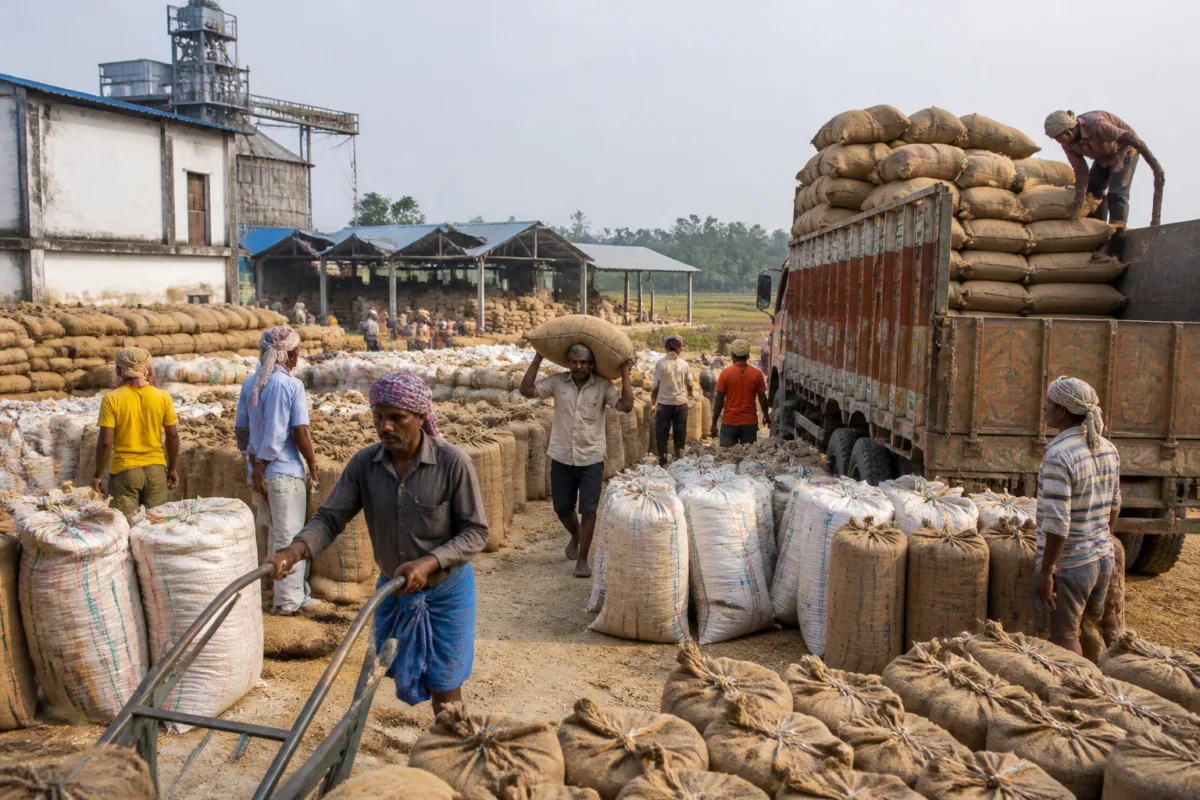
A backlog in lifting rice from mills in Odisha’s Bargarh district has raised concerns about whether the new kharif paddy procurement season can operate smoothly, with rice millers saying their storage capacity is already constrained by stocks from earlier seasons.
The Bargarh district administration has decided to open 240 procurement mandis under the Atabira, Bargarh and Padampur regulated market committees from November 30. The decision was conveyed at a district-level paddy procurement committee meeting held on the previous Sunday, according to Dharitri.
However, rice millers have warned that the procurement system could face difficulties if rice already processed under the custom-milling arrangement is not moved out of their warehouses. Under this arrangement, paddy collected at mandis is supplied to rice mills, which then deliver rice to the state supply corporation and the Food Corporation of India (FCI).
The report said around 124 rice mills in Bargarh district had received paddy collected during earlier procurement cycles. Millers alleged that the corresponding rice had not been lifted fully, leaving their warehouses occupied by old stocks. They said this could limit their ability to accept fresh paddy from mandis once the new procurement process begins.
Nitesh Bansal, vice-president of the All Odisha Rice Millers’ Association, said at the district meeting that millers were ready to cooperate with procurement but did not have adequate space to store additional paddy. He was quoted as saying that half of the previous kharif rice remained to be lifted, while the entire rabi stock was pending. He further claimed that about 75 per cent of one year’s paddy remained stored at the mills.
Bansal also said trucks carrying rice to supply corporation depots were not being unloaded immediately and sometimes remained there for several days. If the situation continued, he said, millers would not be able to lift fresh paddy from the mandis. The association is scheduled to hold a gathering at Barahagoda, near Bargarh town, on November 27, according to the report.
The storage constraint comes as farmers in the district have already started harvesting kharif paddy. Harvesting was interrupted by the impact of a cyclone but later gathered pace. Farmer organisations had sought the start of procurement by November 25, while the administration’s decision places the opening of the mandis five days later.
The delay has reportedly left harvested paddy in fields, threshing yards and along roads. The report said some stocks had been affected by rain and that some farmers had allegedly sold paddy at lower prices because government procurement had not begun. The government’s minimum support price was stated as Rs 3,100 per quintal.
Suresh Nikanti, a leader of the United Farmers’ Organisation, rejected the suggestion that farmers should bear the consequences of the millers’ storage constraints. He said the government should purchase paddy directly and create covered storage capacity instead of depending entirely on millers. He warned that farmers could protest if paddy was not lifted from the mandis because of the problem cited by millers.
The immediate operational question is whether old rice stocks can be cleared and depot unloading improved before the 240 mandis begin receiving fresh paddy. The report records concerns from millers and farmers but does not provide figures from the district administration, the state supply corporation or FCI on the quantity of rice pending collection, available storage capacity or a clearance schedule. Those details will determine the scale of the bottleneck and whether the procurement network can absorb the new harvest without further delays.

