


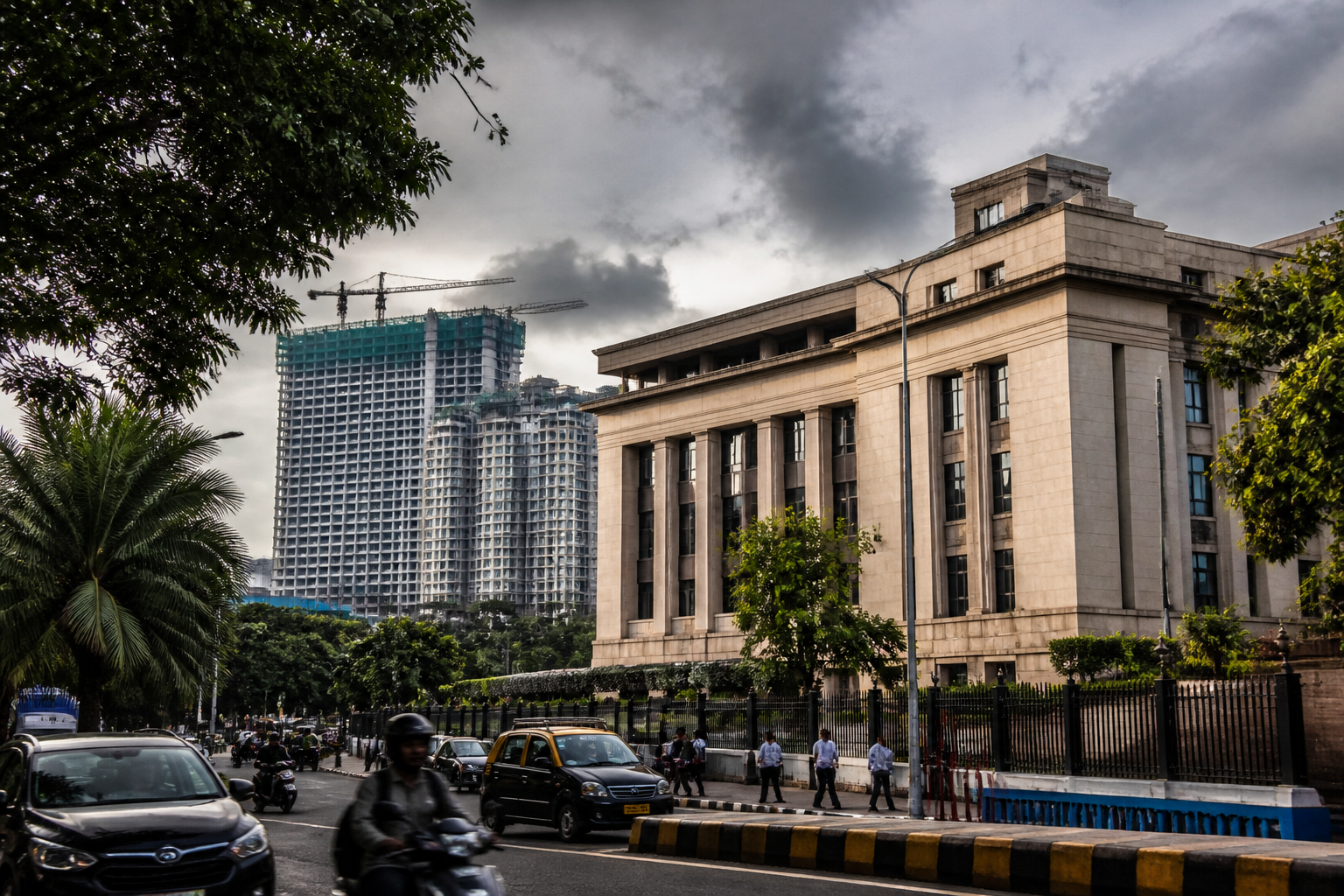
The Reserve Bank of India’s renewed turn towards higher interest rates is more than a macroeconomic shift. It is a test of how India’s housing market, construction pipeline and urban investment cycle respond when inflation control begins to compete with the affordability gains created by an earlier period of rate cuts.
Economists at Goldman Sachs, Standard Chartered, Deutsche Bank and Morgan Stanley are forecasting another 25-basis-point increase at the RBI’s next policy decision on December 4. Some expect a further 50 basis points of tightening in the first half of 2027, which would take the policy rate to 6.25% from 5.5%, according to the report by NDTV Business, sourced to Bloomberg News.
The immediate event was the RBI’s first rate increase in nearly four years and its decision to change its policy stance to “calibrated tightening”. That language matters because it signals a shift from supporting economic recovery towards containing inflationary pressure, even though Governor Sanjay Malhotra described the new stance as a milder form of tightening rather than a fixed commitment to a long sequence of increases.
For cities, the significance lies in how monetary policy travels through the built environment. Higher policy rates can raise the cost of borrowing across the economy. Housing loans, construction finance and working capital for developers are among the channels through which a change in the RBI’s stance can eventually affect urban activity. The supplied report does not provide current housing sales, mortgage or construction-cost data, so the precise scale of the impact is not established. But the policy direction creates a more difficult operating environment for rate-sensitive urban sectors.
The possibility of successive hikes is being driven by a combination of factors. The report says price pressures are becoming broader, while households surveyed by the RBI expect inflation to accelerate sharply in the coming months. Economists also cited energy costs linked to the Middle East conflict, risks to food prices from weak monsoons and a rupee trading near a record low of 96.76 to the US dollar.
Those factors are relevant to the built environment because urban construction depends on a wide chain of costs and financing decisions. Energy prices can affect transport and material movement, while food inflation can reduce the disposable income available to households servicing loans or considering a home purchase. Currency weakness can also increase the cost of imported inputs, although the supplied report does not identify specific construction materials or quantify such an effect.
The RBI’s policy dilemma is therefore not simply about choosing between growth and inflation. It is about managing a recovery whose strength may itself give the central bank room to tighten. India’s economy expanded 7.8% in the April-June quarter, exceeding the RBI’s forecast. Morgan Stanley’s chief India economist, Upasana Chachra, said that broadening inflationary pressures alongside healthy growth momentum, reflected in credit growth, warranted further rate hikes.
That combination changes the policy calculus for urban investment. When growth is resilient, the RBI may be less constrained by the risk that higher rates immediately weaken economic activity. At the same time, the cost of containing inflation may be distributed unevenly. Larger borrowers and financially stronger companies may have more capacity to absorb higher costs, while first-time homebuyers, smaller contractors and households with limited room in their budgets may be more exposed.
The central bank has not, however, committed itself to a predetermined rate path. Governor Malhotra said the duration and extent of the rate-hike cycle would depend on how inflation and growth evolve. HSBC’s Pranjul Bhandari cautioned that the policy stance should not be read as a promise of repeated increases. She expects a December hike followed by a prolonged pause, while pointing to the RBI’s experience in 2018, when it adopted calibrated tightening after two hikes but did not raise rates again before reversing course.
This distinction is important for the housing and construction sectors. A policy signal can affect market expectations before the full cost of higher rates appears in lending products or project accounts. Developers may reassess the timing of launches, land purchases and construction commitments; buyers may delay decisions if loan affordability becomes less certain. These are analytical transmission channels, not outcomes documented in the supplied report, and their actual effect will depend on how banks, non-bank lenders, developers and households respond.
The report also records disagreement among economists. Goldman Sachs’ Santanu Sengupta expects at least another 75 basis points of hikes, citing resilient growth, broadening price pressures and the risk of El Nino-related food inflation in 2027. Citigroup’s Samiran Chakraborty also sees a greater likelihood of 75 basis points of tightening. Barclays’ Aastha Gudwani and economists at ICRA do not expect sharp hikes after December.
That range of forecasts reveals the central uncertainty facing urban decision-makers: the direction of policy has changed, but its eventual endpoint has not been settled. A 25-basis-point increase followed by a pause would create a different environment from a sustained 75-basis-point cycle. The difference would affect the duration of financing stress, the ability of households to plan purchases and the cost assumptions embedded in long-duration construction projects.
The rupee adds another layer to the policy challenge. Governor Malhotra said the currency may be undervalued but also noted that markets can be irrational in the short run. He reiterated that the RBI’s focus was on limiting excessive volatility rather than steering the rupee towards a particular level. Since India is the world’s third-biggest oil importer and oil prices remain high, currency weakness can intensify concerns about imported inflation.
For urban India, this places external stability alongside domestic affordability. Higher rates may help contain inflation expectations and support the currency, as Morgan Stanley’s Chachra argued, but they can also increase the financial pressure on borrowers. The policy objective is not designed around housing alone, and the RBI’s mandate extends well beyond the real estate market. Yet housing and construction are among the areas where monetary policy becomes visible in everyday urban life: through loan instalments, project financing, purchase decisions and the pace of new supply.
The institutional structure is clear in the report. The RBI sets the policy stance, responds to inflation and growth conditions, and seeks to contain excessive currency volatility. Commercial lenders and other financial institutions transmit that stance through borrowing costs. Developers and households then make decisions within those financial conditions. The report does not specify how individual lenders will change rates or how developers will adjust project plans, so those outcomes remain to be observed rather than assumed.
What is established is that the RBI is responding to a more difficult inflation outlook while growth remains strong. What remains uncertain is whether the December decision will be followed by a sustained cycle, a single additional increase or a pause. The distinction will determine whether the current policy shift becomes a temporary adjustment or a longer challenge for housing affordability and urban investment.
The next major signal will come from the RBI’s decision on December 4. Until then, the most important indicators will be inflation expectations, food and energy price pressures, the rupee’s volatility and the strength of growth and credit. Together, they will shape how far the central bank takes calibrated tightening—and how sharply its effects are felt across India’s cities.
