


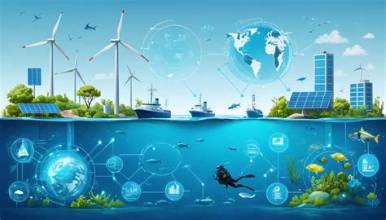
Gujarat’s proposed Rs 100-crore Marine Biotechnology Research & Innovation Corridor in Mocha village, Porbandar district, is more than a research project. As described by the Economic Times, it is being designed as an integrated system linking marine science, biotechnology research, field cultivation, technology development, pilot-scale biomanufacturing, entrepreneurship and commercialisation. The larger question is whether coastal biological resources can be converted into a durable economic value chain without leaving research, manufacturing and coastal communities disconnected from one another.
The initiative is being led by the Gujarat State Biotechnology Mission (GSBTM) under the state Department of Science and Technology. The proposed investment is spread over five years. Its stated objective is to use the state’s marine biological resources to create high-value products while generating new business and livelihood opportunities for coastal communities.
That combination of research, manufacturing and livelihoods is important because the proposal does not treat marine biotechnology as an isolated laboratory activity. The corridor is envisioned as a common platform for government departments, research institutions, universities, industries, startups, micro, small and medium enterprises, and coastal communities. In institutional terms, this means the project is intended to connect actors that normally operate at different stages of the innovation and production process.
The source material does not establish the precise land area, construction schedule, proposed facilities, funding releases, target products or implementation milestones for M-BRIC. It also does not specify how coastal communities will participate, how benefits will be distributed, or which agencies will be responsible for environmental and operational oversight. Those gaps matter because an ecosystem is only as effective as the links between its institutions, infrastructure and users.
The corridor’s proposed value chain begins with identifying marine biological resources. It then moves through research, technology development, product testing, scale-up manufacturing and market access. This sequence is significant because many innovation programmes struggle at the transition between discovery and commercial production. A research finding does not automatically become a product, and a product does not automatically become a viable enterprise. M-BRIC’s stated design attempts to address that entire sequence within one coordinated framework.
The emphasis on pilot-scale biomanufacturing is particularly relevant to the corridor’s proposed role. The source describes pilot-scale production as a bridge between technology development and commercialisation. In practical terms, that stage is where a process must move beyond laboratory research and demonstrate whether it can be tested, refined and scaled. The report does not provide technical details about the facilities or technologies planned, but the inclusion of pilot-scale manufacturing indicates that the proposal is intended to support more than academic research.
The project also places field cultivation within the corridor’s scope. The source refers to seaweed, algae and microbes as possible foundations for new business activity, although it does not identify specific products or commercial partners. That makes the relationship between biological resources and production systems central to the initiative. Field cultivation, research and manufacturing are presented as connected activities rather than separate programmes.
For Porbandar, the stated location gives the project a distinct coastal and regional dimension. The corridor is not described as a generic biotechnology park detached from its resource base. Instead, its proposed rationale is to connect marine resources, research and economic activity in a coastal district. The planned participation of coastal communities further suggests that the project is expected to have a local livelihood component, although the available report does not provide estimates of employment, income or the number of communities involved.
This is also why the corridor should be understood as infrastructure, even though its most visible components may eventually be laboratories, pilot plants or research facilities. Infrastructure is not limited to roads, buildings and transport links. In a project of this kind, the institutional platform that moves knowledge from research to production is part of the productive system. The proposed corridor would need physical facilities, but it would also depend on coordination between departments, universities, companies, startups, MSMEs and communities.
The governance structure announced so far places GSBTM and the Department of Science and Technology at the centre. The proposed participation of multiple government departments indicates that implementation will require coordination beyond a single science agency. The source, however, does not identify the participating departments, the operating authority for the corridor, the legal structure of the platform or the mechanism through which private and community actors will be selected.
That administrative design will shape the project’s eventual performance. A corridor can provide proximity and a shared institutional identity, but it cannot by itself guarantee collaboration. The stated value chain requires decisions about access to marine biological resources, research partnerships, intellectual property, testing, standards, manufacturing approvals and market entry. None of those mechanisms is detailed in the supplied report. They will be important indicators of whether M-BRIC becomes a functioning production ecosystem or remains primarily an umbrella for related activities.
The five-year investment horizon provides a broad implementation frame, but the source does not indicate how the Rs 100 crore will be divided between research, land and buildings, equipment, pilot production, startup support, cultivation or community programmes. Nor does it specify whether the amount is a committed budget, an announced allocation or a projected investment. These distinctions will be important for assessing delivery as the proposal moves forward.
The project’s economic promise is similarly stated at a high level. The report says that marine biological resources could support high-value products and new business opportunities. It does not quantify the expected number of companies, products, jobs or revenues. As a result, the current evidence supports the conclusion that Gujarat is planning an institutional and infrastructure platform for a marine bioeconomy, but it does not yet support claims about the scale of its eventual economic impact.
The corridor’s proposed participation of startups and MSMEs is a notable feature because it widens the intended user base beyond large industrial organisations and established research institutions. If implemented as described, the model could allow smaller enterprises to access research, testing and pilot-scale capabilities that may otherwise be difficult to build independently. However, the report does not state what incentives, financing or technical support would be available to them.
The inclusion of coastal communities raises an equally important implementation question. The initiative is presented as a means of creating livelihood opportunities, but the available information does not describe whether communities would participate as cultivators, suppliers, workers, entrepreneurs, knowledge partners or beneficiaries of local procurement. Those roles have different implications for income, ownership and control. The distinction will determine whether the corridor creates a locally embedded economy or simply locates a technology project near the coast.
Environmental governance is another area that remains undefined in the announcement as reported. Marine biological resources are the foundation of the proposed corridor, yet the supplied material does not identify safeguards, monitoring systems or criteria for sustainable cultivation and extraction. It would be premature to infer either environmental risk or environmental benefit from the announcement alone. The relevant point is that resource management will need to be part of the corridor’s institutional design because the project’s economic model depends on the continued availability of marine resources.
M-BRIC therefore represents a shift in how a state may frame biotechnology infrastructure. Rather than separating research, production and entrepreneurship, the proposal groups them into one corridor and adds coastal communities to the intended ecosystem. The approach reflects an understanding that commercialisation requires more than scientific discovery. It requires facilities, testing capacity, administrative coordination, finance, market connections and a workforce able to participate across the value chain.
The evidence currently confirms the ambition and the proposed architecture, not the results. Gujarat has announced a five-year, Rs 100-crore plan at Mocha in Porbandar, led by GSBTM and the Department of Science and Technology. It has identified the institutions and groups the corridor is expected to connect, and it has outlined a pathway from marine-resource identification to commercialisation. It has not yet, in the supplied material, established the project’s detailed design, funding schedule, product pipeline, community framework or construction timeline.
Those details will determine whether the corridor becomes meaningful coastal economic infrastructure. The next developments to monitor are the release of the implementation plan, identification of participating institutions and agencies, clarification of the investment structure, definition of community participation, and disclosure of the facilities and pilot-scale capabilities to be created. Until then, M-BRIC is best understood as a significant institutional proposal: an attempt to build a complete marine biotechnology ecosystem in Porbandar rather than fund a standalone research facility.
