


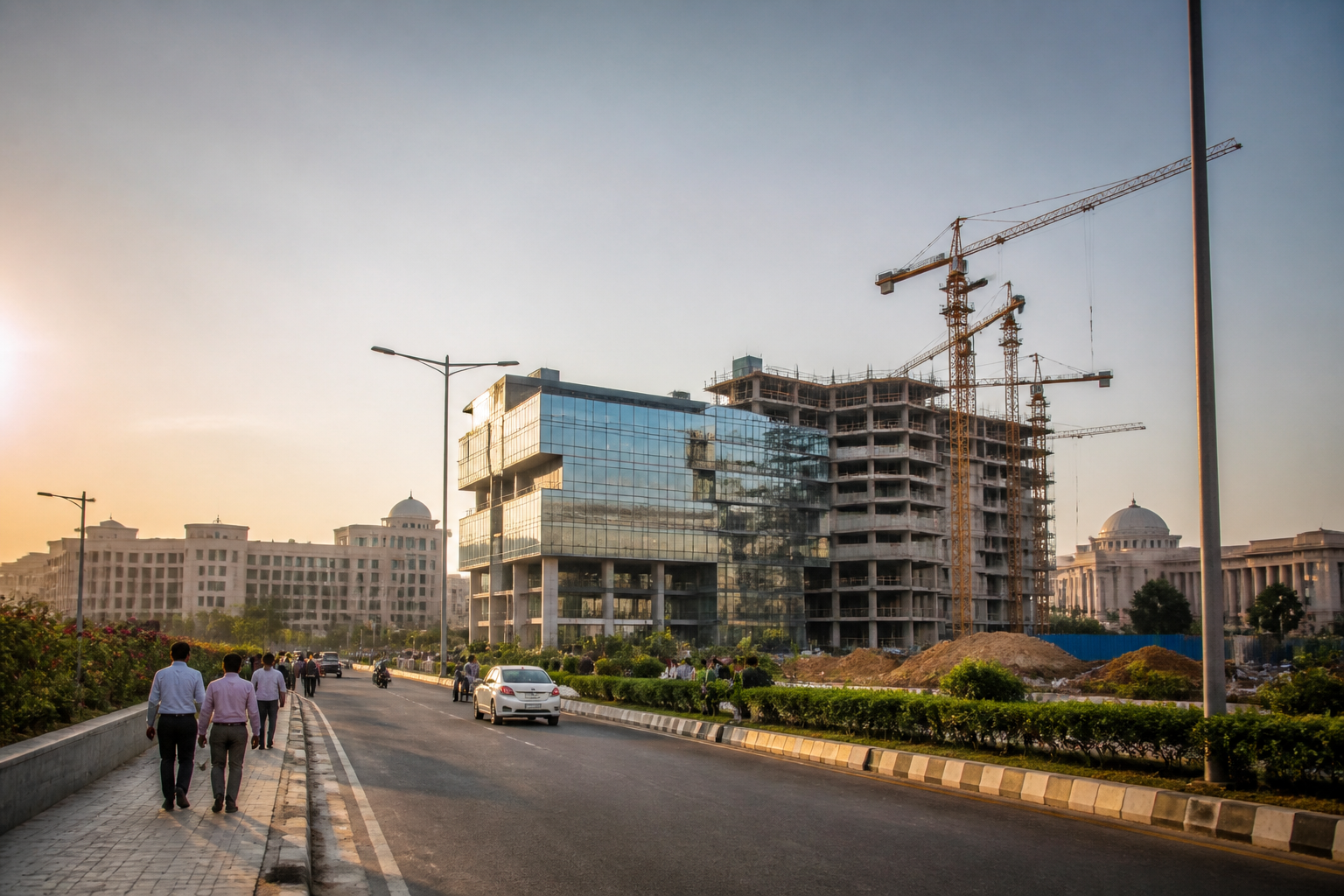
The proposed Ranchi IT park is being presented as a major shift in Jharkhand’s urban and economic ambitions: a technology hub that could attract global companies, create up to 75,000 jobs and place the state more firmly in India’s expanding Global Capability Centre economy. But the announcement also places the focus on a less visible challenge. Delivering such an employment centre will require more than office buildings. It will depend on land assembly, digital infrastructure, mobility, institutional coordination and the ability to create a reliable business environment around a site that is still under consideration.
The project was discussed during a meeting between Jharkhand chief minister Hemant Soren and Deepak Chhabria, president of RMZ Infrastructure. According to the report, the proposed IT park is expected to come up by 2029, with an initial phase generating around 20,000 jobs. Its capacity could rise to nearly 75,000 employment opportunities over the following three years. Authorities are considering an approximately 100-acre site near IIM Ranchi, the new assembly complex and the Jharkhand high court complex.
That location would place the proposed technology district within a significant institutional cluster. IIM Ranchi, the assembly complex and the high court complex represent education, government and judicial functions in the city’s emerging urban geography. The source report does not establish that the site has been finally allotted or that construction has begun. It describes the land as under consideration, making the project a proposal at the planning and investment-discussion stage rather than an operational development.
The distinction matters because large employment projections often begin with a land and investment proposition but become urban projects only when supporting systems are defined. In this case, the proposed park is expected to provide modern office space and advanced digital infrastructure for global technology companies. The supplied report does not provide a project cost, a detailed master plan, a confirmed developer agreement, a construction schedule, a financing structure or a formal list of firms that have committed to locate there.
The employment numbers indicate the scale of the ambition. Around 20,000 jobs are associated with the first phase, while the total could reach nearly 75,000 over the subsequent three years. These figures suggest a staged expansion rather than an immediately available employment centre. They also mean that the park’s eventual footprint cannot be considered separately from the city systems required to support a large daily workforce. The source material, however, does not specify the expected built-up area, transport capacity, housing requirements or the number of workers likely to be recruited from within Ranchi and the wider state.
The Global Capability Centre model gives the proposal a broader economic purpose. Under the model described in the report, international companies could operate core functions in information technology, artificial intelligence, semiconductors and nuclear energy from Jharkhand. Such centres are not limited to back-office activity in the description provided. They are presented as potential bases for specialised functions and future technologies, linking the proposed park to the state’s larger attempt to attract investment in high-skill sectors.
The same meeting also covered potential investments in information technology, artificial intelligence, semiconductors, manufacturing, nuclear energy and digital infrastructure. At this stage, the report does not identify firm commitments in each of these sectors. It records a wide investment conversation around the IT park and the state’s technical and industrial sectors. The breadth of the discussion shows the government’s intended direction, but it does not yet establish which projects will materialise, when they will be implemented or how they will be financed.
For Ranchi, the proposed park could change the relationship between employment and urban development. A technology district near major public institutions may create demand for offices, housing, education, retail, hospitality and local services. It may also increase daily movement towards the area and raise the importance of roads, public transport, pedestrian access, power reliability and high-capacity telecommunications. None of these supporting requirements is detailed in the supplied report, but they are part of the practical planning questions raised by a project of the stated scale.
The land question is therefore central. An approximately 100-acre site is substantial in a city context, particularly when the location is close to major institutional facilities. The eventual development would need to reconcile the requirements of a technology campus with the surrounding public and administrative uses. The source does not say whether the land is government-owned, privately held, already serviced or subject to any acquisition, zoning or environmental process. Those details will determine how quickly a proposal can move from discussion to implementation.
The state government’s institutional response is currently focused on studying models elsewhere. A state IT delegation is expected to visit Bengaluru to examine IT parks, Global Capability Centres and investment models. That visit could help officials understand how technology districts are planned and marketed, but the report does not provide its date, terms of reference or expected recommendations. It does show that Jharkhand is looking beyond a single real-estate project and is considering the administrative and investment structures needed to build a technology ecosystem.
Chief minister Hemant Soren said the government was working to build “a robust and modern IT and technology ecosystem that integrates Jharkhand with future technologies and new industrial possibilities”. The statement defines the policy objective in broad terms. The practical test will be whether the proposed ecosystem can connect land, infrastructure, skills, investment facilitation and long-term operations into one implementable framework.
The skills dimension is especially important because the stated employment target is concentrated in high-technology sectors. The report refers to high-skilled employment but does not provide a training plan, a skills assessment or details of partnerships with universities and technical institutions. IIM Ranchi’s proximity is part of the location context, but the supplied material does not establish any formal role for the institute in the project. Whether local education and training systems can supply the required workforce remains an open question.
The proposal also raises questions about the distribution of economic gains. A major IT park could create direct employment within the campus and indirect opportunities in transport, maintenance, food services, housing and other urban activities. At the same time, a large concentration of high-value offices can create new pressure on land and services around the site. The report does not contain projections on housing demand, rents, commuting patterns or local business participation, so the social and spatial effects cannot yet be quantified.
By setting 2029 as the target for the park, the government has attached the proposal to a defined time horizon. Yet the sequence between now and that target is not described in the available material. There is no information on a final site decision, statutory approvals, tendering, construction phases, anchor tenants or utility commitments. These are not minor administrative details; they are the milestones that would show whether the employment promise is moving from an announcement into a deliverable urban programme.
The project’s significance, therefore, lies in both its potential and its present uncertainty. Ranchi is being positioned as a possible technology and investment centre, while the proposed site near key institutions could become a new employment node in the city. But the evidence currently confirms a government-industry discussion, a broad investment objective, a possible location, a target year and projected job numbers. It does not yet confirm a final land allotment, a signed development agreement, committed companies or a construction start.
The next developments to monitor are the outcome of the Bengaluru study visit, the decision on the approximately 100-acre site, the structure of the proposed partnership with RMZ Infrastructure, and any formal project plan setting out investment, infrastructure and implementation responsibilities. Those steps will determine whether Ranchi’s 75,000-job IT park becomes a functioning technology district or remains an ambitious proposal awaiting the institutional framework needed to build it.
