


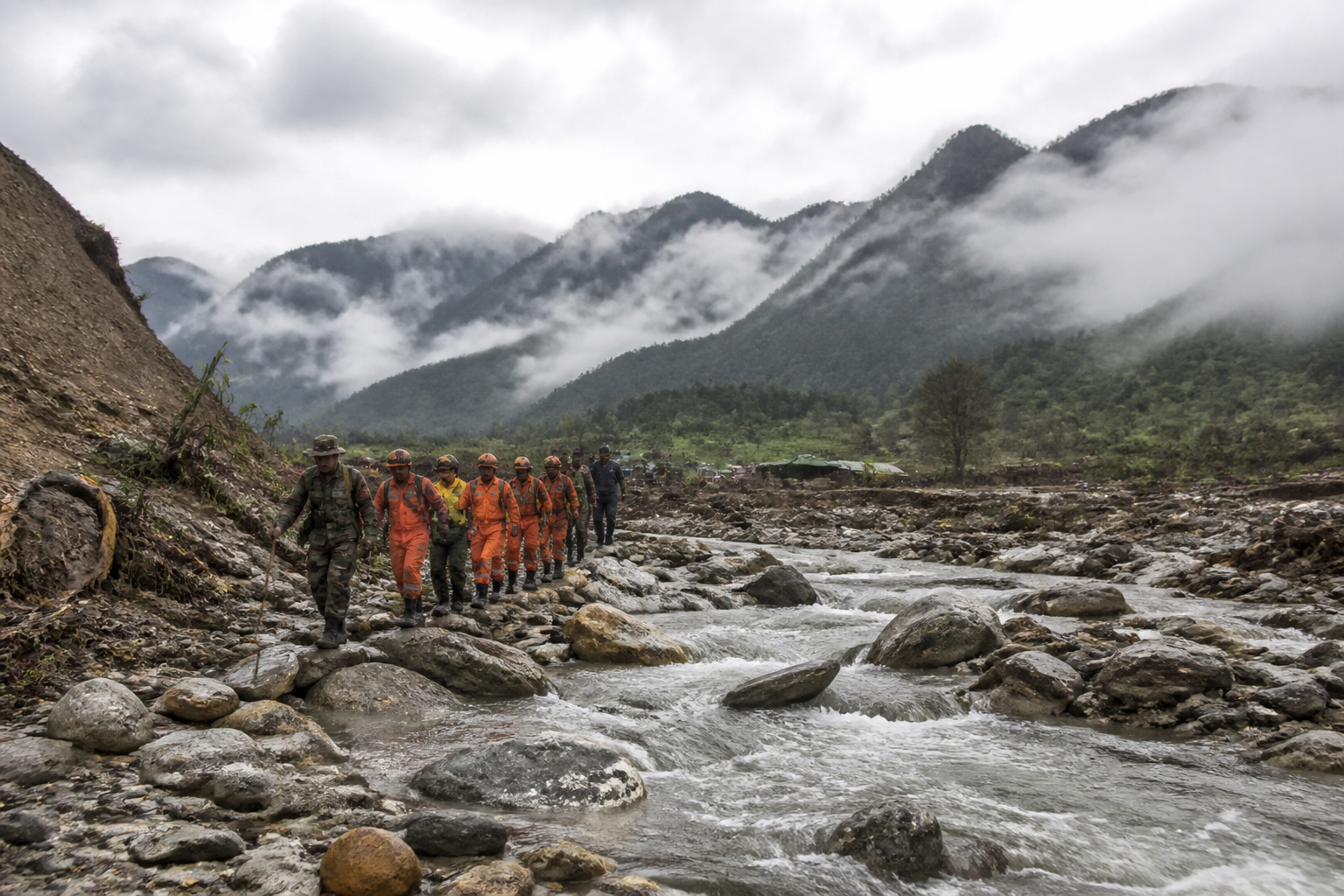
More than six weeks after a cloudburst triggered landslides and flash floods in Arunachal Pradesh’s Dibang Valley, the disappearance of Army havaldar Upendra Yadav has become a case study in what happens after the immediate disaster has passed but its consequences remain unresolved. Three bodies have been recovered from the Pasu Pani area, while Yadav and another soldier remain untraced. For the family in Azamgarh waiting for information, the emergency has not ended.
Yadav, 38, of the 5th Grenadiers, was on active duty at Pasu Pani when the cloudburst struck at about 4.30pm on August 14. The sudden deluge swept away Army shelters and left five personnel missing. Rescue teams from the Army, the Indo-Tibetan Border Police and local emergency services recovered three bodies, but the search for the two remaining soldiers has continued in riverbeds and rugged terrain.
The incident illustrates the particular difficulty of disaster response in remote mountain districts. In such locations, the first phase of an emergency involves reaching affected personnel and communities through difficult terrain. The next phase is more complex: sustaining search operations, identifying recovered bodies, communicating with families and establishing a clear account of what happened. The available account shows that the search has continued, but it also shows that the family still lacks a definitive update.
At Mohammadella village in Azamgarh, Yadav’s relatives have been waiting for information rather than receiving closure. His 24-year-old nephew, Anurag Yadav, said Subedar Major Sanjay Chauhan had been regularly updating the family about the search operations. The family, however, is seeking a clearer account of the incident and wants the search to continue. Their public appeals and poster campaigns reflect the difficulty families face when information remains incomplete for an extended period.
The difference between an ongoing search and an adequately communicated search is important. Search teams may be working in dangerous riverbeds and rugged terrain, but families also need regular, specific information about the area being searched, the resources deployed, the evidence recovered and the next operational steps. The report does not establish that such information has not been generated internally. It does establish that the family continues to seek a definite answer and that attempts to obtain an official update from defence authorities were unsuccessful.
That communication gap is not a peripheral issue in disaster management. It affects how families understand risk, how they assess the credibility of official efforts and how they decide whether to seek public support. In Yadav’s case, relatives turned to social media appeals and poster campaigns to draw attention to the disappearance. Such campaigns can help maintain public focus, but they also indicate that the family does not consider existing channels sufficient to resolve its uncertainty.
The operational facts are stark. Five Army personnel were reported missing after the flash floods. Three bodies have been recovered, while two soldiers, including Yadav, remain untraced. The incident occurred in Pasu Pani, in the Dibang Valley, an area where the search has had to contend with difficult riverbeds and rugged terrain. The response has involved the Army, the Indo-Tibetan Border Police and local emergency personnel, bringing together defence, central security and local emergency capacities.
The available information does not provide details of the search equipment, the precise area covered, the frequency of family briefings or the formal status of the operation. It also does not establish whether the search has been expanded, reduced or placed under a defined review process. These omissions matter because the status of a missing person after a major flood is not only a rescue question. It is also a documentation, identification and institutional accountability question.
The episode points to a broader challenge in disaster governance: response systems are often measured by visible early action, while the prolonged aftermath receives less public attention. The first images from a flood typically show inundated areas, damaged shelters and rescue teams. Weeks later, the central public concern may be less visible. It may involve missing persons, family support, body recovery, compensation procedures, records and explanations. These tasks require sustained coordination even after the immediate floodwaters have receded.
In this case, the institutional chain is identifiable but the public communication chain appears less clear. The Army and the Indo-Tibetan Border Police were involved in the search, and a senior officer of the 5th Grenadiers reportedly declined to speak because he was not authorised to address the media. Calls and messages to the defence public relations officer in Tezpur went unanswered. The absence of an on-record update does not prove that operations have stopped, but it leaves a significant information gap around an event involving active-duty personnel.
That gap is particularly consequential because the family is located far from the disaster site. The relatives in Azamgarh cannot directly observe the terrain, meet search teams or verify operational developments. Their understanding depends on communication from the institutions involved. Regular briefings therefore become an essential part of the response, not merely a public relations exercise.
The incident also shows why mountain disaster preparedness cannot be separated from personnel safety and infrastructure access. The cloudburst struck an Army position in a remote valley, swept away shelters and disrupted the physical conditions needed for rescue. The source report does not provide details about shelter design, warning systems, communications infrastructure or access routes, so no conclusion can be drawn about whether any particular preventive measure failed. But the sequence demonstrates how quickly intense rainfall, landslides and flash flooding can transform a functioning outpost into a search zone.
For authorities, the next steps are therefore both operational and communicative. Search teams must continue working in the difficult terrain described in the report, while the family requires a clear account of the search and any developments concerning Yadav and the other missing soldier. The response also requires a formal record of the three recovered personnel, the circumstances of the flood and the status of the remaining search. None of these outcomes can be assumed from the information currently available.
The Arunachal flash floods have passed as a breaking event, but their institutional aftermath remains active. The case confirms that three bodies were recovered and two soldiers remain untraced after the August 14 disaster. It also confirms that Yadav’s family is still waiting for definitive information and that attempts to obtain an official update were unsuccessful. What remains unclear is the current operational status of the search and the timeline for a formal account. Those are the developments that warrant continued monitoring.
