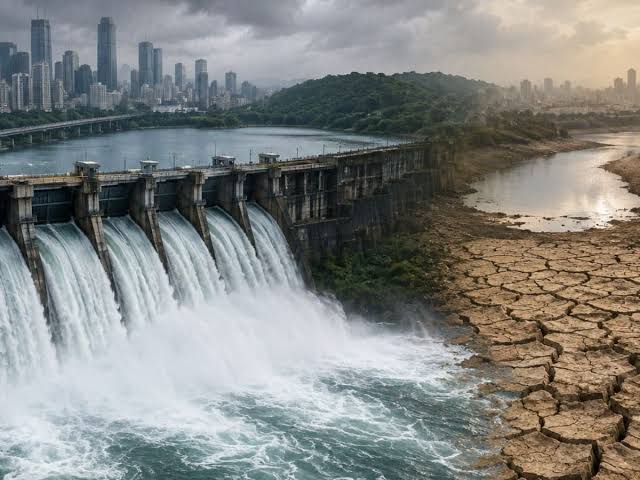
Mumbai Water Scarcity Raises Fresh Reservoir Management Concerns
Mumbai’s water security is facing renewed pressure despite substantial reservoir stocks, with the civic administration warning that its seven water-supplying lakes must be managed conservatively amid Maharashtra’s drought conditions. The Brihanmumbai Municipal Corporation says the existing stock is being planned to last into 2027, keeping the city’s 10% water cut in place as officials prepare for higher evaporation and uncertain rainfall.
Mumbai depends primarily on seven lakes — Tulsi, Vihar, Tansa, Modak Sagar, Bhatsa, Upper Vaitarna and Middle Vaitarna — for its drinking-water supply. Current combined storage is around 96.64% of capacity, slightly below last year’s 97.57%. Despite the relatively high level, the BMC has warned that continued drought conditions and rising temperatures could increase evaporation and reduce the effective water buffer. The situation illustrates why Mumbai water scarcity cannot be assessed only by looking at reservoir levels on a single date. The city has to carry sufficient reserves through the dry months before the next substantial monsoon recharge. Maintaining a safety margin becomes more important when rainfall is uneven and prolonged dry periods can increase both demand and evaporation. Mumbai’s dependence on rainfall-fed reservoirs also creates a structural vulnerability. The city has limited conventional freshwater sources outside its lake system, while underground water is constrained by the high salinity associated with its coastal geography. Earlier this year, the BMC introduced a 10% reduction in supply after forecasts pointed to a below-normal monsoon and concerns about rapidly depleting reserves.
The crisis also exposes a second layer of water-security risk: the capacity and condition of the reservoirs themselves. A civic review earlier this year noted that Mumbai’s seven supply lakes had not undergone desilting since 2015, although engineering assessments indicated only a marginal reduction in storage capacity at the lakes examined. For Mumbai water scarcity, therefore, conservation cannot rely solely on asking households to reduce consumption. Supply planning needs to combine reservoir protection, catchment management, leakage reduction, demand management and additional sources of water. The city has already been examining alternatives. Plans for additional treatment capacity and projects such as desalination and new water infrastructure could eventually reduce dependence on the existing reservoir system. But these projects require substantial investment and long implementation periods, making demand management essential in the interim. The broader regional picture adds urgency. Maharashtra has declared drought across 265 of its 358 tehsils after an 18% monsoon rainfall deficit, while national reservoir storage has also fallen below the recent long-term average.
Mumbai’s immediate challenge is consequently one of managing abundance carefully rather than waiting for scarcity to become visible at the tap. Maintaining reserves through the next dry season, diversifying supply sources and reducing avoidable losses will determine how resilient the city remains as rainfall patterns become less predictable.