


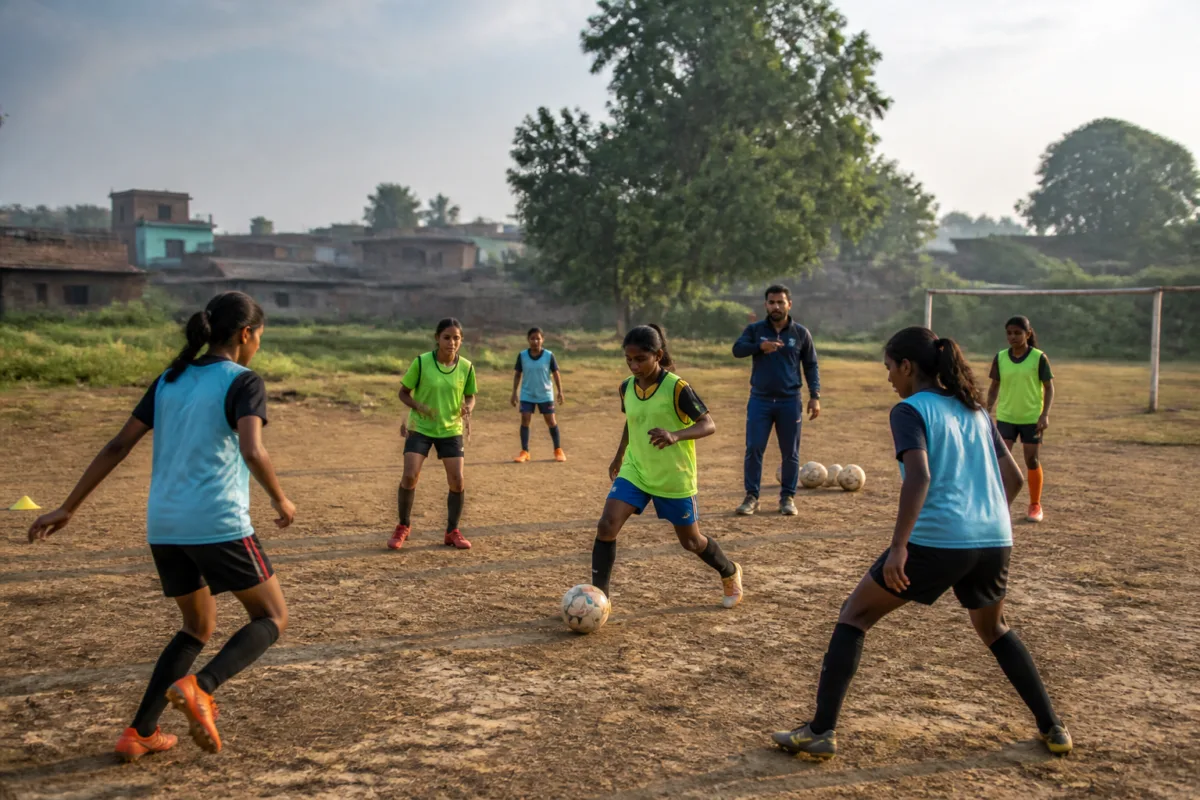
A football academy in Ranchi’s Kanke block is doing more than preparing girls for matches. By combining free coaching, schooling support and sustained engagement with families, coach Anwarul Haq’s initiative is creating an alternative to the social and economic pressures that can push girls towards leaving school and marrying early. Its progress also exposes a familiar weakness in urban and rural public systems: talent can be developed through community effort, but the basic infrastructure needed to sustain it remains absent.
Haq began training girls in Chardi village in 2021 after noticing a difference between students at the government residential girls’ school where he worked part-time as a sports teacher and girls in his own village. The school students, he said, came from poor economic backgrounds but had visible talent and aspirations. Many girls in the village, by contrast, lacked direction and were married early by their families.
The distinction is important because it places sport within a wider chain of opportunity. Football is not presented as an isolated extracurricular activity. It is being used to keep girls connected to school, build confidence, create a structured daily routine and give them access to a possible career path. Haq also tutors the girls in the evenings, arguing that sporting achievement alone cannot secure their future.
The academy now trains about 150 girls free of cost, including two from neighbouring West Bengal. Twenty girls have played in national-level matches over the past five years, according to the report. Divyani Linda has represented India at the SAFF Under-19 Women’s Championship, providing the most prominent example of how a village-level programme can connect to national competition.
These outcomes matter because access to sport depends on more than ability. Families must permit girls to attend training, schools must remain part of their lives, and there must be a safe and usable place to practise. Haq’s account shows that each of those conditions has required persuasion and personal effort rather than a clearly established institutional pathway.
When the programme began, he had only four girls. He said some parents objected to their daughters wearing shorts, while others needed repeated visits and requests before they agreed to send them for training. The gradual expansion to 150 participants indicates that attitudes changed as families saw benefits in the programme. It also shows the significance of trust at the local level: a coach who works with families and supports education can become an intermediary between households, schools and sporting institutions.
The choice of football was partly practical. Haq selected it because it required limited equipment and was less expensive than several other sports. That decision reflects the economics of access. A programme does not need a large budget to begin, but sustaining participation at scale requires more than footballs and coaching. It requires grounds, travel arrangements, equipment, coaching time, education support and links to competitive opportunities.
The academy’s main limitation is its lack of a dedicated ground. Training takes place without a permanent facility, and Haq said repeated approaches to officials had not resulted in government assistance. The gap is not simply an inconvenience for a sports programme. A dedicated ground would provide a stable physical base for training, reduce dependence on the availability of shared spaces and give the academy a more durable presence in the community.
This is where the story becomes an institutional question. The academy has demonstrated demand, participation and measurable sporting outcomes, but the report does not identify a formal public funding arrangement, municipal partnership or government programme supporting it. The absence of such support leaves the initiative dependent on the coach’s unpaid or under-resourced labour and on the continued willingness of families to participate.
That dependence creates a familiar pattern in the development of community facilities. Individuals often identify a local need before institutions do. They assemble participants, negotiate with families and provide services with limited resources. Once results become visible, the programme may attract recognition, but recognition does not automatically produce land, maintenance budgets, equipment or administrative support. The Kanke academy’s experience illustrates the distance between social value and institutional backing.
The available numbers show both achievement and scale. About 150 girls are currently receiving free coaching, while 20 have appeared in national-level matches over the past five years. One participant has reached an India Under-19 team. These figures do not establish a complete measure of the academy’s impact, and the report does not provide details on retention in school, household income, the age profile of participants or the number of girls who continued training over time. But they do establish that the programme has moved beyond a small recreational activity.
The numbers also need to be read alongside the infrastructure deficit. A programme serving 150 girls cannot be assessed only through the success of its most accomplished player. Its wider value lies in the routine opportunities it provides to all participants: regular physical activity, peer networks, contact with a mentor and continued connection to education. The report’s account of evening tutoring suggests that the academy is functioning as a support structure rather than only as a training centre.
At the same time, the evidence does not show that football alone prevents early marriage or guarantees a career. Haq’s intervention operates within families, schools and local social conditions that the report describes but does not quantify. Its contribution is more precise: it offers girls an organised alternative, keeps education in view and creates a route towards competitive sport for some participants.
The policy landscape implied by the story is therefore broader than sports administration. The programme sits at the intersection of girls’ education, gender equity, youth development, community recreation and local infrastructure. Responsibility for these areas may be distributed across different institutions, but the academy’s needs are integrated. A coach may be able to provide training and tutoring, yet cannot by himself supply a permanent ground or establish formal pathways to public assistance.
The report does not specify which authority controls the land or playgrounds used in the area, what applications Haq submitted, or why previous requests did not produce support. Those details would be necessary to determine whether the problem is a shortage of public land, an administrative gap, inadequate funding, or the absence of a programme designed for community-level women’s sport. The available evidence establishes the need but not the precise institutional failure.
That limitation is itself significant. Local initiatives are often visible through personal stories and individual achievements, while the administrative record behind their infrastructure needs remains less visible. A more complete account would track the academy’s attempts to secure assistance, identify the relevant authorities and examine whether existing sports, education or rural development schemes can support such facilities.
For cities and expanding urban regions, the question is also about how opportunity is distributed beyond formal stadiums and elite academies. Kanke’s villages are not described as having access to a dedicated facility for these girls, yet the programme has produced participation at national level. This suggests that sporting potential can exist well outside established urban institutions. Without accessible grounds and sustained support, however, the burden of converting potential into opportunity remains with families and individual organisers.
Haq’s academy does not prove that a single intervention can resolve early marriage, educational disadvantage or gender inequality. It does show how a modest, locally rooted programme can connect several public goals at once. The girls’ participation, the academy’s national-level results and the coach’s education support provide evidence of what community action can achieve. The lack of a dedicated ground and government assistance shows the point at which community initiative alone reaches its limits.
The next question is not whether the academy has produced enough success to deserve attention. The reported outcomes already make that clear. It is whether the institutions responsible for local land, sport, education and youth development will recognise such programmes as part of essential community infrastructure rather than as isolated personal projects. The available report confirms the academy’s progress and its unmet need; it does not establish what official action, if any, will follow.

