


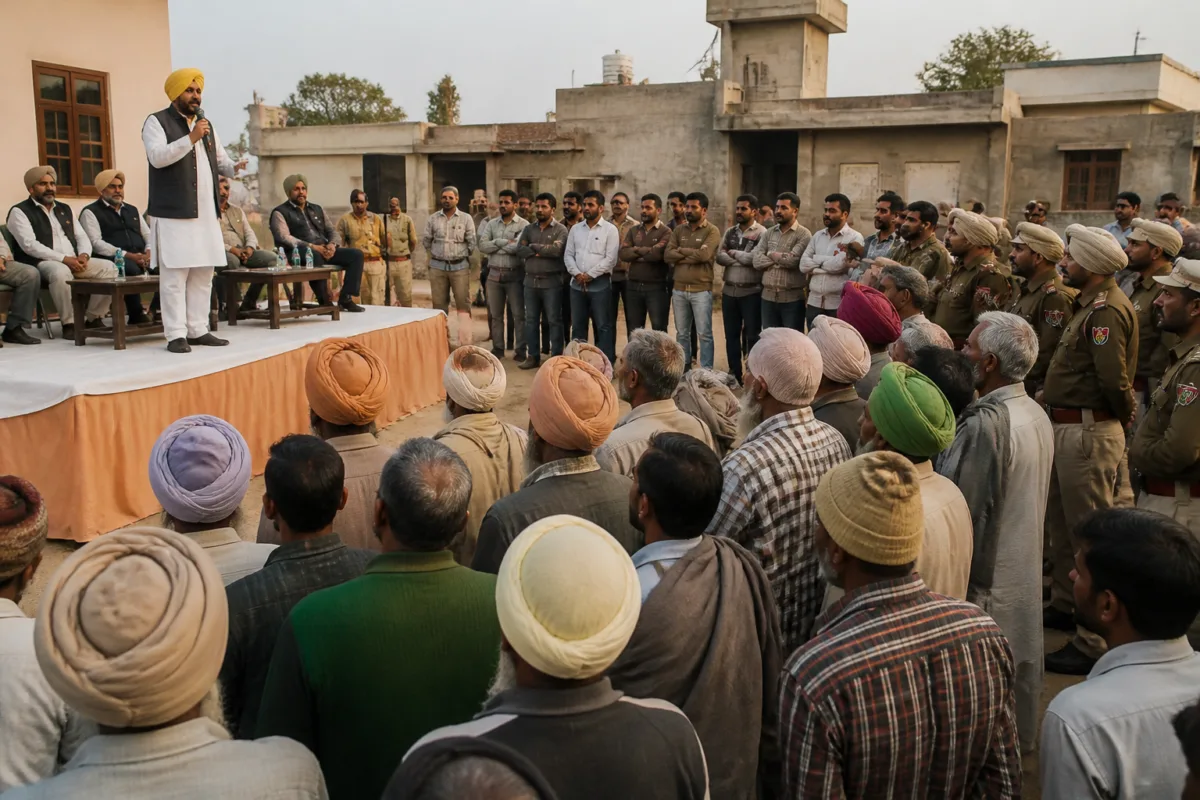
A public confrontation in Tolawal village, near Sunam in Sangrur district, has turned a local complaint about heroin sales into a wider test of Punjab’s anti-drug governance. The incident brought together three unresolved questions: whether residents can safely report drug activity, whether the police response is strong enough to produce sustained enforcement, and how much responsibility the state can place on communities when the formal criminal justice system remains central to the outcome.
The confrontation took place during a public function at which cabinet minister and Aam Aadmi Party state chief Aman Arora was distributing property ownership documents to beneficiaries of the Punjab government’s Mera Ghar Mere Naam scheme. Nihang Sikh youth Gurpreet Singh Goldy approached the stage and alleged that “chitta”, a local term for heroin, was being sold openly, comparing its availability to the sale of toffees. Other residents supported his intervention and questioned the village sarpanch about drug trafficking and a rise in thefts, according to the Times of India report.
Arora’s response revealed the government’s stated approach to the problem. He said the police and administration could not eradicate drug abuse without active community participation. He also pointed to what he described as a cycle in which residents of neighbouring villages stood as bail guarantors for people arrested for drug peddling, enabling them to secure release. He urged villagers to take a collective oath not to stand as guarantors for those accused of drug trafficking and asked residents to support local anti-drug committees.
The minister directed the deputy superintendent of police present at the event to investigate the allegations and submit a report. Sunam DSP Harsimran Singh told the newspaper that he would check whether any deaths from drug overdoses had been reported in the village and whether suspected smugglers had been booked there. He also said no formal information had been received from Goldy at that point and that a cordon and search operation, or CASO, would be launched in villages across the Sunam subdivision.
This sequence is significant because it shows how an allegation moves through the state system. A resident raises a public complaint. A minister orders a police inquiry. The local police seek to establish whether there are recorded deaths, previous cases or formal complaints. An enforcement operation is then proposed. Each step depends on a different institution, and each produces a different measure of success. A public accusation may generate immediate political attention, but a police case requires evidence, a documented complaint, investigation and subsequent legal process.
The exchange also illustrates the limits of treating the drug crisis only as a policing problem. Police searches and arrests may be necessary, but they do not by themselves answer why residents believe drugs are openly available, why families may hesitate to approach the authorities, or why people accused of trafficking are able to return to their communities after securing bail. The minister’s appeal to residents acknowledges that local networks influence enforcement. At the same time, shifting part of the burden to villagers raises a practical question: what protection, legal guidance and institutional support do communities receive when they provide information or refuse to assist accused persons with bail?
The supplied report does not establish whether the allegations made at Tolawal are true, how many people may be involved, or whether heroin is being sold openly in the village. The DSP’s statement makes clear that these questions remained subject to verification. It also indicates that the authorities had not received formal information from the individual who raised the complaint when he spoke at the event. The proposed inquiry and CASO are therefore important not as proof of the allegations, but as the next official steps in determining whether the claims correspond to recorded offences or other evidence.
The administrative setting adds another layer. Arora was touring eight villages in the Sunam constituency to distribute ownership letters to 2,256 families under the Mera Ghar Mere Naam scheme. A programme focused on property rights and household security became the setting for a confrontation over public safety and addiction. That shift is not incidental. Property ownership, livelihoods, family stability and public order are closely connected in rural settlements. When residents raise drug-related concerns during a government event, they are using a visible administrative platform to demand attention to a problem that affects more than law enforcement statistics.
The incident also follows a series of public challenges to the state’s handling of drugs in Sangrur district. Two months earlier, anti-drug activist Mohanjit Singh Sheron protested from a rooftop during Chief Minister Bhagwant Mann’s Lok Milni event in the district. According to the report, he waved a black flag and alleged that heroin was being sold openly. He later alleged illegal detention and police torture, including electric shocks and physical assault. Those allegations led to interventions by the National Human Rights Commission and political leaders. The supplied material does not state the outcome of those interventions, leaving the accountability question unresolved.
Another incident cited in the report involved Gulzar Singh, a 47-year-old Dalit labourer from Sangrur district, who died by suicide on September 7 after allegedly facing harassment for publicly questioning a state minister. The report says his death triggered a political outcry, but it does not provide a final official finding on the alleged harassment or establish a direct connection to the drug trade. More recently, the broad daylight murder of anti-drug activist Parvinder Singh Jhota was cited as another sign of growing frustration and grassroots resistance. The circumstances and official investigation into that killing are not detailed in the supplied material.
Together, these episodes show that the drug crisis has become a question of institutional trust as much as enforcement. Residents are not only asking whether the police can arrest peddlers. They are also asking whether complaints will be recorded, whether activists will be protected, whether allegations of police misconduct will be independently examined and whether government promises can be tested against conditions in individual villages.
The political response has further widened the dispute. Shiromani Akali Dal president Sukhbir Singh Badal criticised the government after the video of the confrontation went viral, noting that Tolawal is around 1.5 kilometres from Chief Minister Bhagwant Mann’s native village, Satauj. Haryana Chief Minister Nayab Singh Saini also attacked the AAP government and linked the confrontation to public anger over unfulfilled promises and the drug crisis. These statements are political claims, not independent findings about the situation in Tolawal, but their circulation shows how local drug allegations quickly become part of a larger contest over governance in Punjab.
Arora defended the AAP government’s record and said no serving minister or MLA was linked to the drug trade, unlike in previous regimes. That statement addresses political accountability, but it does not resolve the operational questions raised by residents. The relevant test for the administration will be whether the investigation establishes facts, whether offences are registered where evidence supports them, whether search operations follow due process, and whether the authorities report their findings publicly.
The government’s proposed response has two distinct parts: community mobilisation and police action. The appeal for local anti-drug committees and collective refusal to stand as bail guarantors seeks to make villages part of the enforcement chain. The proposed CASO represents the coercive arm of the state. The effectiveness of this combination will depend on how responsibilities are divided. Communities can provide information and social support, but investigation, evidence collection, arrest procedures, prosecution and protection of witnesses remain functions of the formal justice system.
The case also highlights a measurement problem. The minister asked residents to consider their role in enabling accused persons to obtain bail, while the DSP said he would check overdose deaths and previous bookings. These are different indicators: community behaviour, health consequences and criminal cases. None alone captures the full scale of the problem. The report does not provide figures for drug seizures, arrests, convictions, overdoses, treatment access or the number of anti-drug committees in the affected villages. Without such information, the public cannot assess whether official action is reducing supply, improving safety or merely producing periodic enforcement campaigns.
For residents, the immediate issue is whether the promised follow-up will be visible beyond the public event. The DSP said he would examine available information and initiate a CASO across villages in the Sunam subdivision. The next verifiable developments are therefore the police report, any formal complaint from the residents, the outcome of the search operations and any cases registered. These steps will determine whether the confrontation produces institutional action or remains another viral episode in Punjab’s continuing drug debate.
The Tolawal incident confirms that Punjab’s drug crisis cannot be understood through political speeches or isolated arrests alone. It is simultaneously a public-health concern, a policing challenge, a test of community protection and a measure of confidence in local administration. The evidence supplied in the report establishes the confrontation, the official responses and the history of similar public protests, but not the truth of every allegation. That distinction matters. The credibility of the government’s response will depend on transparent verification, due process and whether residents see sustained action after the cameras and political delegations move on.

