


The delayed cremation of anti-drug activist Parvinder Singh Jhota, who was shot dead in Mansa while livestreaming a confrontation over the alleged sale of banned pharmaceuticals, has turned a local murder into a wider test of Punjab’s public safety and enforcement systems. The case has moved from a street-level dispute to a CBI investigation after protests and political intervention, but the sequence also shows how citizens can be pushed into policing failures when formal institutions are seen as ineffective.
Jhota, 42, was killed on October 13 in a market in Mansa, according to the Times of India report. He had been livestreaming a confrontation with a local pharmacy owner over the illegal sale of banned pharmaceuticals when he was shot. His body was cremated 26 days later at family-owned fields on the outskirts of Mansa. The delay was not presented as a routine family decision. It followed protests, a hunger strike by his father and demands for action against local officials.
The case therefore has two distinct dimensions. The first is the criminal investigation into the killing. The second is the public response to the alleged availability of narcotics and restricted medicines in a town where an activist was attempting to expose the issue publicly. The two are connected because the credibility of the investigation will influence whether residents believe the state can protect people who raise concerns about illegal drug sales.
The transfer of the murder investigation to the Central Bureau of Investigation followed widespread protests and a visit by Union home minister Amit Shah on October 20. The report does not provide details of the CBI’s findings, arrests, charges or investigation timetable. That absence is important. A change in investigating agency can signal that the existing process has lost public confidence, but it does not itself establish guilt, administrative failure or the final cause of the killing.
Jhota’s family and supporters linked the case to demands for greater accountability from the local administration. His father, Bhim Singh, undertook a two-day hunger strike demanding the transfer of Mansa SSP Vaibhav Chaudhary. He ended the fast after an appeal by five Singh Sahibs. The report records these developments as part of the protest surrounding the case, but does not state whether the SSP was transferred or whether any departmental action followed.
That distinction matters for understanding governance. Public anger often focuses on the most visible local official after a serious crime, but institutional responsibility is distributed across the police, district administration, health and pharmaceutical regulators, prosecution agencies and the courts. The report identifies the alleged confrontation over banned pharmaceuticals and the subsequent murder investigation, but it does not establish how the medicines entered the market, whether earlier complaints had been filed, or which agency was responsible for acting on them.
The story also exposes the limits of treating narcotics enforcement only as a policing problem. Illegal or unauthorised pharmaceutical sales sit at the intersection of criminal law, drug regulation, public health and local commerce. A pharmacy or medicine market can operate within the everyday economy of a town, making enforcement dependent on inspections, licensing records, supply-chain monitoring and police action. When these systems do not work together, citizens may encounter the consequences as addiction, unsafe medicines, intimidation or violence without knowing which authority is expected to intervene.
The supplied report does not provide data on drug seizures, pharmacy inspections, prosecutions, overdose cases or treatment access in Mansa or Punjab. It also does not establish whether the alleged sale involved narcotic drugs, psychotropic substances, prescription medicines or another category of banned pharmaceutical. That gap prevents a broader quantitative assessment of the drug market described by Jhota’s family and supporters. It does, however, make clear that the issue had enough public resonance to trigger protests and a change in the agency investigating the murder.
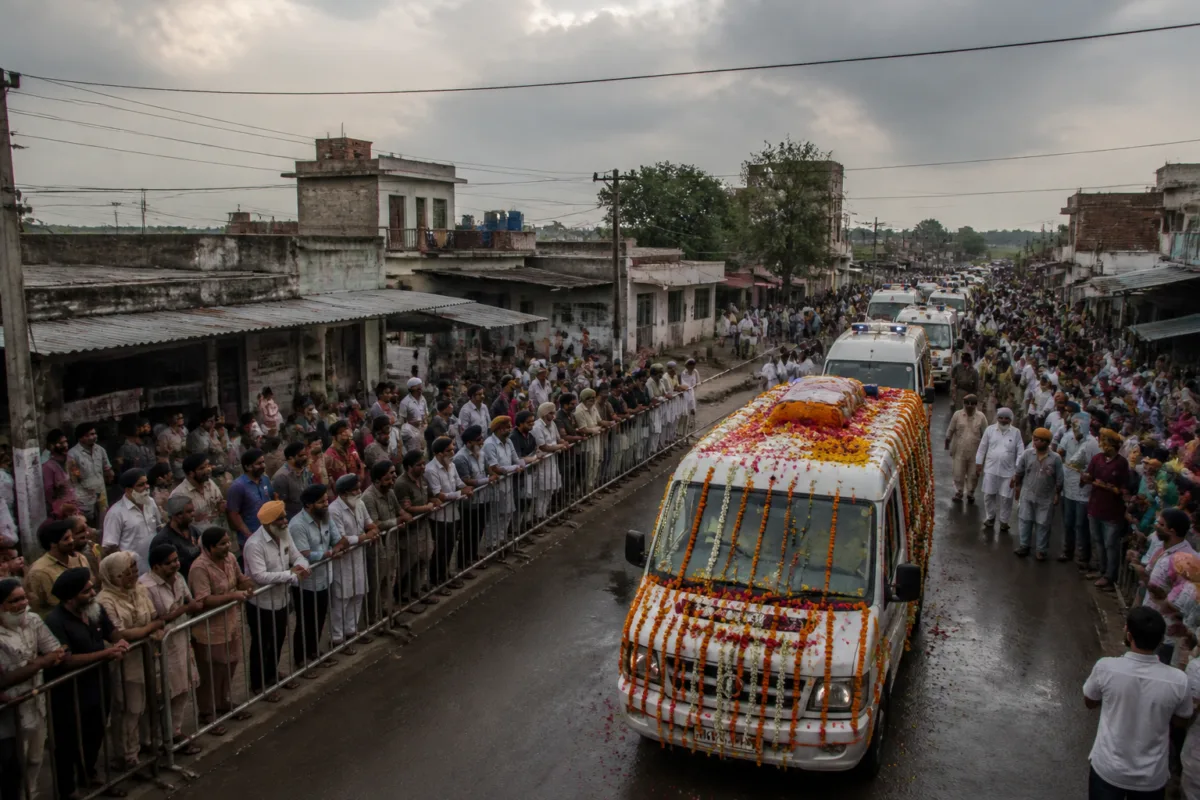
The location is relevant to the institutional question. Mansa is not described merely as the site of a homicide; it is the setting for a procession, a protest site and a public campaign against narcotics. The body was brought from PGIMER, Chandigarh, in a flower-decked ambulance and taken first to the protest site before being moved to Jhota’s home. People paid tribute at multiple points along the route, while petals were showered from a paraglider. These details show how the funeral became a public civic event rather than a private ceremony.
That transformation has consequences for urban and regional governance. In smaller cities and towns, public spaces such as markets, protest sites, roads and religious institutions become the places where institutional trust is displayed or contested. A murder connected to an alleged enforcement failure can quickly reshape how residents use those spaces. Markets may be viewed as unsafe, demonstrations may become the main channel for demanding action, and religious or community leaders may assume a mediating role when administrative mechanisms are not trusted.
Bhim Singh called on people to continue Jhota’s campaign against narcotics after lighting the funeral pyre with Jhota’s two sons. A memorial service is scheduled for November 15 at Gurdwara Sulisar Sahib in Kot Dharmu, 13 kilometres from Mansa, according to the report. The continuation of the campaign means the case is unlikely to end with the cremation. Its future significance will depend on whether the investigation produces publicly credible findings and whether authorities address the wider concerns raised by the family and supporters.
The handover to the CBI also illustrates the political and administrative pressures surrounding high-profile local cases. The decision followed protests and the Union home minister’s visit, rather than being described as the result of a routine investigative review. This does not prove that the earlier investigation was inadequate. It does show that public confidence can become a factor in determining how a case is handled, particularly when the victim is seen as having challenged a visible social problem.
For residents, the key issue is not only who fired the shots. It is whether people who report or confront illegal activity can do so without being exposed to unacceptable risk, and whether the state has mechanisms that make private citizens feel they do not need to become investigators themselves. The report does not say that Jhota had been formally designated as a complainant, informant or public authority. It records that he was livestreaming a confrontation, a fact that highlights the risks of direct citizen intervention when institutional enforcement is perceived as slow or absent.
The evidence currently supports a narrower conclusion than the public rhetoric around the case may suggest. Jhota was killed during a livestreamed confrontation; protests followed; the murder investigation was transferred to the CBI; his father demanded action against the local senior police officer; and the family and supporters have continued to connect his memory with a campaign against narcotics. The supplied material does not establish the full chain of responsibility for the alleged pharmaceutical sales, the motive for the killing, the progress of the CBI probe or the effectiveness of any subsequent regulatory action.
Those unanswered questions define what should be monitored next. The CBI’s findings, any arrests or charges, the status of the demand concerning the Mansa SSP, and the authorities’ response to alleged illegal pharmaceutical sales will determine whether the case produces institutional accountability or remains primarily a symbol of public anger. The November 15 memorial service will be another public moment, but the more consequential test will be whether formal agencies can convert the concern surrounding Jhota’s death into transparent investigation and enforceable action.

