


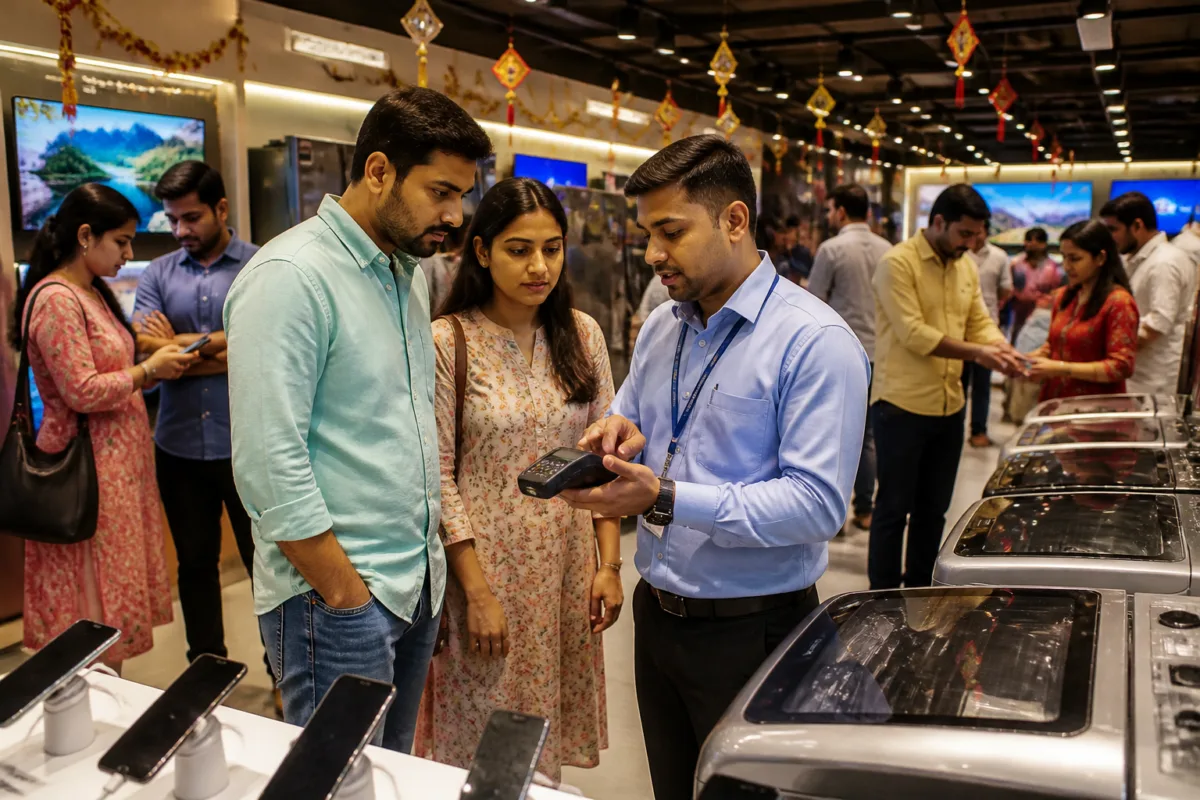
Pune’s festive credit boom is changing how households pay for ordinary consumption. Residents are increasingly using equated monthly instalments, credit-card conversions, instant loans and buy-now-pay-later products to purchase electronics, appliances and holidays as expenses rise and festive bonuses remain limited, according to a report by the Times of India.
The shift is more significant than a seasonal change in payment preference. It points to a household economy in which the ability to buy is increasingly separated from the ability to pay immediately. For consumers, the monthly instalment can make an expensive purchase appear manageable. For lenders and retailers, it creates more opportunities to sell during a concentrated shopping period. But the same mechanism can also move pressure from the point of sale into future household budgets.
The evidence supplied from Pune is drawn from residents in Hadapsar and Aundh, a consumer-durables retailer in Baner, lenders and financial experts. It does not establish that all households are borrowing more or that festive consumption has risen across the city. It does show, however, that credit is becoming more visible in the way some urban households finance purchases and travel.
One Hadapsar resident, Avinash Thakker, told the newspaper that festive bonuses were no longer significant enough to cover the season’s competing demands. He cited new electronics and travel among the expenses and said his household was making some purchases through EMI and buy-now-pay-later arrangements. Aundh resident Pankaj Sharma similarly said rising costs had made credit-card EMIs and instalment payments more appealing.
These accounts illustrate the affordability calculation behind small-ticket borrowing. A buyer may not have enough disposable cash for a full payment, but may still be able to commit to a six- or twelve-month instalment. That changes the immediate decision from whether the household can afford the product to whether it can absorb one more recurring payment. The distinction becomes important when several purchases are made during the same festive period.
The retailer’s account from Baner suggests that the supply side is actively reinforcing this behaviour. According to the retailer, purchases had previously been more evenly divided between EMI payments and debit-card or cash transactions. This year, attractive EMI and instant-credit offers were encouraging more customers to choose instalments. The reported change therefore reflects not only consumer demand but also the way financial products are being presented at the point of purchase.
Banks and non-banking financial companies are offering festive loans and instant-credit products across categories. ICICI Bank said in a press release that customers could access discounts and cashback through cards, internet banking, cardless EMIs and no-cost EMIs. The offers covered electronics, travel, fashion and home decor. Such arrangements make credit part of the shopping interface rather than a separate financial decision made later at a bank branch or loan office.
That integration matters because the transaction becomes easier while the cost of the commitment can become less visible. The monthly instalment is usually more prominent in a purchase conversation than the total amount repaid, fees, penalties or the effect of missing a payment. A “no-cost” EMI may reduce or offset interest in a particular offer, but the broader household obligation remains: money that will be unavailable for essentials, savings or emergencies over the following months.
The report also records a shift in the size and purpose of borrowing. Satyam Kumar, co-founder and chief executive of Loan Tap, said consumer electronics and holidays were driving borrowing, including domestic and East Asian travel. He said many borrowers were choosing small loans with six- to twelve-month tenures or buy-now-pay-later products. This suggests that short-term credit is not limited to durable goods but is also being used for experiences and discretionary travel.
Data cited from digital lending platform Kissht adds another indicator. The platform reported that loan applications in August were nearly 50% higher than in August 2025. Its chief data and analytics officer, Neha Shivran, said average loan sizes had almost doubled, rising from Rs 21,400 a year earlier to Rs 42,700 in August. She attributed part of the increase to business lending and customers planning larger festive purchases.
The Kissht figures cannot by themselves be treated as a measure of Pune’s entire consumer-credit market. They relate to one digital lending platform, and the report says the increase was partly linked to business lending as well as festive purchases. Still, the change in applications and average loan size provides a useful signal of how digital credit platforms are experiencing demand. It also cautions against reducing the trend to a simple rise in electronics purchases: the reported increase may combine different forms and purposes of borrowing.
The urban context is important. Pune’s residents are making these decisions within a city where work, housing, mobility, education, travel and household consumption compete for the same monthly income. The report does not provide citywide figures for wages, household debt or living costs, so it cannot quantify how much of the average household budget is being absorbed by EMIs. But the residents’ comments connect the credit trend to a familiar financial pressure: festive income is finite, while seasonal expectations and routine expenses continue at the same time.
The institutional arrangement behind the trend is distributed across several actors. Retailers use payment offers to support sales. Banks and non-banking financial companies design card, loan and EMI products. Digital lending platforms process applications and promote short-term borrowing. Consumers decide whether the resulting instalment can be carried alongside existing commitments. No single actor appears to control the full household balance sheet, which is why the final risk can remain difficult to see at the moment of purchase.
Credit-card EMIs and buy-now-pay-later products also create different repayment relationships. A borrower may make a direct instalment payment, convert a card purchase into an EMI or defer payment through a digital platform. The report does not provide the interest rates, processing charges or penalty structures for the products being used by Pune consumers. Without those details, the affordability of individual offers cannot be compared. The available evidence supports a conclusion about increased reliance on credit, not a judgement that every offer is unsuitable or harmful.
The financial planner quoted in the report identified the central issue as accumulation. Consumers, the planner said, should assess their overall financial commitments rather than focus only on the monthly instalment. They were advised to check total repayment amounts, fees and penalties and to retain enough money for essentials, savings and emergencies. This is a basic budgeting point, but it becomes more important when multiple offers are marketed together during a short period.
For households, the risk is not necessarily a single large loan. It may be the layering of several apparently manageable obligations: a phone or appliance EMI, a travel payment, a credit-card conversion and a deferred purchase. Each commitment can look affordable in isolation. Together, they can narrow the household’s room to respond to an unexpected expense or income disruption. The supplied report does not establish how many consumers are already experiencing repayment stress, so that outcome should not be assumed. It does establish why the structure of borrowing deserves attention.
For Pune’s retail economy, the expansion of instalment payments can support sales when cash budgets are under pressure. It may allow customers to bring forward purchases and may help retailers sell higher-value products or packages. The same expansion makes sales performance increasingly connected to the availability and design of consumer credit. A strong festive season funded by borrowing therefore says something about the financial system supporting consumption, but not necessarily about the strength of household purchasing power.
The evidence also leaves several questions unanswered. The report does not distinguish between new borrowers and existing credit users, secured and unsecured borrowing, or households that repay in full and those that carry balances. It does not provide a citywide estimate of festive purchases financed through EMIs. Nor does it show whether higher loan applications are translating into higher defaults or repayment stress. These gaps matter because application growth and average loan size measure demand for credit, not its eventual impact on household finances.
What the report does confirm is a clear change in the payment conversation around festive consumption in Pune. Residents cite rising costs and modest bonuses; retailers report stronger movement towards EMI and instant-credit products; lenders describe borrowing for electronics, travel and larger purchases; and a digital platform reports sharp year-on-year increases in applications and average loan size. The broader urban question is whether easy access to short-term credit is helping households smooth temporary spending or allowing affordability pressures to be carried into future months. That distinction will depend on repayment data, product costs and household-level debt information that are not included in the supplied report.

