


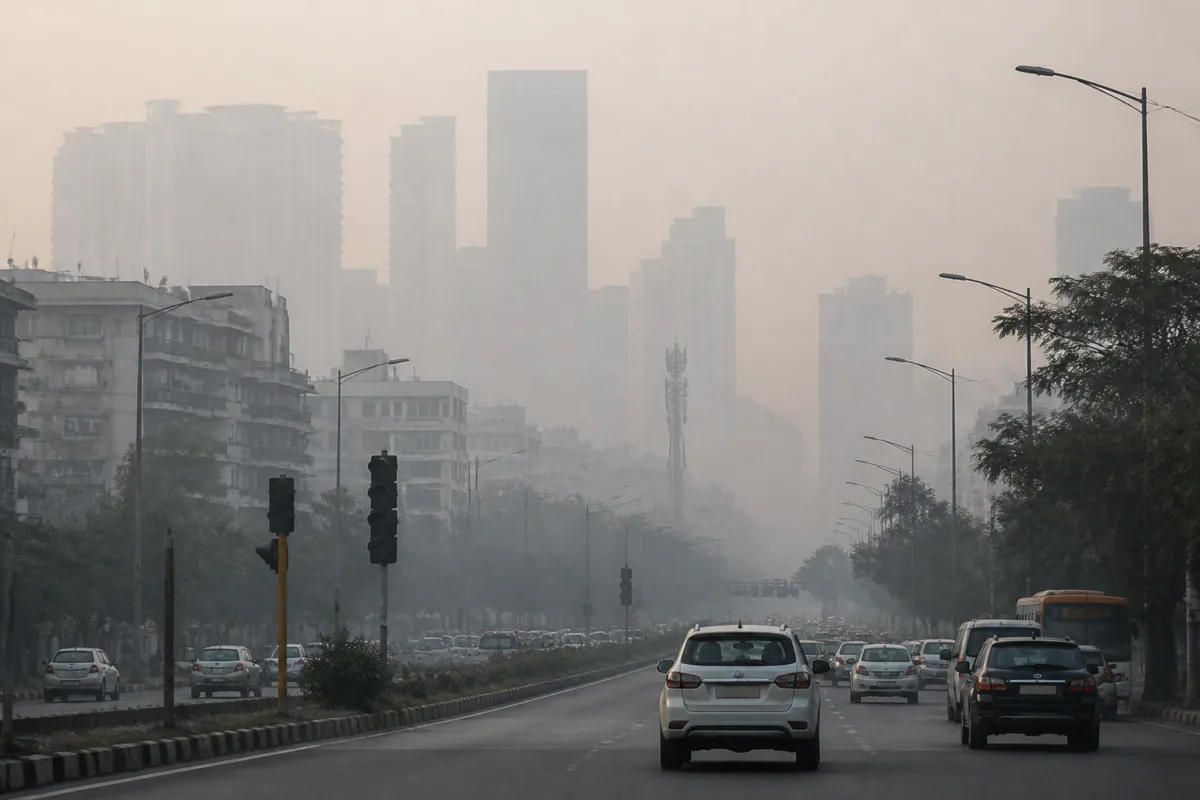
Delhi’s air quality deteriorated sharply after Diwali as a thick grey haze reduced visibility across the capital, irritated residents’ eyes and throats, and pushed the city’s average Air Quality Index to 370 in the ‘very poor’ category on Monday. The Air Quality Early Warning System forecast that conditions could worsen into the ‘severe’ category during the day and remain there for the following few days.
The worst readings in the city’s monitoring network came from DTU and Burari Crossing, where the AQI reached 437 each. Several areas, including Bawana, Burari, Jahangirpuri, Sonia Vihar, Punjabi Bagh, Okhla and Rohini, also recorded air quality in the severe category, according to the report.
The Central Pollution Control Board classifies an AQI of 0 to 50 as ‘good’, 51 to 100 as ‘satisfactory’, 101 to 200 as ‘moderate’, 201 to 300 as ‘poor’, 301 to 400 as ‘very poor’ and 401 to 500 as ‘severe’. The official monitoring data cited in the report showed that 20 of 59 stations reporting at 10 pm on Diwali were in the severe category. Six stations were in the poor category and the remaining 33 were in the very poor category.
Sonia Vihar recorded the highest station-level AQI on Diwali night at 463, followed by Jahangirpuri at 450. The city’s average AQI settled at 376 on Sunday. Firecracker bursting increased from around 5 pm to 6 pm across locations including Pitampura, Burari, Mayur Vihar and parts of Lutyens’ Delhi, with residents reporting the smell of burnt crackers, reduced visibility and difficulty breathing as smoke accumulated over roads and residential neighbourhoods.
The report also cited substantially higher readings from independent monitoring platforms. AQI.in recorded Delhi’s AQI at 2,283 after Diwali and 637 on Monday morning, classifying the latter as ‘hazardous’. IQAir data placed the city’s PM2.5 concentration at 170 micrograms per cubic metre, around 34 times the World Health Organisation’s annual guideline value. The platform recorded PM10 at 126 micrograms per cubic metre, ozone at 31, nitrogen dioxide at 44.6, sulphur dioxide at 32 and carbon monoxide at 1,461.5 micrograms per cubic metre.
PM2.5 is a fine particulate pollutant that can penetrate deep into the lungs and enter the bloodstream. The report attributed the deterioration to firecracker emissions, unfavourable weather conditions, vehicle emissions and stubble burning in neighbouring states. It also cited the Air Quality Early Warning System’s assessment that a ventilation index below 6,000 square metres per second, combined with average wind speeds below 10 kmph, limits the effective dispersion of pollutants.
The latest deterioration followed firecracker use across the capital despite restrictions on their use. The Air Quality Early Warning System’s forecast, as reported, is that Delhi will remain in the severe category over the subsequent few days, subject to prevailing weather and pollution conditions.

