


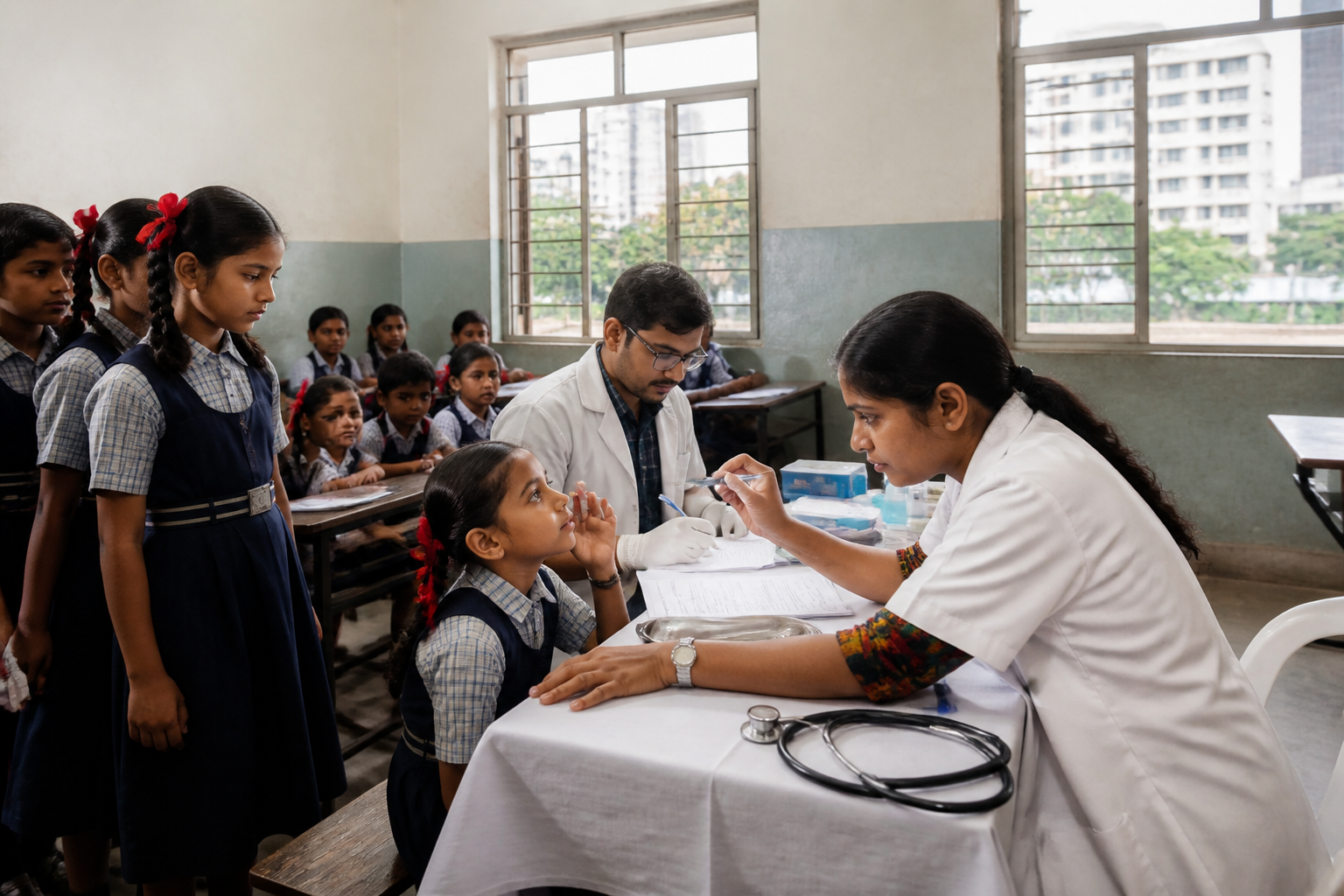
Only 38 per cent of students targeted under the Rashtriya Bal Swasthya Karyakram in Pune district had undergone health screening between April and September 2026. The figure is not merely a shortfall in an administrative target. It shows how a programme designed to detect health problems early can lose effectiveness when its frontline screening network does not reach children at the required scale.
The Pune district target for the six-month period was 1,070,132 students. Of these, 411,050 had been examined, according to data reported by Loksatta. That leaves a large proportion of the intended school-going population outside the programme’s documented screening coverage during the period under review.
The gap is part of a wider state-level pattern. Across Maharashtra, 5,355,431 students had been screened against a target of 12,443,889, taking coverage to 43 per cent. The state average was therefore higher than Pune’s, but still below half of the student target. In some districts, performance was considerably better: Dhule recorded 67 per cent coverage, Ahilyanagar 64 per cent, Nandurbar 59 per cent, Sindhudurg 55 per cent and Gondia 52 per cent.
These differences matter because the programme depends on repeated, organised contact with children rather than on families independently seeking care. The Rashtriya Bal Swasthya Karyakram, or RBSK, is intended to screen children from birth to 18 years for four broad categories: birth defects, childhood illnesses, deficiencies and developmental delays. Problems identified during screening can lead to referrals for further treatment, including surgery.
That design makes the programme an important part of the public health system’s preventive layer. A child with a congenital condition, nutritional deficiency or developmental delay may not be taken to a health facility until symptoms become serious, particularly when families face cost, distance or information barriers. Screening in schools and anganwadi centres is meant to bring the first point of detection closer to where children live and study.
RBSK uses mobile health teams for this purpose. Children above six years are screened in schools, while those between six weeks and six years are examined at anganwadi centres. At the state level, 1,196 mobile health teams are reported to be operating. Each team consists of two medical officers, one auxiliary nurse midwife and one pharmacist.
The team structure indicates both the strength and the vulnerability of the model. A mobile unit can extend services across dispersed schools and anganwadi centres, but its reach depends on staff availability, scheduling, travel, coordination with institutions and the number of children assigned to each team. The supplied data does not establish which of these factors caused Pune’s lower coverage. It does, however, show that the existence of a formal network has not translated into uniform screening performance across districts.
The contrast between school and anganwadi screening is especially significant. While the student screening rate in Maharashtra was 43 per cent, coverage among anganwadi children was reported at 69 per cent. Against a target of 6,052,071 children, 4,128,674 had been screened. Health problems were identified in 658,384 of those children.
This difference suggests that the programme is reaching younger children more effectively than school-going students, at least in the period covered by the data. The reasons are not specified in the report, so they cannot be assumed. However, the operational environments are different. Anganwadi centres provide a more concentrated institutional setting for younger children, while school screening involves larger student populations and coordination across multiple schools and schedules. The figures point to a delivery gap that requires administrative explanation rather than a simple comparison of targets and achievements.
The referral data presents a more positive picture once children are identified for treatment. Between April and August 2026, 810 of 820 children identified for heart surgery had completed the procedure. In the category covering other surgeries, 7,252 of 7,259 identified children had undergone surgery. These figures represent completion rates of approximately 99 per cent in both groups.
The contrast is important. The programme appears to have recorded strong outcomes after certain children entered the treatment pipeline, while the larger challenge lies earlier: ensuring that children are screened in the first place. A health system can perform well at referral and treatment stages for detected cases and still leave substantial unmet need if its initial coverage remains low.
This distinction also changes how programme performance should be assessed. A high number of completed surgeries is valuable, but it cannot compensate for children who were never examined and therefore never referred. Screening coverage, the number of conditions detected, referral completion and treatment outcomes measure different stages of the system. Combining them into one headline performance figure would conceal where the actual bottleneck lies.
In Pune, the central concern is therefore not only that 411,050 students were screened. It is that the programme had set a target of more than one million students and reached fewer than four in ten during the six-month period. The report does not provide school-wise coverage, staffing vacancies, team attendance, missed visits, referral numbers from screening or the reasons for variation between districts. Without those details, the causes of the shortfall remain unestablished.
The state-level variation nevertheless offers an administrative clue. Dhule, Ahilyanagar, Nandurbar, Sindhudurg and Gondia exceeded Pune’s coverage rate, with Dhule reaching 67 per cent. This means the state average is not an unavoidable ceiling imposed by the programme’s design. Different districts are achieving different levels of reach within the same broad framework. The supplied material does not identify the practices behind the stronger results, but the comparison makes district-level implementation a central question.
Pune’s lower rate also deserves attention because the district has a large and diverse student population, reflected in its target of 1,070,132 children. A programme that operates through mobile teams must manage the logistical demands of urban, peri-urban and rural locations, along with school calendars and institutional coordination. The available report does not break the district figure down by geography or school type, so it is not possible to determine whether the shortfall is concentrated in particular areas.
The institutional responsibility is distributed across the health and child development systems. Schools are the principal screening locations for children above six, while anganwadi centres serve younger children. Mobile health teams carry out examinations and refer children for further care. That arrangement requires more than medical personnel: it requires planning, route scheduling, school access, records, follow-up and coordination between screening and treatment facilities.
The numbers indicate that the treatment chain can function efficiently for children already identified. They also indicate that the preventive and detection chain is uneven. This is a governance problem because the programme’s public value depends on continuity across both stages. A child who is screened but not referred remains underserved; a child who is referred but cannot complete treatment also remains underserved; and a child who is never screened is invisible to the system altogether.
The figures from Maharashtra therefore tell two stories at once. One is about capacity: 1,196 mobile teams and high completion rates for reported surgeries show that the state has an established mechanism for reaching children and connecting some of them to care. The other is about coverage: fewer than half of the student target had been screened, while the rate among anganwadi children was substantially higher.
For citizens, the immediate implication is that programme availability cannot be equated with universal access. Families may assume that school or anganwadi-based screening has taken place, but the reported coverage figures show that many children were outside the programme’s recorded reach during the period. The data does not establish whether those children received equivalent examinations through another channel.
The larger urban question is how public systems measure access when services are delivered through institutions rather than individual appointments. Pune’s result shows that a programme can have defined clinical categories, mobile teams and successful surgical referrals, yet still fall short at the point where the largest number of children must be reached. The next layer of accountability lies in making district-level coverage, team deployment and follow-up performance visible.
The evidence currently confirms a substantial screening gap in Pune and a wider state-level shortfall among students, alongside stronger anganwadi coverage and high reported completion of identified surgeries. It does not establish the operational causes of the gap or whether missed children were screened through other services. Those questions will determine whether the problem is one of staffing, scheduling, access, reporting or coordination. The programme’s subsequent coverage figures and district-level implementation data will show whether the shortfall narrows and where corrective action is required.
