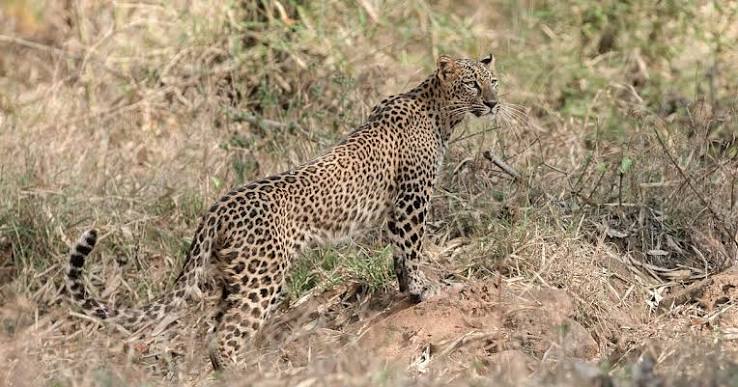
A month-long operation in Pune district’s Shirur taluka ended with the capture of a male leopard after repeated sightings raised fears among villages and followed a fatal human-leopard encounter. Forest officials, supported by wildlife responders, tracked the animal through camera surveillance and movement patterns before securing it near farmland early Sunday.
The operation reflects a growing challenge for settlements located close to agricultural and forest landscapes: managing encounters with wildlife without treating the presence of animals as an isolated law-and-order issue. As cultivation, housing and other human activity expand into previously open landscapes, the boundary between habitat and settlement can become increasingly difficult to maintain. Officials used trap cameras and strategically positioned cages to identify the leopard’s movement routes. The animal was eventually tranquilised and captured near a local farm. Such operations require careful coordination because indiscriminate intervention can increase risks for residents while also creating unnecessary stress for wildlife. The incident also places attention on the wider ecology of Pune district. Leopards are adaptable predators and can survive in fragmented landscapes where natural vegetation exists alongside farms and settlements. Their movement through agricultural areas can therefore reflect changes in habitat, prey availability and human land use rather than simply an increase in the number of animals.
For rural communities, however, the risks are immediate. Farmers and agricultural workers often spend long hours outdoors, while livestock and farm activity can bring people and wildlife into closer proximity. Following a fatal encounter, uncertainty can also affect how safely residents use fields, roads and surrounding open areas. Urban planners and conservation experts increasingly stress the importance of mapping wildlife corridors and retaining connected green landscapes as development spreads beyond established urban centres. Protecting these ecological links can reduce the likelihood of animals being pushed into heavily populated areas while preserving biodiversity around expanding settlements.
The Pune leopard capture therefore offers a short-term safety outcome but also points to a longer planning question. Pune’s human-wildlife conflict cannot be addressed only when an animal enters a village. Better habitat mapping, rapid response systems, community awareness and protection of natural corridors can help reduce repeated encounters. For authorities, the next step will be to assess where the leopard came from, how frequently wildlife is moving through the area and whether local land-use changes are increasing interaction with people. A safer landscape for residents ultimately depends on managing development and ecological space together.