


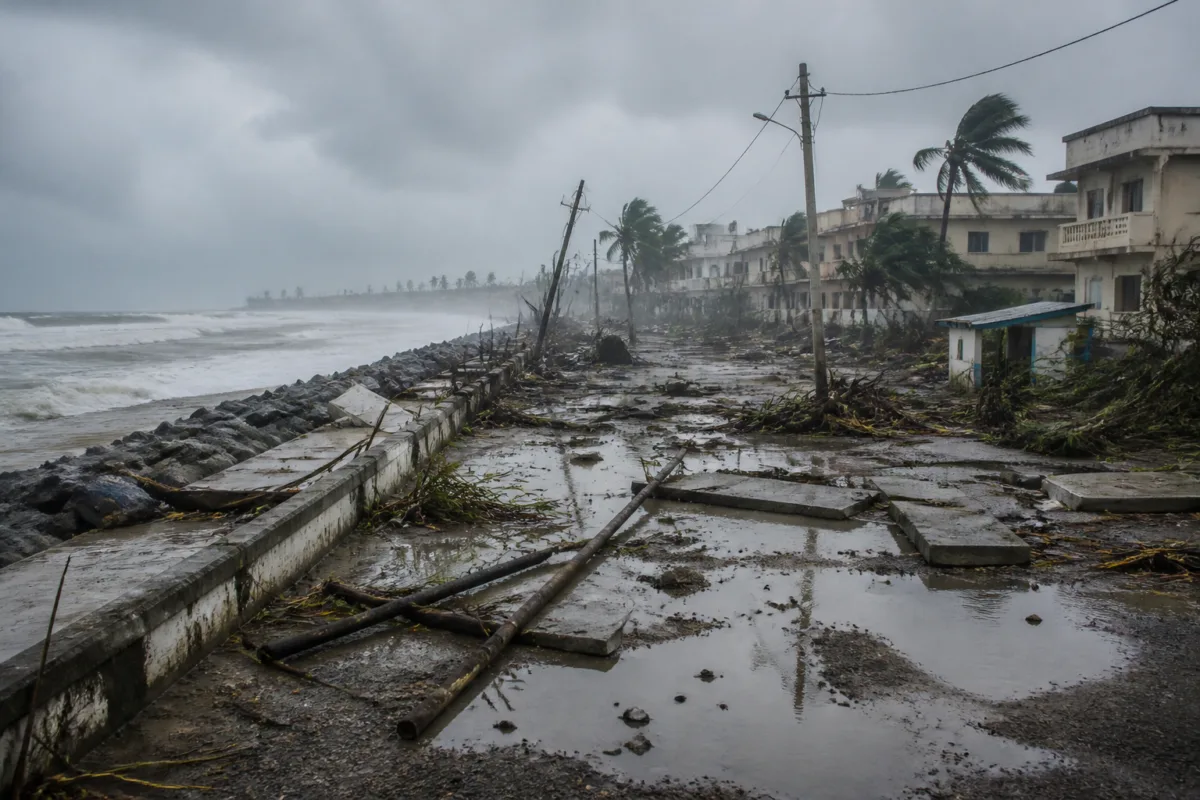
The Imperial College London study on Cyclone Arnab puts a precise number on a problem that coastal cities and districts can no longer treat as a distant climate projection: human-caused global warming increased the storm’s direct economic damage in Andhra Pradesh by 33 per cent. The finding matters because the reported change in the cyclone’s wind speed was comparatively small, yet it translated into substantially greater risks for homes, infrastructure, crops and livelihoods.
Cyclone Arnab made landfall on the Andhra Pradesh coast on 28 October, according to the report. International tracking data cited in the study placed the storm’s intensity at the equivalent of a Category 3 hurricane on the Saffir-Simpson scale when it reached the coast. Its average maximum sustained wind speed over one minute was reported at 202 kilometres per hour, accompanied by intense rainfall and extensive damage to coastal infrastructure.
The study’s central contribution is not simply the description of a powerful cyclone. It is the comparison between the world as it exists under present climate conditions and a hypothetical climate without human-caused global warming. Researchers used the Imperial College Storm Model, or IRIS, to examine how the storm’s characteristics and resulting damage differed between the two scenarios. On that basis, the study estimated that the direct economic loss caused by Cyclone Arnab was 33 per cent higher than it would have been in a pre-industrial climate.
That attribution changes how the damage is understood. A cyclone’s destruction is often recorded as a disaster that begins when the storm makes landfall. The study instead connects the scale of loss to the physical changes produced by warming before the event reaches the coast. The difference is important for urban and infrastructure planning because it places climate conditions, not only the storm’s arrival, inside the risk calculation.
The reported findings also show why small changes in hazard intensity can have large consequences on the ground. According to the study, human-caused global warming increased the cyclone’s wind speed by 5 per cent. The researchers, including Grantham Institute director Professor Ralph Toumi and researcher Dr Nathan Sparks, said that apparently modest increases of 5 to 11 per cent in wind speed or rainfall can result in more homes being destroyed, greater crop losses and deeper damage to livelihoods.
This relationship is especially significant for coastal settlements, where buildings, transport links, utilities and economic activity are concentrated in exposed areas. The supplied report does not provide a separate asset-by-asset account of the damage in Andhra Pradesh, nor does it identify the exact value of the direct loss. But it establishes the mechanism clearly: stronger winds and heavier rainfall increase the physical stress on buildings and infrastructure, while also disrupting the economic systems that depend on them.
The study’s future scenario is more severe. If global temperatures rise by 2.6 degrees Celsius by the end of this century, a storm similar to Arnab could become 8 per cent more powerful and cause up to 56 per cent more economic damage, the report says. The projection does not mean that every future cyclone will follow an identical path or produce the same loss. It does show how a relatively limited increase in storm power can produce a much larger increase in damage when exposure and asset values are taken into account.
That 56 per cent figure is the most consequential part of the study for infrastructure decision-making. It indicates that damage does not rise in a simple, one-to-one relationship with wind speed or rainfall. Homes may cross a threshold at which roofs or walls fail. Roads and bridges may become unusable after flooding. Power, water and communications systems may be disrupted at the same time, multiplying the effect on households and businesses. The report does not quantify each of these channels separately, but its findings on direct economic loss point to the combined nature of the risk.
The study used the Climate Damage Tracker and a database containing the paths of millions of synthetic cyclones to assess the social and economic effects of warming. Synthetic storm-track databases are relevant because a single observed cyclone cannot by itself reveal how much of its intensity or damage was climate-driven. By comparing large numbers of simulated storm paths and contrasting present conditions with a world without global warming, the researchers attempted to isolate the contribution of warming to the event.
This approach also explains why the study is more useful than a simple post-disaster loss estimate. A conventional damage figure describes what was lost after the event. The attribution exercise asks a different question: how much worse was the loss because the climate had already changed? For public authorities, that distinction can affect how coastal risk is assessed, how infrastructure is designed and how future losses are accounted for.
The evidence supplied with the report does not identify a specific Andhra Pradesh government programme, municipal plan, funding mechanism or construction standard linked to Cyclone Arnab. It therefore cannot establish whether existing coastal infrastructure was designed for the level of wind and rainfall described, or whether particular failures resulted from inadequate maintenance, weak construction or exceptional weather. Those questions require official damage assessments and engineering data that are not included in the study summary.
What the study does establish is a widening gap between historical assumptions and current physical conditions. Infrastructure designed around past storm patterns may face hazards that are no longer represented by those patterns. This is not only a question for large public works. Housing, agricultural assets, local roads, drainage networks and small businesses can all contribute to the economic loss measured after a cyclone. When these systems fail together, the disruption extends beyond the immediate area of structural damage.
The policy significance therefore lies in the way climate attribution can enter routine urban and regional planning. The study does not prescribe a particular policy response, but its evidence supports a more precise risk framework in which the intensity of future hazards and the value of exposed assets are considered together. Planning only for the average historical cyclone would not capture the conditions described in the report’s present-climate and 2.6-degree scenarios.
The data story is stark even within the limited figures available. Cyclone Arnab had maximum sustained winds of 202 kilometres per hour at landfall. Warming was associated with a 5 per cent increase in wind speed, yet the estimated direct economic damage was 33 per cent higher than in the pre-industrial comparison. Under the future temperature scenario cited by the study, storm power could increase by 8 per cent while economic damage could rise by as much as 56 per cent. These figures show a widening ratio between hazard intensity and loss.
The study’s warning is not confined to meteorology. It is about the vulnerability of the built environment and the livelihoods supported by it. A storm becomes an urban and regional crisis when homes, transport, utilities, farms and local businesses cannot absorb the physical shock. The report connects these outcomes to warming, but it does not claim that climate change is the only determinant of damage. Exposure, construction quality, land use, preparedness and the condition of public infrastructure would also influence the final loss, although those variables are not separately measured in the supplied material.
That limitation is important. The 33 per cent estimate should be read as the study’s attribution of additional direct economic damage under its modelling framework, not as a complete accounting of every social consequence of Cyclone Arnab. It does not include, in the supplied summary, a full count of affected households, deaths, displaced residents, infrastructure assets or recovery costs. Nor does it establish how losses were distributed between urban communities, rural areas, farmers, businesses and public agencies.
Even with those limits, the study raises a central question for India’s coastal development: whether future investment decisions will treat climate change as a separate environmental concern or as a factor that changes the performance and cost of ordinary infrastructure. The findings suggest that the latter approach is increasingly necessary. For coastal Andhra Pradesh, the relevant issue is not simply whether another cyclone will arrive, but whether the buildings, networks and livelihoods exposed to it are being assessed against a climate that has already shifted.
The evidence confirms that human-caused warming increased the estimated damage from Cyclone Arnab and that a warmer future could make a similar storm considerably more expensive. What remains unclear from the supplied report is how the damage was distributed across assets and communities, and how authorities intend to respond. Those are the next facts needed to connect climate attribution to infrastructure standards, public spending and coastal resilience planning.

