


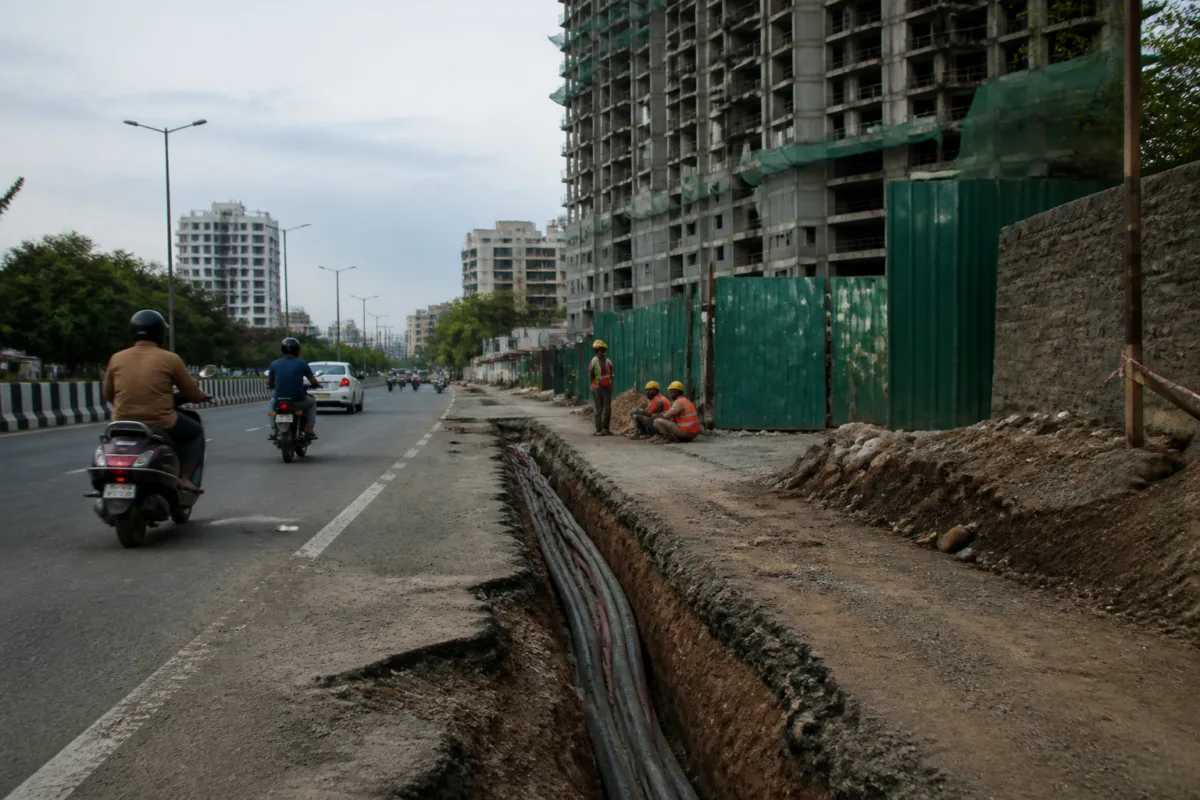
A ₹2.04 crore Pune civic fine linked to the Kasturi Spaces project has reportedly remained unrecovered for more than three years, exposing a larger enforcement problem: municipal authorities can issue penalties for damage to public infrastructure, but converting those orders into actual payments remains far more difficult. The case concerns an alleged unauthorised excavation of about 650 metres of a public asphalt road in the Mhalunge-Balewadi area for laying an electrical cable.
According to a report by Civic Mirror – Pune, the road department of the Pune Municipal Corporation issued a legal notice in 2023 to Bharat Agarwal, identified in the report as a principal owner of the Kasturi Spaces project. The notice imposed a penalty of ₹2,04,82,560 and directed that construction or permission-related work should not proceed until the amount was paid. The report says the corporation has not recovered any part of the penalty so far.
The case is significant not only because of the size of the outstanding amount, but because the alleged damage involved a public road rather than a private construction site. Road surfaces, underground utility corridors and reinstatement works are municipal assets. When a developer or contractor excavates a road without prior permission, the issue extends beyond a dispute over a fee. It concerns access, safety, maintenance costs and the authority of the city to control activity within its right of way.
The supplied report says the road department directed the building department to stop work and not process further permissions until the penalty was deposited. It also says that, in practice, no stop-work order was implemented against the project. Civic Mirror reported that the project had reached the final stage of obtaining an occupancy certificate, while the road department had refused to issue the certificate until the penalty was paid. The report does not provide the relevant municipal file, the penalty calculation or the precise legal basis for linking occupancy approval to payment.
This distinction matters. A notice on a municipal record is an administrative action; recovery is a separate stage requiring follow-up, enforceable orders and coordination between departments. If the corporation has accepted that a public road was excavated without permission and has calculated the resulting penalty, the effectiveness of the action depends on whether the amount is collected, the road is properly restored and future permissions are handled consistently. If the penalty remains pending while the project advances through other approval stages, the enforcement process can become fragmented.
The report attributes the allegations of administrative protection and possible collusion to the Aam Aadmi Party’s youth wing. Its state president, Raviraj Kale, criticised the corporation and questioned why the municipal machinery acts swiftly against ordinary taxpayers with small arrears but has not recovered the larger amount from the developer. These are political allegations, not established findings. The report does not cite an inquiry report, audit finding, court order or disciplinary proceeding confirming collusion or an improper financial arrangement.
The corporation’s road department has, however, been quoted as ordering an inquiry and further action. Rajesh Bankar, identified as the head of the road department, said that directions were being issued for an immediate investigation. That response creates an official administrative record that the matter remains live, but it does not by itself establish whether the original excavation was unauthorised, why recovery was delayed or which officials were responsible for implementing the earlier directions.
The developer’s position is also incomplete in the supplied material. Civic Mirror said it repeatedly attempted to contact Bharat Agarwal but could not reach him. There is therefore no recorded response from the developer explaining whether permission had been sought, whether the penalty was disputed, whether the road was restored or why the amount remained unpaid. Those questions are central to assessing the dispute and should be addressed before any final determination is made.
The geography of the case adds to its importance. The Mhalunge-Balewadi belt has seen extensive real estate and infrastructure activity, making coordination between construction projects and municipal services especially important. Large projects require power connections, access roads, drainage, water supply and other networks. Each connection that crosses or affects a public road must be managed through a system that identifies the applicant, approves the excavation, specifies restoration standards and records completion.
The report describes a 650-metre stretch of road being excavated for an electrical cable. The length indicates that the work was not a minor roadside intervention. Yet the source material does not establish whether the entire stretch was left unrepaired, whether the road was restored, what traffic or safety disruption occurred, or how the penalty was calculated. Those missing details are important because a penalty may include restoration costs, administrative charges, damage compensation or other components. Without the calculation sheet and inspection record, the public cannot independently assess whether ₹2.04 crore was proportionate.
The case also illustrates the difference between municipal revenue and municipal enforcement. The reported penalty is not simply money owed to the civic body. It represents the financial consequence attached to an alleged breach involving public land and infrastructure. If the amount is not collected, the corporation may lose revenue, but the deeper institutional loss is the weakening of the compliance signal sent to other project proponents. That conclusion remains a structural concern rather than a finding that any particular developer received preferential treatment.
The reported instructions concerning an occupancy certificate bring another layer of administration into focus. Completion or occupancy approvals are generally treated as milestones at which the authority verifies whether a project has met applicable conditions. In this case, the road department’s reported refusal to clear the certificate until payment suggests that recovery may have become linked to a later approval stage. The supplied material does not clarify whether such a linkage is mandatory under municipal rules, whether other departments agreed with it or whether the project received any interim permissions after the 2023 notice.
This uncertainty points to the need for a clear public record. The corporation’s inquiry would need to establish when the excavation took place, which permissions were sought or denied, how the road department assessed the work, when the notice was served, whether an appeal or stay was filed, what action the building department took and whether the road was restored to the required standard. It would also need to identify the officers responsible for monitoring compliance with the stop-work direction, if that direction was formally issued.
The political response has introduced a seven-day demand for recovery with interest and threatened demonstrations outside the municipal headquarters. The demand and protest warning are attributable to the Aam Aadmi Party’s youth wing. They do not substitute for the corporation’s statutory process, but they show how unresolved enforcement cases can become public accountability issues, particularly when the amount involved is large and the alleged violation concerns a common urban asset.
The evidence currently confirms that a substantial penalty was reportedly issued, that the amount has allegedly not been recovered and that the road department has ordered an inquiry. It does not establish the allegations of collusion, the final liability of the developer, the condition of the excavated road or the reasons for the delay. The next meaningful developments are therefore the publication of the inquiry findings, disclosure of the recovery and approval records, clarification from the developer and confirmation of whether the penalty is paid or legally contested. Until then, the Kasturi Spaces case remains a test of whether Pune’s municipal enforcement system can move beyond notices and deliver an accountable outcome.

