


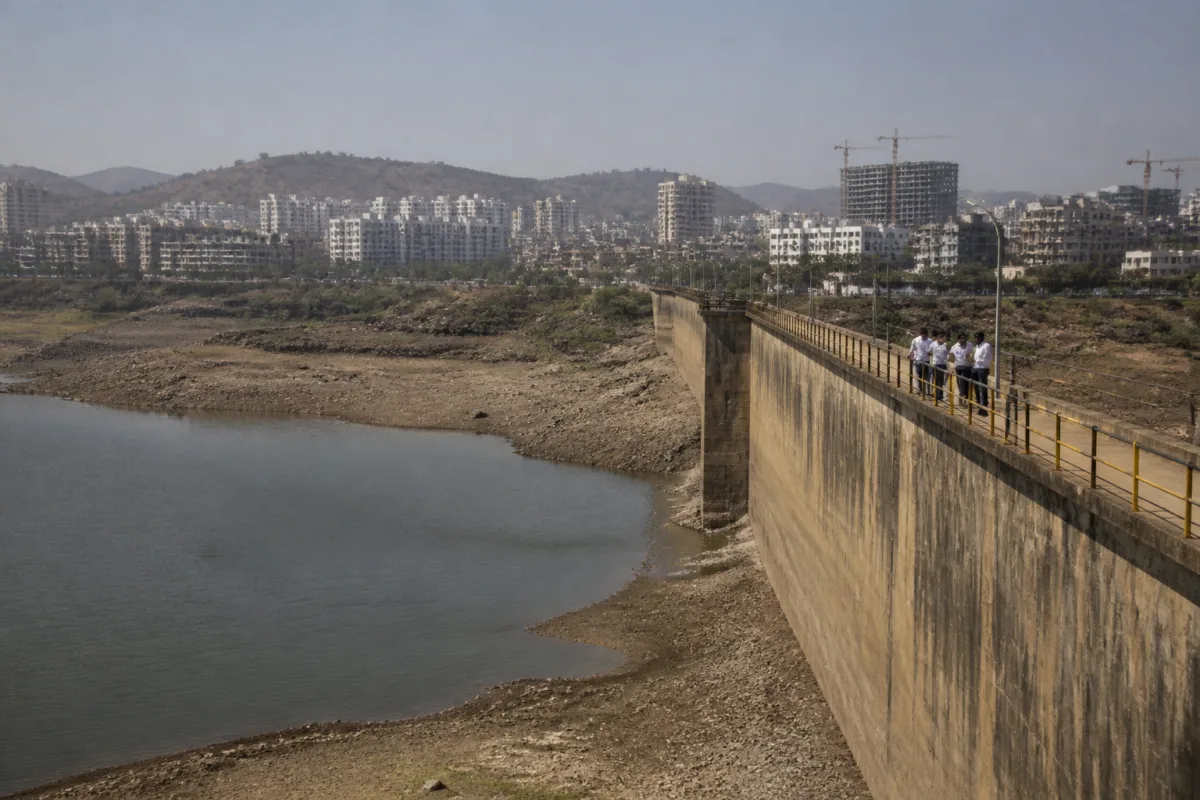
A proposal for Pune Municipal Corporation to build its own dam has brought the city’s recurring water question back to a more fundamental issue: who is actually being counted when the municipal water requirement is calculated? The proposal, submitted by civic opposition leader Nilesh Nikam, argues that Pune’s allocation is inadequate for a city whose resident, migrant, student and temporary populations have expanded beyond conventional administrative estimates.
Nikam has asked the state government to consider a proposal for the civic body to construct its own dam rather than depend only on repeated demands for a higher allocation from the Water Resources Department. Two separate resolutions have been submitted to the municipal secretary’s office, according to the report. The proposal is not an approved project, and the supplied material does not establish that the state government or the municipal administration has accepted it.
The immediate argument is based on a mismatch between available water and the population using the system. The Khadakwasla dam chain has a storage capacity of 29.15 TMC, the report states, but the Water Resources Department has not increased Pune’s water quota in line with the city’s demand. Nikam’s position is that the municipal corporation should not rely only on correspondence and requests made through canal committee meetings. It should begin planning an independent source of water, he has argued.
That demand shifts the debate from allocation to institutional control. Pune’s water supply is not simply a question of how much water exists in a reservoir. It also involves which authority controls the source, how the available stock is divided, what population is recognised in planning, and whether the municipal system is designed for people who live in the city temporarily as well as those recorded as permanent residents.
### Pune water shortage and the population question
The proposal identifies a population group that is often visible in the city’s economy but may be less visible in conventional civic planning. Nikam has estimated that between 15 lakh and 20 lakh people may have moved to Pune for employment, business, education and other reasons. The report does not provide an independent population survey or explain how this estimate was calculated. It does, however, list several categories of residents whose daily water use would add pressure to the municipal network.
These include people working in Pimpri-Chinchwad, Chakan, the Ranjangaon industrial area and the Hinjewadi IT Park but living in Pune. The list also includes construction workers, contract workers, casual labourers, self-employed workers, domestic workers and wage earners. Students preparing for competitive examinations or studying in the city, young people living in paying guest accommodation, hostel residents and people staying in residential hotels are also identified as significant users.
The distinction matters because a city’s infrastructure is used by more people than the number reflected in formal household records. Workers may commute across municipal boundaries while drawing water where they live. Students may stay in hostels or paying guest accommodation rather than registered family homes. Construction and service workers may change addresses or live in arrangements that are not fully captured by standard property or household databases.
The report does not establish that any particular group is responsible for water shortages. Nor does it show how much of Pune’s water consumption is attributable to migrants, students or temporary residents. The proposal’s importance lies instead in the question it raises: whether water planning is based on the population that is officially recorded, or on the population that actually depends on the network every day.
Nikam has called for an independent count of these residents. The proposed exercise would involve municipal regional offices, the building department and the property tax assessment and collection department. The intention is to use the resulting figure to support a demand for a larger water quota from the Water Resources Department.
Such a count would represent an administrative intervention before it becomes a water-supply intervention. It would attempt to connect information already held by different municipal departments with the city’s water planning process. Building-related records could indicate where new occupancy is emerging, while property-tax and regional-office data could offer a more local picture of households, establishments and accommodation facilities. The supplied report does not specify the proposed methodology, timeline, legal basis or cost of this exercise.
### From quota negotiations to a new dam proposal
Pune’s current water debate, as described in the proposal, is shaped by the relationship between the municipal corporation and the Water Resources Department. The civic body seeks a larger allocation, while the department controls decisions relating to the broader reservoir system. Nikam’s argument is that municipal planning should not remain limited to seeking a higher quota through official correspondence and canal committee discussions.
A municipal dam proposal would therefore involve a significant change in the way the city approaches water security. It would move the discussion towards a source owned or directly developed by the civic body. That could potentially give the municipality a different institutional position, but the supplied material does not establish the proposed dam’s location, capacity, construction cost, land requirement, environmental approvals, financing model or completion timeline.
Those details are essential because a dam is not a short-term response to a seasonal shortage. It is a major infrastructure project involving hydrology, land, catchment protection, downstream impacts, construction, operation and long-term maintenance. None of these project parameters has been provided in the report. At this stage, the proposal should therefore be understood as a demand for the municipal corporation to examine an independent source, not as a sanctioned water project.
The proposal also exposes the limits of treating water allocation as a single-number negotiation. A larger quota may address part of the immediate pressure, but it would not by itself answer how many people the city serves, where demand is concentrated, whether supply is distributed evenly or how much water is lost before reaching users. The supplied material does not provide data on distribution losses, ward-level supply, per-capita availability, tanker dependence, groundwater use or seasonal variation.
That absence is important. Without such information, it is not possible to determine whether the main problem is an inadequate source, an outdated quota, incomplete population accounting, distribution constraints or a combination of these factors. The proposal highlights the first two issues, but the evidence provided does not settle the balance between them.
### The administrative challenge behind the demand
The proposed population count would require the municipal corporation to treat mobility as part of infrastructure planning. Pune is connected to employment and education centres that extend beyond its administrative boundary. People can live in one city, work in another and use services across several local jurisdictions. Industrial areas, information-technology parks, educational institutions and construction sites create demand that does not always follow the boundaries used for municipal administration.
This creates a recurring problem for urban governance. Local bodies are generally expected to plan services within their jurisdiction, but the population using those services can be mobile, seasonal or difficult to record. Paying guest accommodation, hostels, residential hotels and informal worker housing may not be reflected in the same datasets used for regular residential properties. The proposal’s call for coordination between regional offices, the building department and the tax department recognises that no single municipal unit may hold the complete picture.
The report also notes that water-shortage complaints were not received during Diwali because many residents had travelled to their native places. That observation appears in the resolution cited by the report. It suggests that demand can change sharply during holiday periods, but it does not provide enough evidence to measure the effect or establish a direct causal link between lower complaints and lower water consumption.
Even so, the point has planning significance. A city’s water requirement cannot be assessed only through occasional snapshots. Demand may vary with work patterns, academic calendars, festivals, migration cycles, construction activity and occupancy levels. A count conducted at one point in the year could miss these fluctuations unless the municipal corporation defines how temporary and changing populations will be measured.
The same issue applies to the proposed 15 lakh to 20 lakh estimate. A figure of that scale would have substantial implications for water planning, but the report does not clarify whether it refers to people living within Pune Municipal Corporation limits, people using the city’s services, or a wider metropolitan population connected to Pune’s employment and education economy. That distinction would need to be resolved before the number could support a formal allocation request.
### What the proposal establishes—and what it does not
The proposal establishes that a senior municipal opposition figure has asked the civic administration to pursue two connected measures: examine the possibility of constructing a municipal dam and independently count migrant and temporary residents to strengthen the case for a higher water quota. It also establishes that the demand is framed around population growth, the stated inadequacy of the existing quota and the reported 29.15 TMC storage capacity of the Khadakwasla dam chain.
It does not establish that Pune has secured approval for a dam, that additional water will be allocated, or that the estimated migrant population has been verified. It also does not provide a technical assessment of the city’s current supply, a demand forecast, or a comparison between the municipal network’s designed capacity and actual use.
These gaps do not make the proposal irrelevant. They identify the next stage of scrutiny. Before a major source project can be evaluated, the municipal corporation would need to clarify the population base, calculate present and projected demand, map the existing supply system and establish the institutional and financial responsibilities involved. The state government’s response would also determine whether the proposal moves beyond a civic resolution.
Pune’s water debate is therefore not only about whether the city should receive more water or build a new dam. It is also about whether the city’s administrative systems can identify the people who depend on its infrastructure. The proposal places population accounting, interdepartmental data and source-level planning in the same frame. Its further significance will depend on whether the municipal corporation, the Water Resources Department and the state government convert those questions into documented assessments and formally stated decisions.

