


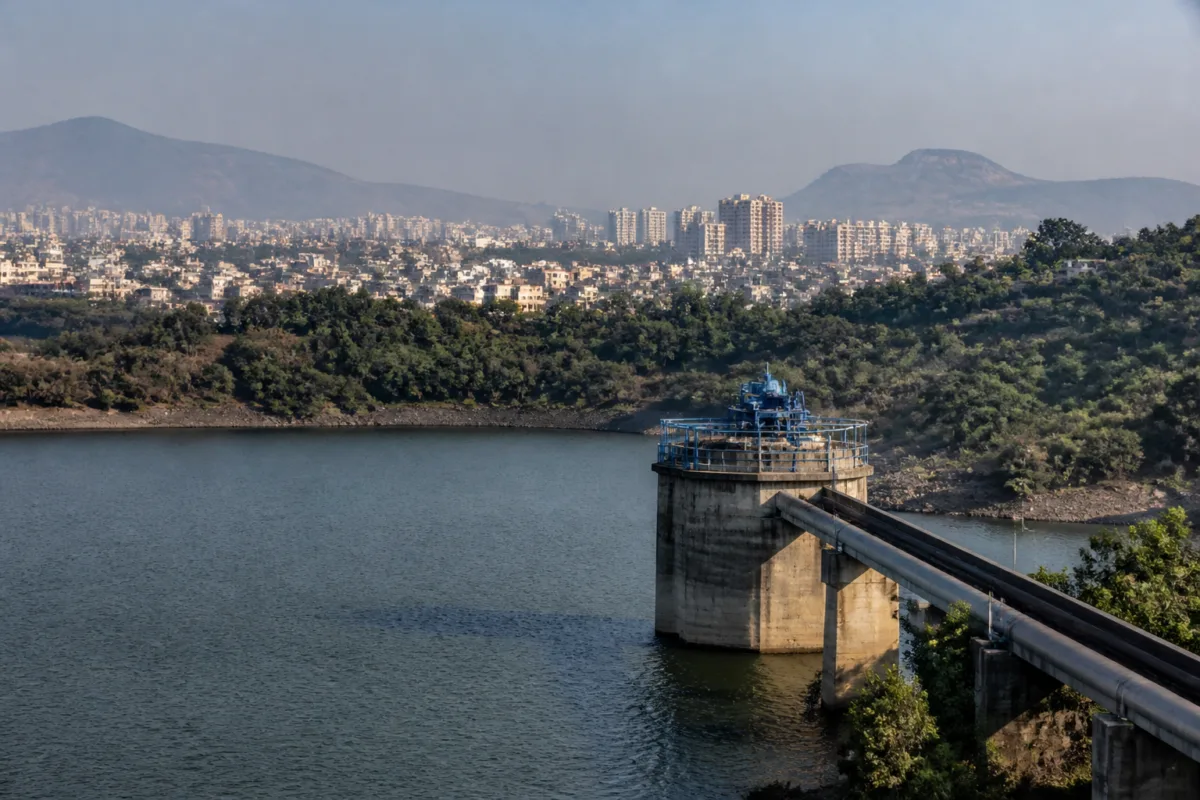
Pune’s request for an additional five thousand million cubic feet of water from Mulshi dam is more than a demand for a larger allocation. It reveals a widening mismatch between the city’s expanding administrative footprint, its sanctioned water quota and the amount of water its distribution network can actually deliver to residents.
The Pune Municipal Corporation is expected to place the demand before Chief Minister Devendra Fadnavis at a meeting on November 20 convened through the Pune Metropolitan Region Development Authority. The meeting will examine water planning for Pune, with the PMC presenting its demand for Mulshi water as well as alternative supply proposals.
The immediate numbers explain the pressure. Pune currently receives around 16 TMC of water a year, while its estimated requirement is above 21 TMC. A letter from the PMC’s water supply department to the state water resources department estimates that the city and its 34 newly merged villages will require 21.03 TMC during 2025-26. The sanctioned quota from the Khadakwasla, Pavana and Bhama Askhed dams, however, is stated to be 14.61 TMC.
That difference is not simply a supply problem. It is also a question of how the city has expanded and how water entitlements are recorded after expansion. The addition of 34 villages to the PMC’s limits has increased the number of areas that must be served through the municipal system. The civic body is therefore asking the state to address both the physical availability of water and the administrative treatment of allocations intended for the merged areas.
The dispute over the 1.75 TMC allocation for the newly merged villages illustrates this institutional problem. The water resources department has told the PMC that the share would be transferred to the civic body. The PMC has complained that the amount is not being counted in its sanctioned quota. Until such allocations are clearly incorporated into the city’s recognised supply, the reported requirement and the formal entitlement will continue to describe different versions of Pune’s water position.
The proposed Mulshi allocation is not a new request. The PMC sent a proposal to the state government in July 2024 seeking five TMC from the dam for non-irrigation use, but no decision had been taken at the time of the report. The renewed request places the issue within a longer planning horizon. The PMC has also sought reservation of its water allocation until 2055-56, estimating that annual demand could rise to 47.13 TMC by then.
That long-term estimate matters because it shifts the debate from an annual shortage to the planning model governing Pune’s growth. A request for five TMC may address an immediate gap, but the civic body’s own projection indicates that demand could more than double from the stated 2025-26 requirement over the next three decades. The evidence supplied in the report does not establish how much of that increase would come from population growth, newly incorporated settlements, changes in consumption or other forms of urban expansion. It does, however, show that the PMC is planning for a substantially larger water system than the one reflected in its current sanctioned quota.
The city’s water challenge is also shaped by losses within the network. Around 35 per cent of the water supplied through the distribution system is reported to be lost. The PMC has said it wants to reduce this figure to 20 per cent through its 24×7 equal water supply scheme. This makes network efficiency a central part of the supply question: additional water from a dam would increase available volume, but a significant portion of existing supply is currently not reaching end users as accounted-for consumption.
The leakage figure also complicates the way scarcity is understood. Pune’s reported gap between requirement and sanctioned supply is a problem of allocation and source capacity. The reported distribution losses are a separate system-performance problem. They cannot be treated as interchangeable, but together they determine how much water is available at the household and neighbourhood level. The PMC’s 24×7 scheme therefore sits alongside, rather than outside, the demand for new sources.
The civic body is also expected to place alternatives before the state. One proposal involves bringing water through a tunnel from Khadakwasla to Fursungi. Another would draw canal water for the newly merged villages in the Uruli Devachi area. These options suggest that the water planning discussion will not be limited to whether Mulshi dam should provide an additional non-irrigation allocation. It will also concern the infrastructure required to move water to areas that have entered the municipal boundary but may not be integrated into the existing supply network.
The distinction between source allocation and delivery infrastructure is important for the newly merged villages. A municipal boundary can expand faster than pipes, treatment systems and distribution arrangements. The report identifies the villages as a major reason for the increase in estimated requirement, while the proposed tunnel and canal options indicate that serving them may require additional conveyance infrastructure. The supplied material does not provide the cost, capacity or completion timeline of either proposal, so their likely contribution to Pune’s water balance remains unestablished.
Pune’s water planning also involves competing uses. The PMC has opposed a proposed 30 per cent cut in its water quota. It argues that around 6.5 TMC of treated sewage water is already being made available for irrigation. This position links the allocation debate to the question of whether treated wastewater can reduce pressure on potable or raw freshwater sources. The figure indicates an existing reuse stream, but the report does not specify the locations served, the quality standards applied or the share of irrigation demand covered.
What the available evidence does establish is that Pune is pursuing several responses at once: a new allocation from Mulshi, recognition of the 1.75 TMC share for merged villages, alternative conveyance routes, protection of its quota from a proposed cut, reduction of network losses and continued use of treated sewage water for irrigation. These measures belong to different parts of the urban water system. Some concern source supply, some concern institutional allocation, some concern infrastructure and others concern demand management or reuse.
The institutional structure makes the upcoming meeting significant. The PMC controls the municipal water supply system, but the water resources department controls the relevant dam allocations and state-level decisions. The PMRDA has convened the meeting, while the chief minister is expected to hear the civic body’s demands. Pune’s water position is therefore shaped by decisions across municipal, regional and state institutions rather than by the PMC alone.
This arrangement can make accountability difficult. The PMC can report a requirement and propose projects, but it cannot unilaterally create a dam allocation. The water resources department can determine or communicate entitlements, but the municipal corporation must distribute water across a growing urban area. The PMRDA provides a regional planning platform, but the report does not specify what authority it will exercise over the final allocation or project decisions. The November 20 meeting is consequently a point of coordination among agencies with different responsibilities.
The data presented in the report offers a clear progression. The PMC estimates a requirement of 21.03 TMC for 2025-26 against a sanctioned quota of 14.61 TMC. The city is reported to receive around 16 TMC annually, still below the estimated need. About 35 per cent of supplied water is lost in the distribution network, with a target of reducing losses to 20 per cent. Around 6.5 TMC of treated sewage water is reported to be available for irrigation. By 2055, the PMC estimates that annual requirement could reach 47.13 TMC.
These figures should not be combined as though they measure the same thing. The 14.61 TMC sanctioned quota, the approximately 16 TMC received supply, the 21.03 TMC estimated requirement and the 47.13 TMC long-term projection represent different stages of the water system. The first concerns formal allocation, the second actual annual supply, the third projected demand for a specific financial year and the fourth a longer-term estimate. Their value lies in showing the scale of the planning gap, not in producing a single definitive shortage figure.
The numbers also show why a single-source solution may not resolve the city’s water stress. Additional Mulshi water could increase source availability if approved and delivered. Yet the city’s own plans also depend on reducing losses, using treated sewage water for irrigation, constructing alternative conveyance infrastructure and clarifying the allocation for merged villages. The available evidence does not say how much each measure would contribute, or whether any one of them could meet the projected demand on its own.
For residents, the institutional debate will eventually be experienced through the reliability and reach of everyday supply. The report does not provide neighbourhood-level data on hours of supply, tanker dependence, pressure or differences between established parts of Pune and the newly merged villages. It does show, however, that the city is attempting to extend service across a larger territory while its formal quota remains below its estimated requirement and a substantial share of supplied water is lost before it is accounted for.
The central urban question is therefore not only where Pune will obtain its next five TMC. It is whether the city can align expansion, water entitlements, distribution infrastructure, wastewater reuse and network performance within one accountable planning framework. The current evidence points to a system under pressure from all five directions, but it does not yet establish which combination of proposals will be approved or funded.
The November 20 meeting is the next formal milestone. Its significance will depend on whether it produces a decision on the additional Mulshi allocation, clarifies the 1.75 TMC share for the merged villages, addresses the proposed quota reduction and advances the alternative supply proposals. Until those decisions are recorded, Pune’s water planning remains defined by a widening requirement, a disputed allocation framework and infrastructure losses that the PMC says it intends to reduce.

