


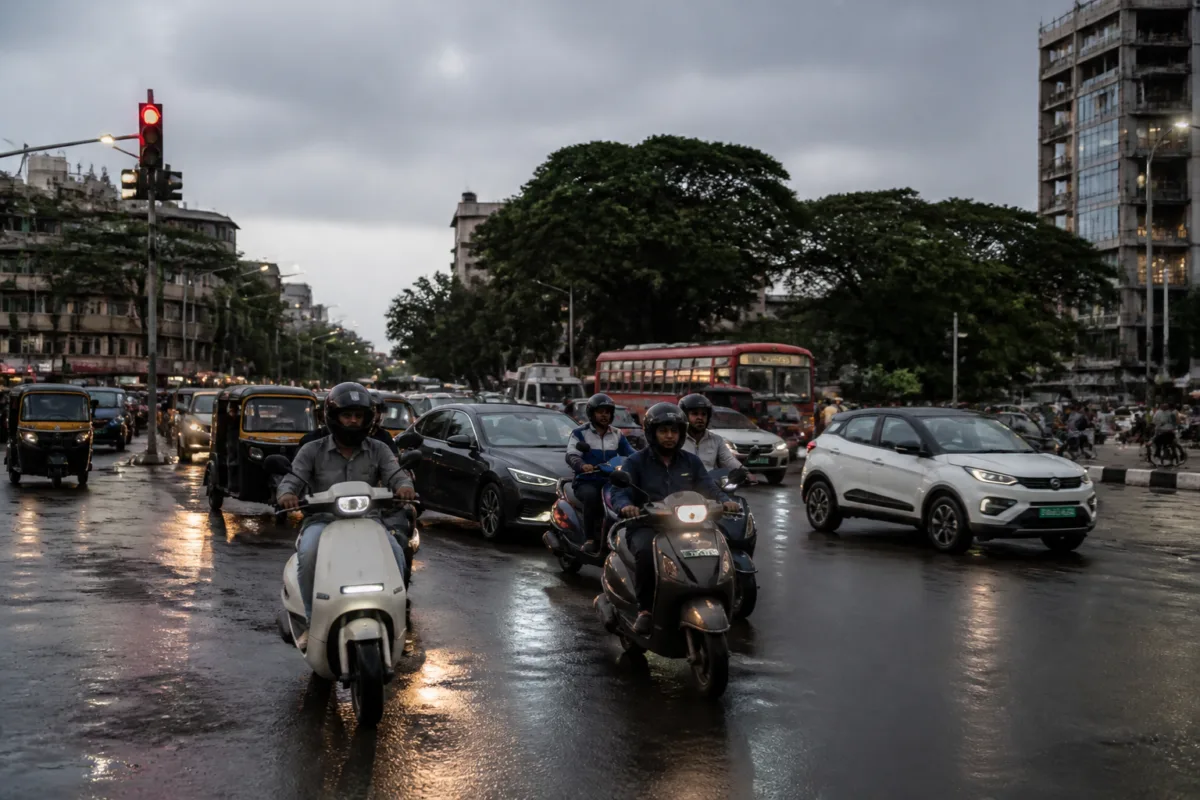
Pune’s vehicle registrations fell sharply during the 2026 Dussehra period, but the decline did not affect every part of the market equally. Regional Transport Office data reported by Pune Mirror shows that total registrations dropped 25.7% year on year between October 10 and 19, while electric vehicle registrations rose 4.6%. The contrast offers a revealing snapshot of a city where overall vehicle demand weakened even as electric mobility continued to expand.
The RTO recorded 10,534 new vehicle registrations during the 2026 Dussehra period, compared with 14,168 during the corresponding period in 2025. The difference was 3,634 vehicles. A festive-period comparison is significant because such periods are commonly treated by the vehicle industry as an important window for purchases. In Pune’s case, however, the latest figures point to a broad contraction rather than a simple change in the timing of purchases.
The data does not establish why registrations declined. Pune Mirror’s report, based on RTO records, specifically notes that the figures record the change in registrations but do not show the reasons behind the overall fall. That distinction matters. Registration data can show what entered the city’s vehicle fleet during a defined period, but it cannot by itself identify whether buyers postponed purchases, shifted to other periods, faced affordability constraints or responded to market conditions. Those explanations are not established in the supplied evidence.
The most pronounced decline was in cars. Registrations fell from 4,813 during the comparable period last year to 2,595 this year, a reduction of nearly 46%. The car segment therefore contracted considerably faster than the overall vehicle market. Since the available data does not provide category-wise reasons, it cannot determine whether this reflected weaker household demand, delayed purchases, changes in financing conditions or other factors.
The fall was not limited to private cars. Tourist taxis and auto-rickshaws also recorded substantial drops, while goods vehicles and tractors registered lower numbers. These categories connect vehicle registrations to several different parts of the urban economy: household mobility, commercial passenger transport, goods movement and rural or peri-urban activity. Their simultaneous decline indicates that the slowdown was spread across both personal and work-related vehicle purchases during the period covered.
Against that wider contraction, electric vehicles moved in the opposite direction. EV registrations increased from 1,566 during the comparable period last year to 1,638 this year, a rise of around 4.6%. The increase was modest in absolute terms, but it is notable because it occurred while total vehicle registrations fell by more than a quarter.
Electric motorcycles accounted for the largest share of the EV registrations listed in the report. Their registrations rose from 1,152 to 1,182. Electric cars also recorded an increase, moving from 355 to 382. Bus registrations edged up from 33 to 36, even as most other vehicle categories declined. The data therefore suggests that the EV trend was not confined to a single vehicle type, although electric motorcycles remained the dominant category among the registrations reported.
The figures also show why total vehicle numbers and the composition of new registrations need to be read separately. A city can experience a decline in the number of vehicles being added while seeing a change in the technologies represented within that smaller addition. Pune’s latest Dussehra numbers show precisely that pattern: fewer vehicles overall, but a slightly larger electric component.
This does not mean that EVs offset the broader fall. The increase of 72 EV registrations was much smaller than the total decline of 3,634 vehicles across all categories. Electric vehicles continued to gain ground within the registration mix, but their growth was not large enough to compensate for the contraction in conventional and other vehicle categories. The evidence supports a more limited conclusion: EV demand showed resilience during a weak registration period.
The distinction is particularly important for understanding urban mobility transitions. A rise in EV registrations can indicate that electric vehicles are becoming more acceptable to buyers, but it does not automatically establish that the city’s overall transport pattern is becoming less dependent on private vehicles. The Pune data supplied here does not include vehicle kilometres, scrappage, public transport ridership, charging infrastructure, trip lengths or the number of existing vehicles removed from service. It therefore cannot measure the effect of the registration changes on congestion, emissions or road use.
Nor does the data establish whether electric vehicles replaced conventional vehicles that would otherwise have been purchased during the same period. The source records new registrations, not the counterfactual choices of buyers. A buyer who registers an electric motorcycle may be switching from a petrol vehicle, adding another vehicle to a household or replacing an older vehicle. Without those details, the numbers show market movement but not the full behavioural change behind it.
The category pattern nevertheless provides an institutional signal for transport planners. The RTO is recording registrations across private, commercial, goods, agricultural and electric categories, creating a view of how the city’s vehicle fleet is changing at the point of entry. That administrative record is useful, but it is not a complete mobility dashboard. Registration data needs to be interpreted alongside the operation of public transport, road capacity, parking demand, charging access and the use of commercial vehicles if authorities want to understand how the urban system is evolving.
Pune’s figures also underline the difference between vehicle-market growth and mobility demand. A fall in registrations does not necessarily mean that people travelled less or that congestion eased. It only means fewer new vehicles were registered during the specified 10-day period than during the corresponding period last year. Existing vehicles remain in use, and the report provides no evidence about traffic volumes or public transport use. Equally, the increase in EV registrations does not by itself show that electric vehicles are replacing petrol or diesel vehicles at the city scale.
The strongest evidence in the report concerns the divergence between segments. Cars saw a sharp reduction, commercial and goods-related categories also weakened, and EVs recorded a small increase. That divergence could become more meaningful if it persists across longer periods, but the supplied material covers only the two comparable Dussehra windows. A longer registration series would be needed to establish whether the latest numbers represent a temporary festive-period change or a sustained shift in Pune’s vehicle market.
The immediate urban question is therefore not simply whether Pune sold fewer vehicles during Dussehra. It is whether the city is entering a period in which the volume of new vehicle additions is weakening while the technology mix gradually changes. The current figures provide evidence of the first pattern during one defined period and a modest indication of the second. They do not yet establish a long-term trend.
For residents, the practical implications remain unresolved in the available data. Fewer new car registrations could eventually affect the pace at which private vehicles are added to the road network, but the report does not provide traffic or parking evidence. Rising electric two-wheeler and car registrations could increase demand for charging and maintenance systems, but no information is supplied on charging capacity or public policy support. The data points to questions for Pune’s transport institutions without answering them.
What the RTO figures confirm is a clear contraction in Pune’s 2026 Dussehra vehicle registrations, led by a steep fall in cars, alongside continued but modest growth in electric vehicles. What remains uncertain is the cause of the overall decline, the extent to which EVs represent replacement rather than additional ownership, and whether the shift will continue beyond the October 10–19 period. Future registration data will show whether this was a short festive-season slowdown or an early signal of a broader change in Pune’s urban mobility market.

