


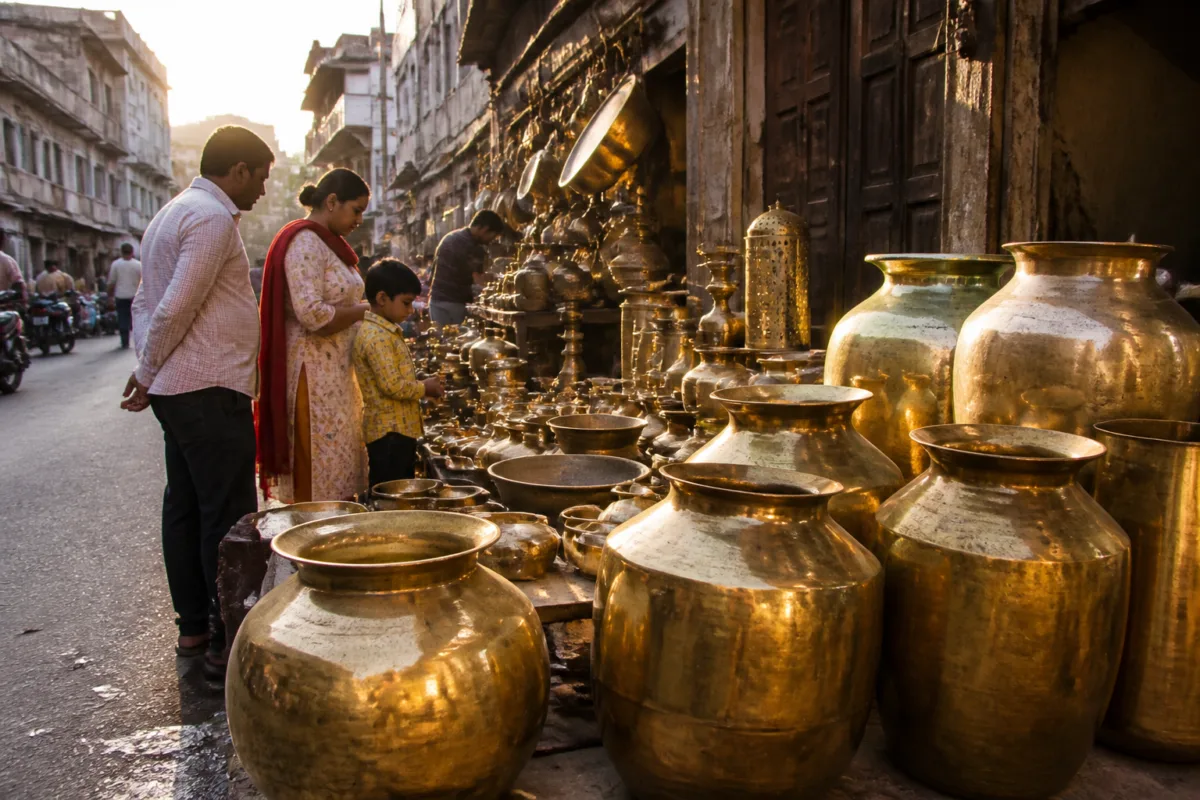
Ahmedabad’s brass utensil market is becoming a place where an older household economy is being converted into cash. At Manek Chowk, families from Gujarat’s villages are reportedly bringing inherited brass vessels for sale as changing kitchens, rising prices and urbanising lifestyles reduce the role these objects once played in everyday life and marriage traditions.
The shift is not simply about a material being replaced by another. Brass vessels once occupied a visible place in Gujarati homes, particularly in the arrangements prepared for a daughter’s wedding. Large vessels, storage containers and cooking utensils were treated as symbols of prosperity, tradition and family standing. According to the report by Gujarat Samachar – Ahmedabad, those objects are increasingly being stored in lofts and boxes, or removed from homes altogether when their owners decide that their monetary value is greater than their practical or cultural value.
The reported price of brass has made that decision more immediate. The material is currently being quoted at approximately ₹1,700 per kilogram, according to the source. For households holding several heavy vessels, the rate creates an incentive to sell objects that have become difficult to use, clean and store. What was once transferred within a family is therefore entering a market where weight, condition and metal value matter more than its history.
### Brass utensils and the urbanisation of domestic life
The decline of brass utensils reflects a wider change in how households are designed and managed. The source links the transition to modular kitchens, stainless steel and cutlery, all of which are presented as more compatible with contemporary domestic routines. Younger family members are also described as reluctant to undertake the cleaning and maintenance associated with brass.
That detail is important because the replacement of brass is not being driven only by fashion. It is also connected to labour inside the home. Brass requires regular cleaning to retain its appearance, while households moving towards compact, standardised and convenience-oriented kitchens may prefer items that are easier to maintain. The report does not provide comparative data on ownership or usage, but it captures the practical calculation behind the change: an object that once represented household wealth can become a burden when the time and space required to preserve it are no longer available.
Urbanisation changes domestic life even when a household remains outside a major city. The source says that villages are also being influenced by modern kitchens and urban lifestyles. This suggests that the relevant boundary is no longer simply rural versus urban. Products, aspirations and household formats associated with city life are reaching smaller settlements, while inherited goods from those settlements are moving into city markets such as Manek Chowk.
The result is a two-way urban connection. Consumption patterns are travelling from cities into villages, while the material remains of older rural and semi-urban households are arriving in Ahmedabad for resale. Manek Chowk becomes the point where these two movements meet: modern household preferences on one side and the liquidation of inherited assets on the other.
### Manek Chowk as a market for changing inheritance
The report describes Manek Chowk as an established utensils market where old brass and bronze objects are now displayed in shops and showcases. Their role has changed sharply. Earlier, similar vessels were acquired for use or placed in a daughter’s wedding trousseau. Today, many are being presented as merchandise after families decide to sell them.
This change turns the market into more than a retail location. It becomes an urban archive of domestic practices that are no longer being reproduced at the same rate. A vessel arriving from a village may retain evidence of a family’s economic history, marriage customs and cooking practices, but the market evaluates it primarily as a saleable object. Its next life may be as a collectible, a decorative item, a repaired utensil or a source of metal.
The report attributes the increase in sellers to old-utensil traders, who say that more people from villages have been coming to sell inherited brass vessels in recent times. The article does not identify the individual traders or provide a quantified increase in arrivals. That limitation matters: the reported rise is a market observation rather than a measured regional trend. Yet it identifies a clear mechanism. When a material becomes difficult to use and its resale price rises, the market can accelerate the separation of objects from the households that preserved them.
The ₹1,700-per-kilogram figure also shows how commodity prices can influence cultural continuity. A family may value an old vessel for its connection to parents or grandparents, but a higher scrap or resale value gives that object a competing economic meaning. The value of heritage is then measured against immediate household needs, storage constraints and the effort required to maintain it.
### What the evidence establishes—and what it does not
The available report establishes three connected developments. First, brass utensils have lost ground to stainless steel, modern kitchenware and cutlery in the households described. Second, inherited brass vessels are reportedly being sold by families from Gujarat’s villages. Third, Manek Chowk’s traders are receiving these objects as part of that flow, with the current brass price providing an additional incentive.
The evidence does not establish how many households have sold their utensils, how the volume compares with earlier years, or whether the reported movement is occurring across Gujarat or mainly among particular communities and income groups. It also does not provide a breakdown of brass prices over time, the proportion of vessels sold for reuse rather than scrap, or the number of Manek Chowk shops involved.
Those gaps prevent the story from being treated as a complete account of the decline of brassware. The report is better understood as a grounded account of a visible transition in household consumption and a market response to it. Its strongest evidence comes from the relationship between changing domestic preferences and what traders are seeing in Ahmedabad’s historic market.
The absence of measurement is itself relevant to the heritage question. Once family objects are sold, the transaction may be recorded as a commodity exchange rather than as the disappearance of a domestic tradition. There may be no formal inventory of the vessels leaving homes, no register of the practices associated with them and no administrative mechanism tracking their movement. The change can therefore be socially significant while remaining statistically invisible.
### The policy question behind a private sale
No government scheme, conservation programme or institutional response is identified in the supplied report. That means the transition is currently presented as a household and market decision rather than a matter being managed through cultural, urban or small-business policy.
Yet the story sits at the intersection of several urban systems. Manek Chowk is part of Ahmedabad’s historic commercial fabric, and its utensils trade connects older forms of production and consumption with contemporary resale markets. The movement of inherited goods into such markets raises questions about how historic commercial districts preserve not only buildings and streets but also the trades and social practices that give them meaning.
It also raises a question about the difference between preserving an object and preserving its use. Brass vessels may remain visible in shop displays after leaving homes, but display does not necessarily preserve the social practice associated with them. A wedding tradition, a method of cooking or a routine of household maintenance can disappear even when the physical objects survive in commercial spaces.
For cities, this matters because urbanisation is often measured through buildings, roads, population and land use. The Manek Chowk account points to a less visible form of urban change: the transformation of household inventories. As kitchens become more standardised and maintenance-intensive objects lose their place in daily routines, urban influence reaches into the material culture of families well beyond the city.
The bigger question is whether the market will remain the only institution deciding what happens to these objects. The supplied evidence does not show any organised attempt to document, repair, reuse or pass on the vessels outside commercial resale. It does show that traders are currently absorbing the supply, while families respond to price and convenience.
Ahmedabad’s brass utensil market therefore captures a transition rather than a single disappearance. The evidence points to inherited vessels moving from household use into commercial circulation as stainless steel, modular kitchens and urban lifestyles reshape domestic choices. The scale of the change remains unmeasured in the supplied report, but the direction is clear: objects once preserved as family wealth are increasingly being judged by their resale value, with Manek Chowk serving as the urban marketplace where that shift becomes visible.

