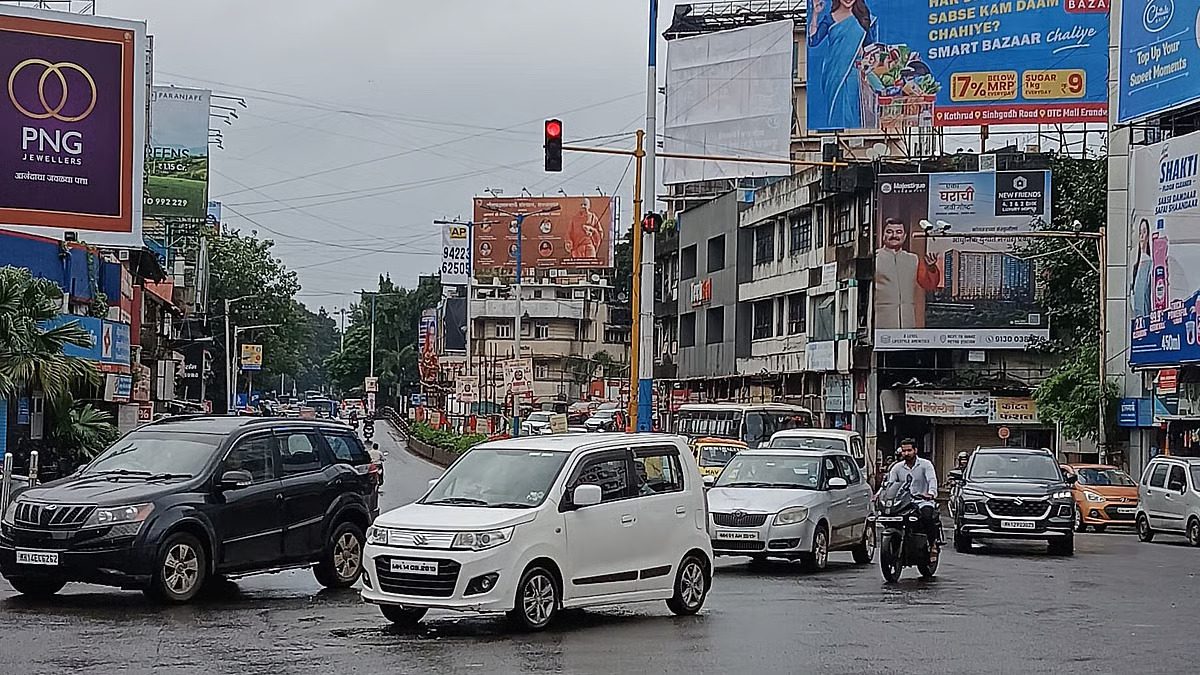
A city choking on its own growth is now turning to artificial intelligence to restore order on its roads. Starting next month, nearly 500 intersections across Pune will be wired into an AI-driven traffic enforcement system that automatically issues challans for violations — a move officials admit is less about technology and more about fixing broken human behaviour.
The Intelligent Traffic Management System (ITMS) marks a sharp departure from decades of underfunded, reactive planning. According to a senior police official, the system will generate up to 99 percent of all traffic challans automatically, removing discretion and delays. “Certainty of punishment changes behaviour,” the official said, explaining why previous fines failed to deter repeat offenders. Behind the push is a stark arithmetic: Pune has 78 lakh registered vehicles but only 7 percent of its land area allocated to roads. By comparison, global best practices recommend 20–25 percent for dense urban cores. The result is a road network operating at nearly five times its intended capacity. A bridge designed for 19,000 vehicles now carries 90,000 daily — a mismatch that turns infrastructure into congestion.
Urban planners have long warned that flyovers and widened roads alone cannot solve what is fundamentally a density and modal shift problem. Only 11 percent of Pune’s citizens currently use public transport. The rest rely on private vehicles, squeezing a system where 32 key roads handle 80 percent of all traffic movement. The AI cameras are not a silver bullet. Officials acknowledge that enforcement must be paired with better road hierarchy, encroachment removal, signal rationalisation, and even basic fixes like pothole repair and clearer markings. Small interventions — including converting select roads to one-way — have already shown measurable improvements in average vehicle speeds. What makes Pune’s approach notable is its shift toward data-driven planning. Instead of relying on outdated surveys, authorities now use real-time inputs from navigation platforms to model traffic flows. That marks a quiet but significant move away from the ad-hoc infrastructure projects that defined previous decades.
For citizens, the AI challan system means fewer traffic police on the ground but far higher odds of being fined for jumping a light or straying into a no-entry zone. The civic question is whether enforcement alone can nudge a car-dependent city toward public transport, walking, and cycling — or whether Pune will simply automate its way into the same gridlock. What changes next is public behaviour. Without a parallel expansion of buses, last-mile connectivity, and safe non-motorised infrastructure, AI cameras risk becoming high-tech tollbooths on a road network that remains fundamentally broken.
Pune Turns To AI Cameras For Traffic Fines