


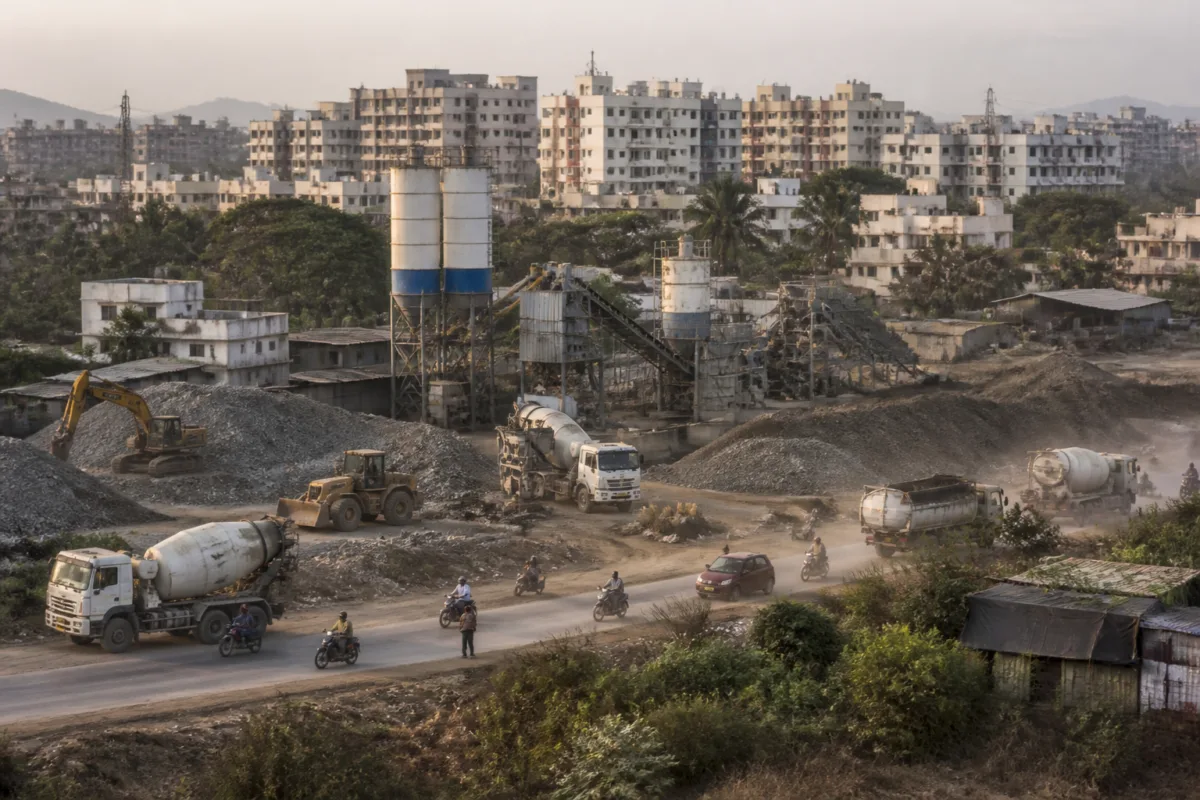
Pune’s ready-mix concrete plants have become a test of whether urban construction can expand without weakening municipal enforcement. A planned demolition drive against unauthorised RMC plants in Vadgaon Khurd was cancelled shortly before it was due to begin, according to a report by Lokmat. The report attributed the cancellation to pressure from a BJP legislator, while Pune Municipal Commissioner Naval Kishor Ram denied that any political person had contacted him and said action would follow if the plants were found to be unauthorised.
The immediate dispute is therefore not only about five concrete plants operating in Vadgaon Khurd. It is about how a city regulates construction-support infrastructure when demand for concrete is high, permissions are unclear or absent, and enforcement involves multiple agencies. The episode also raises a more basic question: whether a municipal demolition action can be sustained when the administration has not yet completed a policy framework for the activity it is trying to regulate.
According to the report, Pune, Pimpri-Chinchwad and the wider district have approximately 300 to 325 RMC plants. Pune Municipal Corporation limits are reported to contain between 100 and 125 plants. The report states that none of these plants has obtained permission from the municipal corporation. Those figures, if confirmed through municipal records, would indicate a regulatory problem extending well beyond one site in Vadgaon Khurd.
Ready-mix concrete plants are closely connected to the building and infrastructure economy. They supply concrete to construction sites, but their operations can also generate dust, vehicle movement and noise. Their location affects nearby residents, roads, river edges and other sensitive urban spaces. The regulatory question is consequently not limited to whether a plant has a construction-related business licence. It also includes land use, environmental safeguards, traffic movement, operating hours, access roads and the responsibilities of municipal and pollution-control authorities.
The Vadgaon Khurd episode follows an earlier municipal action in Khandve-Khadwe Nagar, where seven RMC plants were demolished after a series of reports by Lokmat. The newspaper report says the municipal administration subsequently planned action against plants located near the river and surrounding areas of Vadgaon Khurd. A police deployment had reportedly been arranged for the operation, but the action was cancelled before it began.
The report attributes the cancellation to pressure from a BJP legislator and says that the legislator’s son operates one of the plants in the area. These are serious allegations, but the supplied account does not include documentary evidence of such pressure or an on-record response from the legislator. The municipal commissioner gave a different account. Ram said he had not known about the planned action until he received a message from an individual, after which he ordered that the operation be stopped and asked for detailed information. He said no political person had called or messaged him and that there was no question of political pressure.
That disagreement is central to understanding the institutional problem. The cancellation itself is reported as an event. The reason for the cancellation remains contested. The administration’s explanation suggests that the operation was halted because the commissioner wanted a fuller briefing before proceeding. The report’s sources suggest that political intervention led to the suspension. Without records of the proposed operation, the instructions issued to officials, the police requisition or the subsequent correspondence, the public cannot independently establish which account is accurate.
The episode also shows the consequences of regulating an industry through episodic enforcement. The report says that a policy concerning RMC plants and their vehicle movements was announced by the district collector after an earlier planned action was cancelled. The collector reportedly said that action should not be taken until the policy was prepared and implemented. In May, the administration prepared a policy and sent it to the municipal corporation, the police administration and the Maharashtra Pollution Control Board for comments. The report says that no further action had taken place on the policy.
At the same time, municipal enforcement did not stop entirely. Five unauthorised plants in Bavdhan Budruk were reportedly demolished the previous week. This creates an uneven regulatory landscape: action has been taken in one locality, planned action has been suspended in another, and the broader policy governing plant locations and transport remains pending. For residents and operators, such a system can appear unpredictable. For the administration, it can make every enforcement operation vulnerable to questions about consistency, timing and selective application.
The numbers reported by Lokmat underline the scale of the challenge. If Pune alone has between 100 and 125 RMC plants, and if the wider Pune region and district have about 300 to 325, a case-by-case demolition strategy is unlikely to resolve the regulatory issue by itself. It would address individual sites without clarifying where such plants may operate, what permissions they require, how emissions and dust should be controlled, and how concrete trucks should move through residential areas.
The reported experience of Vadgaon Khurd adds a ground-level dimension. Five plants in the area are said to operate during the day, spreading dust through nearby surroundings. The report also says that the plants have begun operating at night, disturbing residents’ sleep. These complaints are not merely about inconvenience. They point to the conflict between round-the-clock construction supply chains and neighbourhood liveability. A concrete plant may serve projects elsewhere in the city, but the immediate environmental and traffic costs are concentrated around its site.
The policy gap is particularly important because several public authorities appear to have overlapping roles. The municipal corporation is responsible for local permissions and enforcement within its jurisdiction. The police administration is involved when operations require security or when vehicle movement and public order are affected. The Maharashtra Pollution Control Board has a role in environmental regulation. The district administration has attempted to coordinate a policy on RMC plants and transport. The supplied report does not establish how these responsibilities are divided in practice, or whether a single agency has final authority to approve, regulate or close a plant.
That institutional uncertainty can delay action in two ways. Officials may suspend enforcement while waiting for another department’s opinion, or different departments may act without a common operating framework. In both cases, residents experience the result as administrative uncertainty. A policy sent for comments but not implemented does not provide a usable standard for citizens, operators or enforcement officers.
The reported sequence also raises questions about municipal records and transparency. A planned demolition supported by police deployment should ordinarily generate an administrative trail: the inspection findings, notice issued to the operator, legal basis for removal, list of properties covered, reasons for postponement and revised action date. The supplied report does not provide those documents. Their publication would help distinguish a routine administrative review from an externally influenced suspension and would clarify whether the plants were found to be unauthorised under a specific rule.
The issue is not limited to Pune. Across expanding cities, construction materials move through neighbourhoods that were not designed to host industrial activity. When municipal boundaries expand and construction demand grows, concrete batching and transport can become embedded in areas where land values, access roads and residential settlements are changing quickly. The enforcement question is therefore also a planning question: whether cities identify suitable locations for construction-support infrastructure before demand creates informal or unauthorised clusters.
Pune’s own reported figures suggest that this planning question can no longer be treated as a marginal matter. The city’s construction economy depends on concrete supply, but the supply chain requires rules that account for dust, noise, traffic, land use and environmental impacts. A blanket suspension until a policy is finalised may protect administrative consistency, but it can also leave residents exposed if existing plants continue operating. Conversely, isolated demolitions without a clear framework can produce uneven enforcement and renewed disputes.
The evidence currently confirms three things. First, unauthorised RMC plants are a recurring municipal enforcement issue, with action reported in Khandve-Khadwe Nagar and Bavdhan Budruk and a planned operation in Vadgaon Khurd. Second, the district administration’s proposed policy on RMC plants and transport had been circulated for comments but, according to the report, had not progressed further. Third, the alleged political pressure behind the Vadgaon Khurd cancellation remains disputed: Lokmat cited sources making the allegation, while the municipal commissioner denied political contact and said action would be taken if the plants were found to be unauthorised.
The next meaningful developments will be the publication or implementation of the proposed policy, the municipal administration’s documented decision on the Vadgaon Khurd plants, and any official findings on permissions, environmental compliance and operating conditions. Until those records become available, the episode remains less a settled case of political interference than a clear illustration of how incomplete rules and fragmented enforcement can leave residents, officials and construction operators in an uncertain urban system.

