


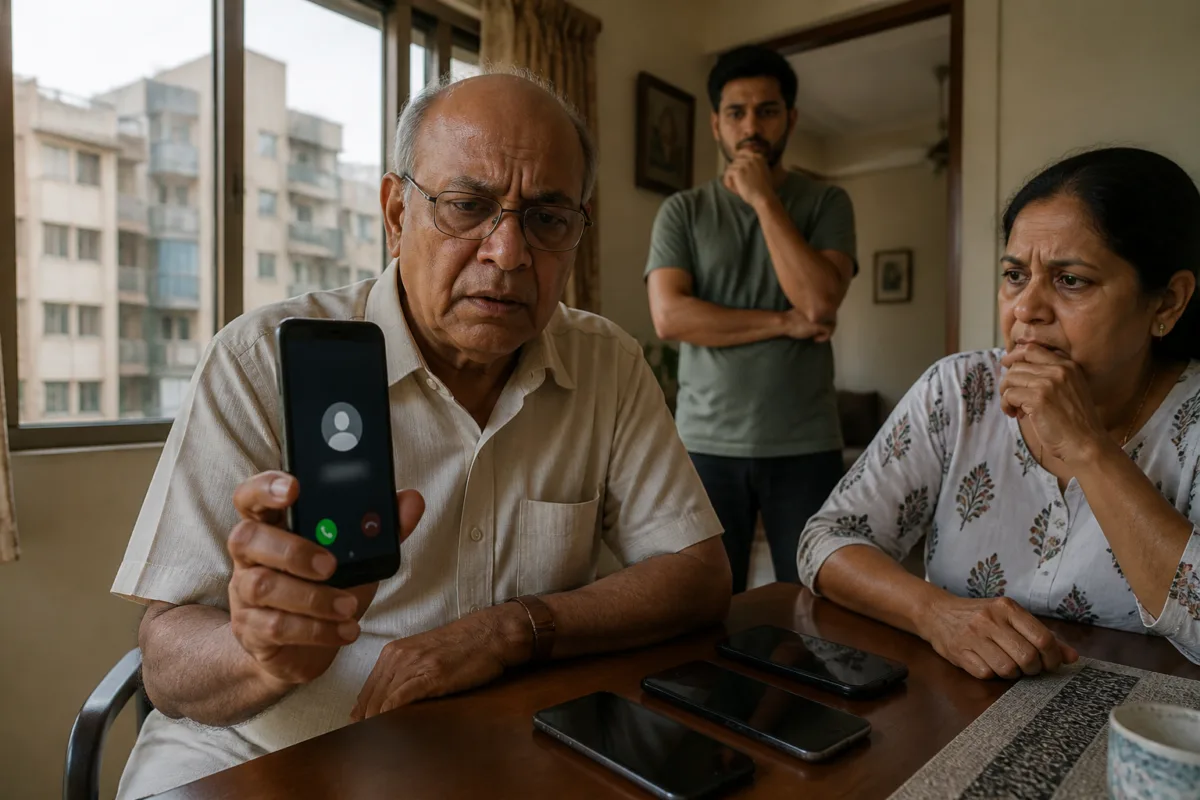
A Pune family’s account of abusive calls over a loan it says nobody in the household took exposes a particularly difficult problem in India’s expanding digital-credit environment: harassment can become an urban safety issue long before the underlying financial claim is established. The family says a caller posing as a recovery agent knew the full names of several relatives, threatened them repeatedly and triggered a fear response that led elderly members to switch off their phones for several hours each day.
The case, reported by the Times of India, concerns Deepak Sukhramani, 63, and his family. According to the report, the trouble began on October 22, when a man identifying himself as Baagwan allegedly claimed that a relative had an outstanding loan of around Rs 12-13 lakh. Sukhramani says the caller became abusive after he denied any connection with the debt. The caller then contacted Sukhramani’s wife, mother, brother and sister-in-law, correctly identifying them by name.
The central fact remains disputed. The family says none of its members had a pending loan and that Mayur, the relative whose name was allegedly linked to the debt, had never received a call about it. Mayur told the Times of India that he learnt of the alleged loan only after relatives began receiving calls. He later approached the local branch of the private lending company named during a conference call and was reportedly told that there was no outstanding loan in his name.
That distinction matters. A demand for repayment is not proof that a debt exists, and a caller’s knowledge of family relationships is not proof of lawful access to a borrower’s records. The supplied report does not establish who made the calls, whether any loan application was filed, how the caller obtained the family’s information, or whether the lending company named on the call had any connection with the harassment. Those questions remain central to the case.
What is established in the account is the impact of the calls. Sukhramani says calls began at around 11 am each day and continued until about 5.30 pm. The family says its elderly members began switching off their phones between 11 am and 5 pm because of the pressure. That response shows how a communications channel that is essential for work, family and commerce can become a source of constant anxiety when unknown callers use threats and personal information.
For Sukhramani, avoiding unknown numbers was not a practical option. He told the newspaper that he works in the car business and receives calls from unfamiliar numbers. The alleged harassment therefore affected not only the family’s emotional security but also its ability to use an ordinary business communication tool. The reported targeting of a pregnant daughter-in-law and a 92-year-old woman further widened the impact beyond the person supposedly connected to the loan.
The case also illustrates the way alleged recovery harassment can spread through a household. Instead of contacting an identified borrower through a documented loan channel, the caller allegedly reached people who said they had no responsibility for the debt. Sukhramani said the caller threatened to continue calling until the loan was repaid, while refusing to provide a satisfactory explanation of where the loan had originated. The family then attempted to connect Mayur and the caller on a conference call so that the alleged borrower could ask how the debt had been created and how it could be repaid.
That exchange produced another unresolved point. Mayur told the Times of India that the caller named a private lending company. When Mayur visited its local branch, he says staff told him that there was no outstanding loan in his name. The report does not include a response from the company confirming or denying the alleged account, nor does it establish whether the caller was an employee, an outsourced recovery agent, an impersonator or an unrelated fraudster.
The reported arrival of one-time passwords added a second layer of concern. Sukhramani said he began receiving OTPs from different e-commerce and delivery platforms and believed the calls appeared to be system-generated. The report does not establish whether these OTPs were connected to the alleged loan harassment, whether any account was accessed, or who initiated the requests. Even so, their arrival intensified the family’s fear because it suggested that someone might be attempting to use his phone number across multiple digital services.
This is where the private incident meets a wider urban systems question. Modern cities depend on remote, phone-based interactions for banking, commerce, transport, deliveries, employment and public services. That convenience also means that a disputed financial demand can reach several members of a household without anyone physically visiting a branch or receiving a conventional notice. When the identity of the caller and the origin of the debt are unclear, the family is left trying to investigate the claim while also protecting itself from further contact.
The institutional response described in the report followed a route that combined local policing with digital complaint mechanisms. The family says it approached the Wanowrie police chowkey on October 23 and again on October 26 after the calls continued. Sukhramani said the first complaint was not accepted immediately and that the family filled in an online FIR form before receiving an acknowledgement after repeated efforts.
Wanowrie police told the Times of India that they had uploaded the complaint and contact numbers on the RBI Sachet app. The police also said they had activated Do Not Disturb to stop unwanted messages and asked the family to contact them when the next call came so that it could be tracked. These steps indicate the limits of a response that depends on the next call arriving at the right time: the family remains exposed to further contact while investigators try to identify its source.
The report does not state whether a formal criminal case was registered, whether telecom records were obtained, whether the private lending company supplied account records, or whether any person was identified. It also does not establish whether the alleged loan was generated through an app, a forged application, an identity-theft incident or a deliberate impersonation attempt. These are not minor details. Each possibility would point to a different institution, evidence trail and remedy.
The family’s experience also raises a question about responsibility when financial communication moves through multiple intermediaries. A caller may describe himself as a recovery agent, while the supposed lender may be a separate company or may deny that the account exists. The person receiving the calls, however, experiences the entire chain as one system. For citizens, the immediate need is not to understand the commercial arrangement behind a call but to know whether the demand is genuine, whether their personal data has been misused and which authority can act.
The available evidence therefore supports a narrower but important conclusion. The Pune family has reported sustained and threatening calls, says the alleged debt does not exist, and says the caller had access to detailed family information. Police have acknowledged the complaint and described steps involving the RBI Sachet app, Do Not Disturb settings and call tracking. The identity of the caller, the origin of the alleged loan, the source of the family data and the connection between the calls and the OTPs remain unestablished in the supplied material.
The next significant development will be whether a subsequent call can be traced and whether documentary records from the named lending company can clarify if any loan account exists. Until then, the case remains a reminder that disputed digital-credit claims can quickly become matters of household safety, privacy and local policing rather than staying confined to a lender-borrower dispute.

