


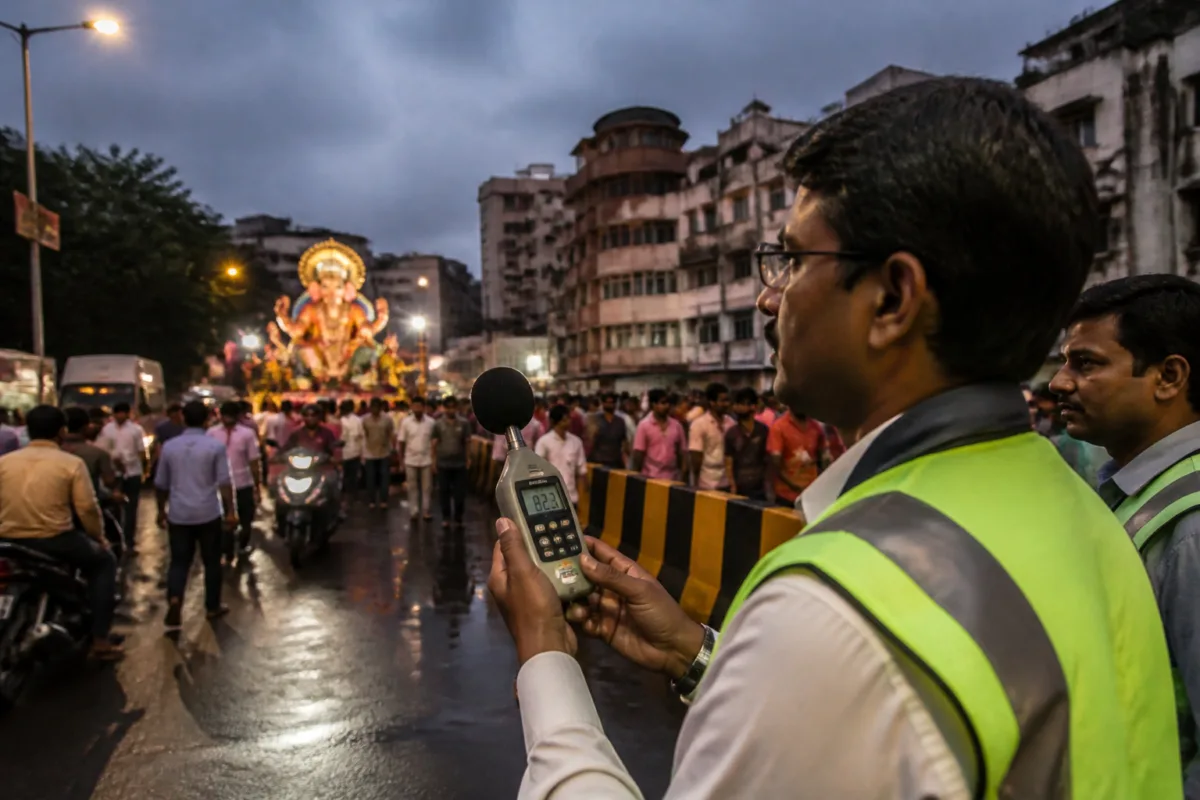
The Maharashtra Pollution Control Board’s failure to publish detailed noise readings from 200 locations in Pune even a month after the Ganesh Chaturthi festival points to a basic weakness in urban enforcement: monitoring is being treated as an exercise in measurement rather than a tool for immediate public action. The festival has ended, but the missing data means residents still cannot clearly see where limits were breached, whether violations were recorded, or what action followed.
According to a report by Lokmat – Pune, the MPCB was responsible for measuring sound levels during the festival. When asked about the detailed figures, the board reportedly said that the data had not yet arrived. The report says the board had collected readings at around 200 locations using decibel meters, but has so far released only a comprehensive summary report rather than location-wise records.
That distinction matters. A summary can confirm that violations occurred, but it cannot show how frequently they occurred, at which locations, during what periods, or whether enforcement followed. For residents who experienced loud music, drums, public-address systems and other amplified sound, the difference between a city-wide summary and a detailed record is the difference between being told that a problem existed and being shown how the administration responded to it.
The monitoring exercise was presented as a special campaign for the festival period. The report says readings were taken each day between 6 pm and midnight at different locations. Where sound levels exceeded permitted limits, organisers were to be instructed initially to reduce the volume. If violations continued, police action was expected to follow. The operational chain, therefore, depended on three linked steps: measurement, communication of the violation and enforcement.
The delayed release of detailed data weakens all three. Without timely publication, residents cannot know whether the readings were used while the events were taking place. Without location-specific information, it is difficult to establish whether instructions were issued to particular organisers. And without an accompanying record of police action, the public cannot assess whether the enforcement mechanism moved beyond warnings.
This is not only a question of transparency after a festival. Noise regulation is a live urban-management function. Sound levels change by time, location and activity. A reading taken during a procession or a loudspeaker performance has value because it can support an intervention at that moment. Once the event is over, the same reading becomes primarily a record of what happened. It may still help accountability, but it no longer protects residents from the immediate exposure that the monitoring was intended to control.
The report places this delay against directions issued by the Bombay High Court. During the Ganesh festival period, the court took note of shortcomings in the implementation of noise-pollution controls through a suo motu petition. The report says the court made clear that noise-level measurement should be carried out in real time and that cases should be registered promptly against those violating the rules.
If those directions are accurately reflected in the supplied report, the central administrative question is not whether the MPCB possessed monitoring equipment. It is whether the agency had a system capable of converting readings into timely, traceable decisions. A real-time framework requires more than deploying decibel meters. It requires clearly assigned responsibility, reliable data transmission, a public reporting mechanism, coordination with the police and a record of what happened after each identified violation.
The Pune episode, as described, suggests that the measurement stage received greater public visibility than the enforcement stage. The MPCB’s campaign was announced, news reports appeared and a contract was reportedly awarded for the work. Yet the detailed output remains unavailable. That creates an institutional gap between announcing an intervention and demonstrating its results.
The gap is especially important because the report says the board’s summary acknowledged violations at different locations. However, it does not identify how many cases were registered, which organisers were proceeded against, or what penalties or other action were taken. The absence of these details does not establish that no action occurred. It does establish that the supplied report does not provide the public with a complete account of the enforcement chain.
That limitation should shape how the episode is read. The available evidence supports a finding of delayed disclosure and incomplete public visibility. It does not support a definitive conclusion that every violation went unpunished or that the monitoring exercise failed at every location. The MPCB’s own reported statement—that detailed data had not yet arrived—also leaves open questions about where the delay occurred: within the monitoring process, in data compilation, in transmission from field teams, or in publication by the board.
The issue had been raised before the festival began. The report says the Loudspeaker Opposition Pune Citizens’ Forum met Pune regional officer B. M. Kukade and submitted a representation seeking daily publication of the readings on the website or through newspapers. The officer reportedly assured the group that action would be taken. The fact that detailed records were still not available a month after the festival has therefore created a second accountability concern: not only whether noise controls were enforced, but whether a specific public-information commitment was fulfilled.
This is where the urban governance dimension becomes clearer. Citizens often experience regulation through a series of disconnected encounters: a complaint, a field visit, a measurement, a warning and, occasionally, a police case. An effective system must connect those events into a record that can be checked. Otherwise, enforcement remains largely invisible. Residents may know that officials visited an area, but not what was measured, what threshold was crossed, who was notified or what happened next.
The report also records concerns about the effect of festival noise on senior citizens, patients and young children. These groups are not incidental to the issue. They represent residents whose ability to avoid noisy public spaces or shield themselves from prolonged exposure may be limited. Yet the supplied material does not provide health measurements, exposure-duration data or a city-wide assessment of harm. The public-health concern is therefore evident at the citizen level, while its scale cannot be established from the available records.
The same evidence gap applies to the measurement programme itself. The report states that readings were taken at 200 locations and during the evening and night window from 6 pm to midnight. It does not provide the full list of locations, the number of readings per location, the instruments used beyond identifying decibel meters, the recorded levels, or the applicable limits for each setting. It also does not say whether the readings were published in a machine-readable or otherwise independently reviewable format.
Those missing details are not technical footnotes. They determine whether the monitoring exercise can be evaluated. A city-wide number of locations can sound substantial, but coverage depends on where those points were placed and whether they represented residential areas, procession routes, religious sites, hospitals, schools or other sensitive locations. Without the underlying records, readers cannot assess the geographic distribution of monitoring or compare reported sound levels across sites.
The policy framework described in the report assigns a shared role to the pollution-control board and the police. The MPCB is responsible for measuring and documenting sound levels, while police action is expected when violations continue after instructions to reduce volume. This division can work only when the handover between agencies is documented. A measurement without a police response record is incomplete; police action without the underlying measurement is difficult for the public to verify.
The delayed data also raises a procurement and contract-management question. The report says a contract was awarded for the monitoring work, but the supplied material does not identify the contractor, the contract value, the deliverables or the deadline for submitting the data. Those details would help establish whether daily reporting was part of the contracted scope and whether the delay represents a service failure, an administrative backlog or a publication decision by the board.
For Pune, the larger lesson is that urban compliance cannot depend only on seasonal campaigns. Festivals intensify the problem, but the institutional requirement is continuous: residents need rules that are measurable, complaints that are traceable and enforcement that can be demonstrated. The report does not establish whether the MPCB’s monitoring model is used consistently outside the festival period. It does show that a campaign framed around real-time control has produced, at least so far, an incomplete public record after the event.
The next stage should be judged against verifiable outputs. The MPCB’s detailed readings, the locations covered, the instances of limit violations and the action taken by the relevant authorities would clarify what the monitoring exercise achieved. Until those records are published, Pune residents are left with a summary acknowledgement of violations but without the evidence needed to examine the city’s response. The festival’s sound may have stopped, but the accountability process remains unfinished.

