


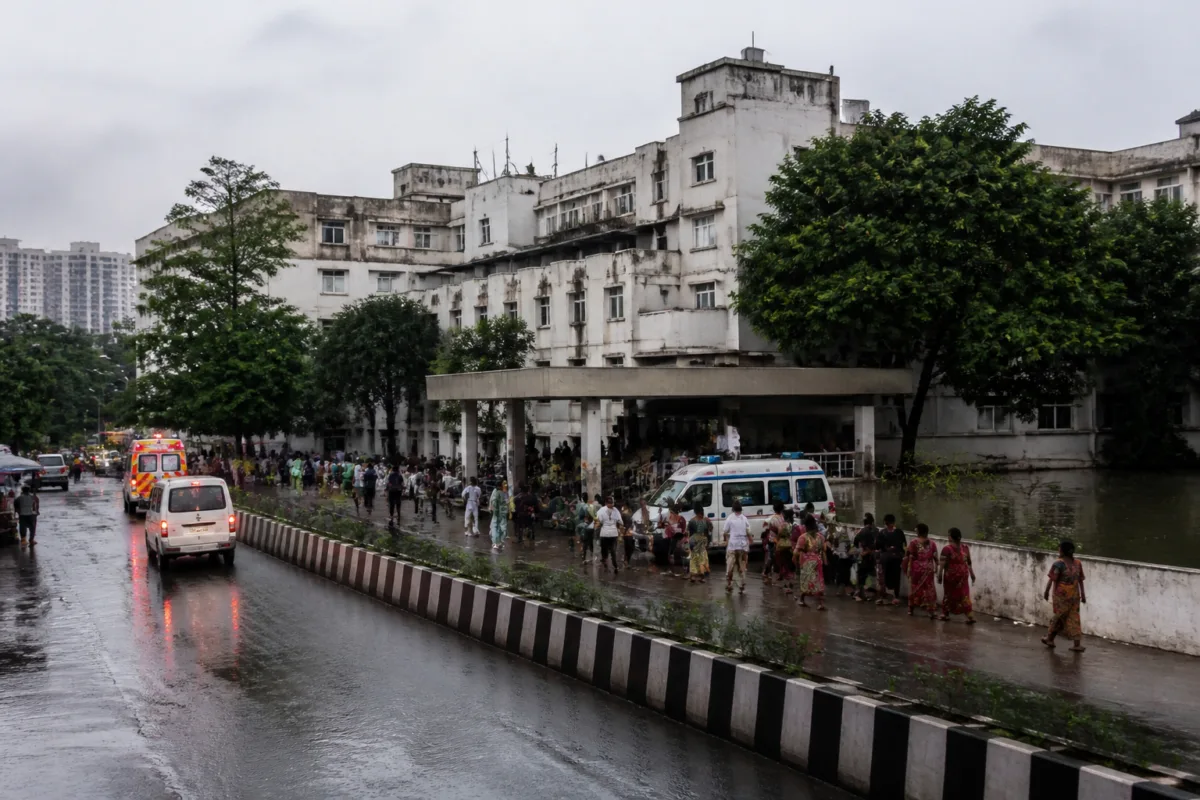
The prolonged decline of Annasaheb Magar Hospital in Hadapsar shows how a public hospital can remain formally present but functionally inadequate for the neighbourhood it serves. Although plans to convert the facility into a 200- to 250-bed multispeciality hospital have been discussed for years, residents continue to report shortages of equipment, specialists, medicines, diagnostic services and usable inpatient capacity.
The hospital is important because of the geography it serves. Hadapsar, Fursungi, Manjari, Mundhwa and nearby informal settlements depend on it for affordable public healthcare. The expansion of Pune Municipal Corporation limits has also increased the population and service burden in the eastern part of the city. Primary care centres and Balasaheb Thackeray Aapla Dawakhana facilities may address some routine needs, but specialist consultations, emergency treatment and inpatient care still require a larger public hospital network.
That distinction is central to understanding the problem. A neighbourhood may have several primary-care facilities and still lack meaningful access to healthcare if patients must travel elsewhere for diagnosis, emergency treatment or admission. According to the Lokmat report, patients are sometimes given medicines based on symptoms without adequate tests, while others are advised to go to Sassoon Hospital or Kamala Nehru Hospital when the required treatment is unavailable. For low-income households, the resulting journey is not merely an inconvenience. It can involve transport costs, lost wages, repeated registration and the risk of turning to private hospitals whose charges are unaffordable.
Annasaheb Magar Hospital’s physical condition further complicates its service role. The existing building was constructed in 1956 and is reportedly considered to have reached the end of its useful life. The hospital campus is lower than the adjoining road, allowing rainwater to enter the premises during the monsoon. The report says that water has reached sensitive areas, including the operation theatre, raising a direct question about the safety and continuity of medical services.
The condition of the building is not separate from the question of clinical capacity. A hospital cannot expand services simply by announcing more beds if the structure, utilities and infection-control systems cannot safely support them. An ageing building may require structural assessment, drainage improvements, electrical upgrades, fire-safety measures, medical-gas systems and redesigned patient movement before additional departments can operate reliably. The supplied report does not establish whether a comprehensive structural or technical audit has been completed, making that an important unresolved part of the modernisation question.
Equipment availability is another indicator of the gap between nominal capacity and real capacity. Lokmat reports that the X-ray machine is not functioning and that the oxygen plant has been shut for several days. Residents have also raised concerns about beds and other material purchased during the Covid-19 period reportedly lying unused. These details point to a broader administrative problem: public healthcare capacity depends not only on procurement, but also on commissioning, maintenance, staffing, power supply, calibration and routine oversight.
The issue is therefore not simply whether Pune Municipal Corporation should buy new equipment. It is whether the existing assets are being tracked and maintained, whether breakdowns are repaired within defined timelines, and whether the hospital has trained personnel to operate them. A working X-ray machine, for example, requires more than the physical equipment. It also requires technicians, reporting arrangements, consumables, maintenance contracts and a patient pathway that connects the result to treatment.
Residents quoted in the report have asked for specialist doctors, trained medical staff, adequate medicines, diagnostic services and sufficient inpatient arrangements. Their demands place the hospital in the wider context of public-sector healthcare access in a rapidly expanding urban area. When residential growth and municipal expansion move faster than hospital planning, existing facilities become overloaded even if their buildings and staffing levels remain unchanged.
The proposed 200- to 250-bed multispeciality facility is intended to address that mismatch. A neighbouring building that formerly housed a police station is reportedly vacant and has been suggested as a possible expansion site. However, the report says that no concrete decision has been taken to start work or use the property for hospital expansion. This is where an announcement becomes a governance test. A plan acquires public value only when it is linked to a defined site, approved design, funding, procurement process, implementation agency and timeline.
According to corporator Hemlata Magar, the hospital is planned to become a super-speciality facility and Rs 4.5 crore has been allocated in the current year. The report does not provide the relevant budget document, administrative sanction, detailed project report or spending schedule. It is therefore not possible from the available material to establish whether the allocation is intended for building construction, equipment, repairs, staffing or a combination of these needs. That distinction matters because Rs 4.5 crore may support immediate repairs and equipment activation, but the full cost and institutional requirements of a 200- to 250-bed multispeciality hospital would depend on the scope approved by the municipal administration.
The funding question also illustrates why hospital modernisation cannot be reduced to a single capital allocation. Buildings and machines are visible investments, but hospital performance depends on recurring expenditure. Specialists, nurses, technicians, pharmacists, cleaners, biomedical engineers and maintenance personnel require continuing budgets. Medicines, oxygen, laboratory supplies and equipment servicing also create operating costs. Without those commitments, a new building can reproduce the same shortages in a newer structure.
The report’s account of referrals to Sassoon and Kamala Nehru hospitals suggests that the city’s public healthcare network is already interconnected. Referral is not inherently a failure; hospitals need different levels of specialisation. The problem arises when patients are redirected because a facility lacks basic diagnostic or emergency capacity, without a clear transport and appointment system. For residents of eastern Pune, the practical quality of the network depends on how quickly and safely patients can move between primary care, Annasaheb Magar Hospital and higher-level institutions.
This makes the hospital a municipal administration issue as much as a health department issue. The corporation must coordinate land use, building safety, drainage, procurement, staffing, equipment maintenance, hospital operations and patient grievance handling. Responsibility can become fragmented when construction, engineering, public health and finance departments work on separate timelines. A modernisation proposal should therefore be evaluated not only by its stated bed count, but also by who is responsible for each stage and how progress will be publicly measured.
The evidence supplied in the report confirms a persistent mismatch between demand and available services. It identifies a 1956 building, reported flooding, a non-functional X-ray machine, a shut oxygen plant, shortages of specialists and calls for 200 to 250 beds. It also records a proposed Rs 4.5 crore allocation and a possible expansion site. What it does not establish is the hospital’s current occupancy, sanctioned strength, actual staff vacancies, equipment inventory, patient volume, structural assessment, project cost or implementation deadline. Those figures would be necessary to judge whether the proposed response matches the scale of the problem.
That missing information should become part of the public discussion. A credible modernisation programme would need to clarify the present condition of the building, the safety of clinical areas during the monsoon, the status of equipment purchased during Covid-19, the staffing plan and the timeline for restoring essential diagnostics. It would also need to explain whether services will continue during repairs or expansion, since construction activity inside an operating hospital can itself affect patient safety and access.
Annasaheb Magar Hospital’s condition raises a larger urban question: what happens when peripheral areas are absorbed into a growing municipal corporation but essential public institutions do not expand at the same pace? The answer is visible in the longer journeys, higher private medical costs and pressure placed on central hospitals. Public healthcare infrastructure is not only a welfare service; it is part of the city’s everyday mobility, household finances and resilience during emergencies.
The available evidence supports the need for immediate attention to functioning equipment, staffing, medicines, building safety and a defined expansion plan. It does not yet show whether the proposed multispeciality project has moved beyond discussion. The next meaningful milestones would be a published implementation plan, confirmation of the Rs 4.5 crore allocation’s purpose, a safety assessment of the existing building, and clear timelines for restoring or replacing essential services.

