


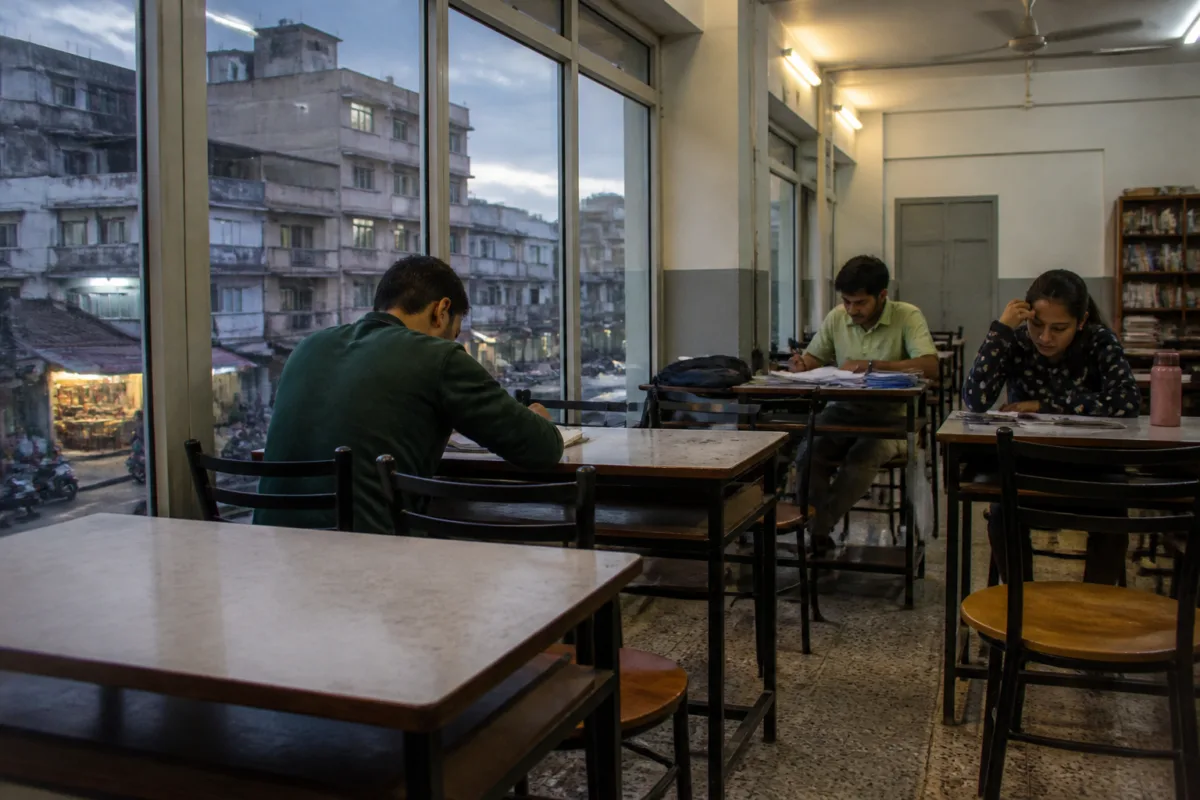
Pune’s MPSC student economy is showing the cost of uncertainty. Students preparing for Maharashtra’s competitive examinations are returning to their villages as delayed examinations, uncertain result timelines and rising living costs collide with financial pressure in their households. Their departure is reducing demand across hostels, messes, coaching classes, study libraries, tea shops and snack outlets in parts of the city.
The shift is concentrated in neighbourhoods such as Sadashiv Peth, Narayan Peth, Shaniwar Peth and Budhwar Peth, which have long accommodated students preparing for government recruitment examinations. The report by Sakal describes these areas not simply as education clusters, but as local economies built around the daily needs of a transient student population. Accommodation, food, study space, teaching, transport and other routine services are connected through the presence of these students.
That connection matters because the economic effect of a student leaving Pune is distributed across several small businesses rather than confined to one institution. A student who vacates a hostel also stops buying meals from a mess, tea from a neighbourhood shop, stationery and study material from local sellers, and services linked to coaching and examination preparation. Individually, each expense may appear modest. Collectively, the report argues, they form a substantial urban consumption cycle.
Sakal estimates that Pune currently has close to one lakh students preparing for competitive examinations. It places the average monthly cost of accommodation and food at Rs 12,000 per student and estimates annual turnover of Rs 1,200 crore through these expenses. The report further says that 30 to 50 per cent of students have returned to their villages because examinations have repeatedly been postponed, with a possible reduction of up to Rs 720 crore in annual turnover.
These figures are estimates cited in the report, rather than an audited account of the sector. They also point to the difficulty of measuring a dispersed urban economy. Unlike a registered company, the MPSC preparation ecosystem includes private rooms, hostels, informal paying-guest arrangements, messes, cafés, libraries, coaching centres and book businesses, each with different revenue patterns. The scale of the reported impact therefore needs to be read as an indication of the disruption, not as a verified citywide economic account.
The pressure is visible at street level. Ganesh Malekar, quoted as a local tea seller, said that the number of students visiting his shop in the morning and evening had fallen by about 100 from an earlier level of roughly 300. Mess operator Shankar Kachare said around half of the students had stopped eating at his establishment. Some had gone back to their villages, while others had changed their food arrangements to reduce expenses. At the same time, he said, the cost of grain, vegetables and cooking gas had not fallen.
This is the central vulnerability of a student-dependent neighbourhood economy: revenue can fall quickly while fixed and semi-fixed costs remain. Hostel rents, commercial electricity bills, employee wages, maintenance and cooking expenses continue even when occupancy and daily customers decline. For small operators, a fall in footfall can therefore affect viability long before the business formally closes.
The hostel sector is reporting a similar contraction. Dattatraya Vidhate, a hostel operator cited by Sakal, said 15 of 50 female students had already returned home and another three or four were expected to leave at the beginning of the following month because the fees were no longer affordable. He also estimated a 30 to 40 per cent impact on the hotel business. Another operator, Rahul Patil, said his hostel had once maintained a waiting list, but its student strength had now fallen by half.
The reported change is not only a demand shock. It is also a sign that the city’s role as a preparation centre depends on students being able to remain in Pune for long periods without certainty about when examinations will be held or results declared. When the examination cycle becomes unpredictable, staying in the city becomes a recurring financial commitment without a clear end point. Students and families then have an incentive to shift preparation back to the village, even if access to coaching, libraries or peer groups is weaker there.
For students from households already facing financial stress, the decision is particularly consequential. The report links the migration to two pressures: the cost of living in Pune and economic difficulty in the villages, including distress associated with drought. This creates a difficult situation in which families must finance preparation while also managing unstable household incomes. Returning home may reduce accommodation and food expenses, but it can also disrupt access to the urban services around which the preparation process has been organised.
The effects extend to businesses that depend on new enrolments. The report says admissions to private coaching classes and the book-publishing business have fallen by 70 to 80 per cent. These are substantial claims and are presented in the report as part of the sector’s current distress. If sustained, such a fall would affect not only teaching businesses but also the wider chain of instructors, administrative workers, publishers, printers, distributors and local retailers attached to examination preparation.
The institutional issue behind the commercial decline is the predictability of the examination system. Competitive examination aspirants plan accommodation, coaching fees and study schedules around an expected calendar. When examinations are delayed or results take longer than expected, the cost of preparation is extended. The burden is carried by students and families, while the city businesses serving them experience irregular demand.
Kiran Nimbhore, a competitive-examination guide quoted by Sakal, said students need a fixed examination schedule and financial support so that economically weaker candidates can continue studying in Pune. That suggestion identifies the gap between examination administration and urban affordability. The examination authority may control the timetable, but the consequences of uncertainty are experienced through housing, food and mobility decisions made in neighbourhoods across the city.
Pune’s MPSC preparation districts also demonstrate how temporary populations shape permanent commercial patterns. Hostels and messes are not incidental services for these students; they are part of the infrastructure of access to competitive examinations. Their availability allows candidates from different parts of Maharashtra to prepare in a city with established coaching, library and peer networks. A reduction in student numbers may therefore change the viability of this support system even before it becomes visible in formal economic data.
The report’s estimate of a Rs 2,000 crore economy linked to competitive-examination students includes the broader ecosystem, while its accommodation and food estimate is placed at Rs 1,200 crore annually. The distinction is important: the larger figure appears to include coaching, study spaces, books and related businesses, whereas the lower estimate concerns living and food expenses. The supplied report does not provide a methodology for either estimate, so the precise size of the economy remains uncertain. What is clearer is the direction of change described by multiple operators: fewer students, lower occupancy and reduced daily consumption.
That pattern raises a wider question about the resilience of neighbourhoods built around a single, highly concentrated customer base. Specialisation can create efficient services and affordable choices for students, but it also exposes local businesses to disruption when the population changes suddenly. In Pune’s case, the disruption is tied to an examination system whose timing affects not only candidates but also the urban services they use.
The evidence currently establishes a reported decline in student presence and business activity, along with continuing costs for operators. It does not establish the final number of students who have left Pune, how long they will remain away, or whether demand will return when examination dates are confirmed. Those developments will determine whether the present contraction is a temporary adjustment or a deeper restructuring of the city’s competitive-examination economy.

