


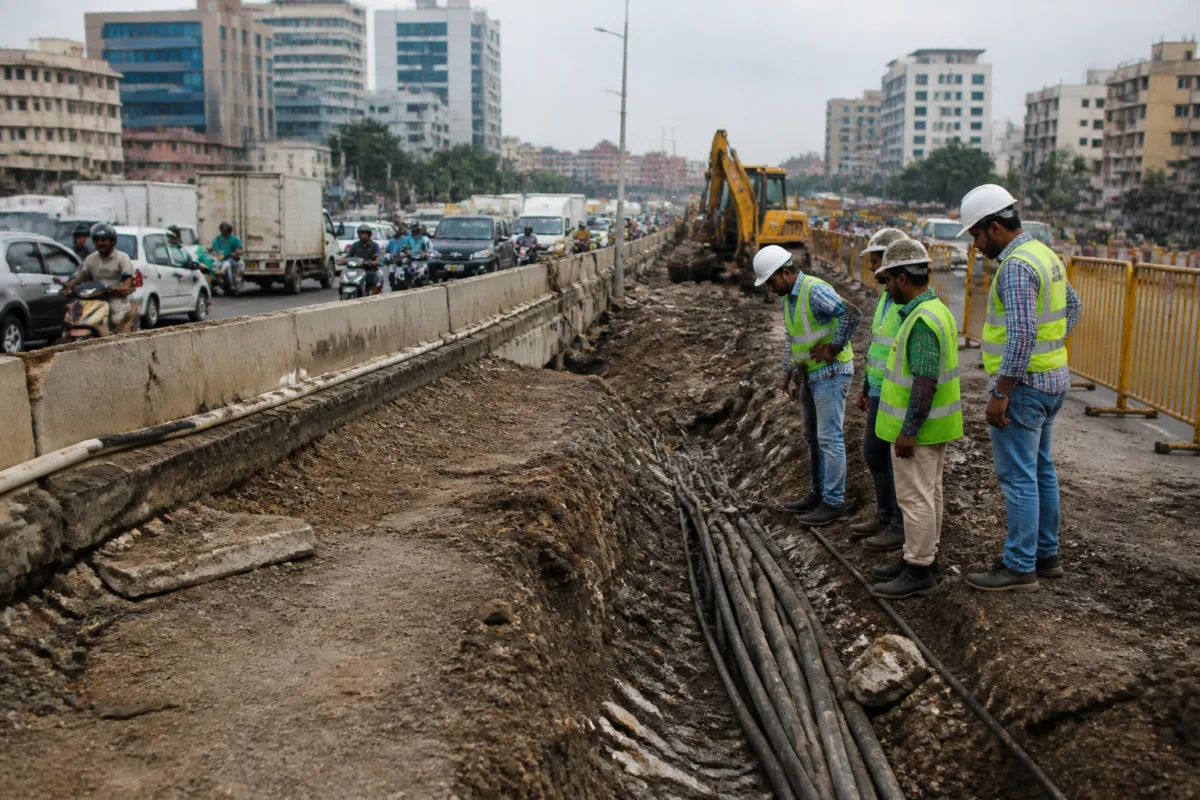
Repeated damage to underground electricity cables during widening work between Wakad Bridge and Chandani Chowk has exposed a basic weakness in urban infrastructure delivery: road expansion can move faster than the mapping, protection and relocation of the utilities buried beneath it. The incidents affected 22 kV cables on 16 and 17 October and another cable on 31 October, according to a report by Civic Mirror – Pune based on information from Mahavitaran officials.
Mahavitaran’s Baner branch office, under the Aundh subdivision, filed a complaint at Bavdhan police station on 27 October against the contractor involved in the work. The electricity distribution company has alleged that highway and service-road work continued despite prior warnings about the underground network and before the cables were safely relocated.
The immediate issue is damage to electrical infrastructure. The larger urban problem is the absence of a reliable interface between transport construction and essential services. A highway widening project does not occupy an empty corridor. Its alignment intersects with electricity cables, water lines, drainage systems, telecom networks and access routes. When these assets are not identified and relocated before civil work begins, the cost is transferred to utility agencies and, ultimately, to residents who depend on uninterrupted services.
The work is taking place along the Mumbai-Bengaluru Highway between Wakad Bridge and Chandani Chowk, a corridor serving rapidly urbanising parts of the Pune metropolitan region. The report identifies the affected electricity assets as underground high- and low-tension lines, including the 22 kV Beverly feeder and the 22 kV Nia feeder. The Beverly feeder cable was damaged on 16 October, while the Nia feeder cable was damaged near Bitwise Chowk on 17 October. Another cable fault was reported on 31 October.
These are not isolated assets serving a single building. Mahavitaran has warned that faults in the lines along the corridor could affect electricity supply in Aundh, Baner and Mahalunge, where a large number of consumers are connected to the network. The report does not establish that all these consumers were affected by each incident, but it records the utility’s concern that future damage could disrupt supply across these areas.
The operational consequences extend beyond the repair bill. When an underground cable is damaged, the distribution company must identify the fault, isolate the affected section, repair or replace the cable and restore supply. Mahavitaran has estimated that the repeated incidents caused losses running into lakhs of rupees through repair and restoration work. The report also says that interruptions inconvenience consumers and affect the utility’s revenue.
The more serious risk arises when road construction changes the position of an existing cable without formally relocating it. Lines currently placed along the road edge could end up beneath the carriageway or under concrete after widening. If a fault develops later, locating the damaged section becomes harder and repairs may require cutting into a completed road. That can extend outages, disrupt traffic and impose another round of civil works on a corridor that was intended to improve movement.
This is the infrastructure sequencing problem at the centre of the dispute. Mahavitaran’s position, as reported, is that cables should be identified and safely shifted before road work proceeds. The utility says the agency undertaking the work must obtain its estimate, secure approval and complete the required process for relocation. In other words, utility shifting is not simply a technical task to be handled after construction. It is part of the project’s design, costing and implementation sequence.
The report indicates that the National Highways Authority of India obtained Mahavitaran’s approval for the work within the Pimpri-Chinchwad Municipal Corporation limits. Senior Mahavitaran officials, however, said that similar permission had not been obtained for work within Pune Municipal Corporation limits. The supplied report does not provide the exact boundary point, approval documents or the contractor’s response. It does, however, identify a significant administrative distinction: a single highway corridor can pass through more than one municipal jurisdiction, with different permissions and coordination requirements.
That division matters because infrastructure corridors are continuous while administrative responsibilities are not. A contractor may work on one project across multiple local-government areas, but utility permissions, road-cutting approvals and asset records may be processed separately. If the project’s coordination system does not reconcile those jurisdictions before excavation begins, work can remain authorised in one section and disputed in another.
The police complaint brings the issue into the legal and public-property domain. Mahavitaran has asked for action against the contractor to prevent further damage to public assets. The complaint records the allegation that work continued despite prior warnings and before safe relocation of the cables. A complaint is not a finding of liability, and the supplied report does not state whether an investigation has resulted in charges or other action. The central question for accountability will be whether the relevant approvals, warnings, site instructions and utility drawings were available and followed before excavation.
The episodes also show why underground infrastructure creates a different maintenance challenge from visible road assets. A damaged streetlight pole or traffic signal can be seen and replaced at the surface. A cable buried below a road may remain inaccessible after construction and its precise location may be difficult to establish without reliable records. The risk therefore increases when new pavement or concrete permanently covers a corridor whose utility alignment has not been verified.
For electricity consumers, the concern is not limited to one contractor or one repair bill. Reliable power depends on a chain of decisions made before a project reaches the construction stage: accurate mapping of existing networks, a clear relocation plan, approval of the cost estimate, protection of live lines during excavation and confirmation that the shifted asset is accessible for future maintenance. The report’s details suggest that a failure at the coordination stage can create both immediate outages and longer-term maintenance exposure.
The institutional arrangement described in the report places Mahavitaran in the role of utility owner and safety authority for its cables, while the highway and service-road project is being executed through agencies and contractors responsible for the transport corridor. Municipal boundaries add another layer. The road project cannot be treated only as a transport intervention because its construction footprint affects electricity distribution and the functioning of neighbourhoods beyond the carriageway.
The evidence supplied does not establish the total cost of the damage, the duration of each outage, the identity of the contractor, the precise project authority or the status of the police complaint. It also does not say whether a complete utility survey was conducted before work began. Those gaps are important because they determine whether the incidents reflect an isolated execution failure or a broader weakness in project planning and inter-agency control.
What the report does establish is a repeated pattern: three cable-related incidents were recorded during the widening work, Mahavitaran says warnings were not adequately acted upon, and a formal complaint was filed after the damage. It also establishes that the utility considers future disruption possible if high- and low-tension lines are not properly planned and shifted before road construction is completed.
The larger urban question is whether Pune’s infrastructure projects are being managed as connected systems or as separate contracts. A wider highway may improve capacity, but its benefits can be undermined if construction damages electricity networks, creates avoidable outages or leaves critical cables inaccessible beneath the finished road. The next relevant milestones are the response to the police complaint, confirmation of the permissions obtained for each municipal jurisdiction and evidence that the affected cables will be safely relocated before further work proceeds.

