


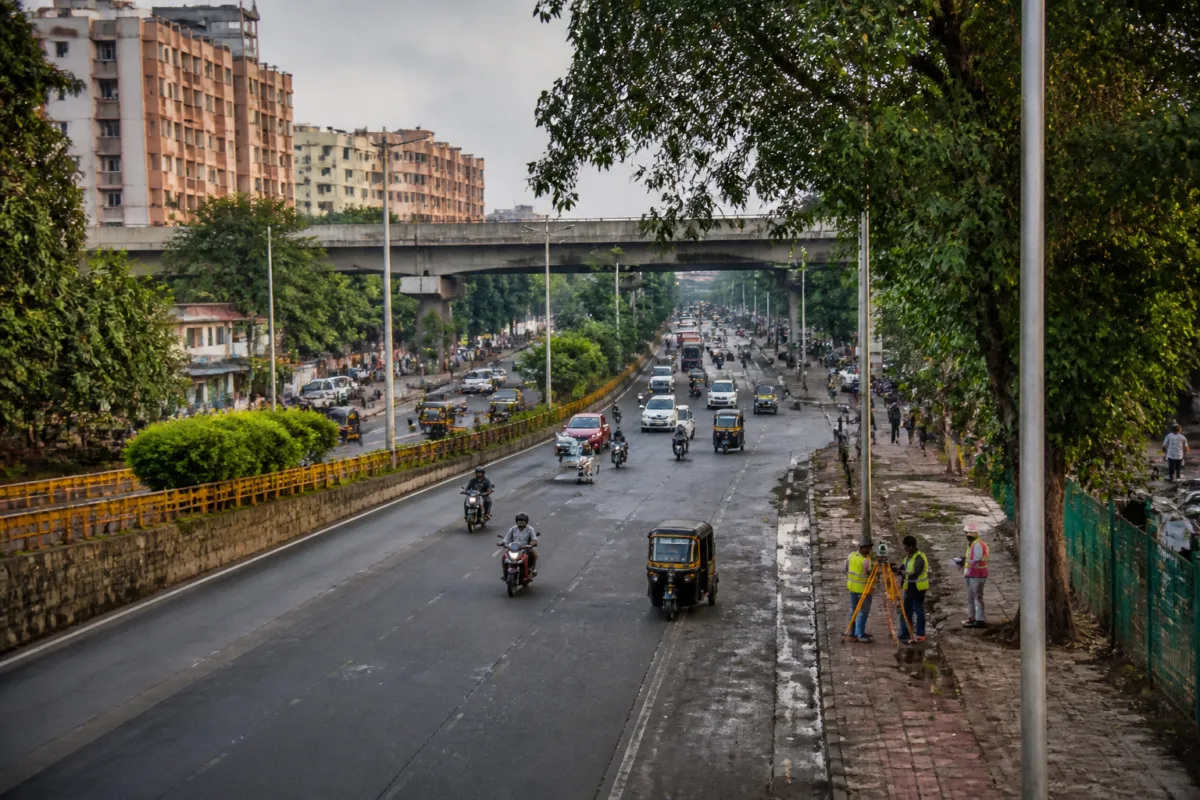
Pune Municipal Corporation’s General Body has approved a proposal to acquire land for the 43.6-km High Capacity Mass Transit Route, with the land requirement estimated at Rs 2,634 crore, according to a report by Pune Mirror. The approval moves the long-discussed elevated corridor closer to implementation, but the reported figures for the total land requirement and land still to be acquired require clarification from official project documents.
The proposed circular route is intended to address Pune’s traffic congestion. The civic body has submitted land-acquisition proposals covering Bopodi, Aundh, Bhamburda, Erandwane, Kothrud, Hingne, Parvati, Munjeri, Wanawadi, Hadapsar, Mundhwa, Vadgaon Sheri, Lohegaon, Yerawada and Dhanori.
Pune Mirror reported that approximately 4,98,390 sq m of land would be required for acquisition, with estimated compensation of Rs 2,634 crore. The report also stated that the project would require 144 hectares in total and that 51 per cent of this land was already in the PMC’s possession. It does not explain whether the 4,98,390 sq m refers only to privately owned land, a particular project component or a different measurement basis. That distinction is important because it affects the scale of compensation, the number of affected properties and the civic body’s financial obligations.
The acquisition is proposed under the Right to Fair Compensation and Transparency in Land Acquisition, Rehabilitation and Resettlement Act, 2013, along with Section 126 of the Maharashtra Regional and Town Planning Act, 1966. The report said the District Collector had directed PMC to deposit the full compensation amount when final awards are issued, instead of requiring the initial 30 per cent deposit before a notification under Section 19. This would reduce the immediate funding requirement for initiating the process, while leaving PMC responsible for substantial provision when final awards are made.
The project’s financial responsibility is linked to jurisdiction. Minutes of a meeting chaired by the Chief Minister reportedly directed the agencies concerned to acquire land and bear the costs for areas under their respective control. PMC is therefore expected to fund land acquisition for the HCMTR within its jurisdiction. The proposal was recommended for approval through the Standing Committee before being forwarded to the state government.
The HCMTR was included in Pune’s 1987 Development Plan. The original proposal envisaged a 36-km, 24-metre-wide route between Bopodi and Vishrantwadi. Following changes at 12 locations to address land-acquisition and implementation constraints, the alignment was expanded to 43.6 km and received final state government approval in 2024, according to the report.
The elevated corridor is planned to begin at Harris Bridge in Bopodi and pass through areas including University Chowk, Senapati Bapat Road, Balbharati-Paud Phata, Sinhagad Road, Swargate, Bibvewadi, Hadapsar, Magarpatta, Vadgaon Sheri, Viman Nagar, New Airport Road and Vishrantwadi before reconnecting to Khadki and Bopodi. Ten entry and exit ramps are proposed to link the route with highways towards Solapur, Satara, Ahmednagar and Sinhagad Road.
The proposed six-lane route would bar two-wheelers and three-wheelers. Its two central lanes are intended for electric buses, while the outer lanes would be available to private vehicles. Around 29 km of the route would run along existing roads, which the report said would reduce the land-acquisition burden.
PMC has also coordinated with MahaMetro and the Maharashtra State Infrastructure Development Corporation on seven crossings and two stretches running parallel to Metro routes. Permissions involving Defence and Forest department land were described as being in the final stage, with technical conditions including vision and sound barriers under consideration.
Implementation is planned in four packages. Two special-purpose-vehicle committees were established in July 2026: an executive committee chaired by the Municipal Commissioner and a high-level committee chaired by the Chief Minister. Project head Dinkar Gojare said the civic administration planned to complete private-land acquisition by January and accelerate the start of physical work.
The next major questions are the final alignment, the properties and owners affected, the confirmed land area requiring acquisition, and the funding schedule for compensation. These details should be reconciled in PMC’s approved resolution, land schedules and acquisition documents before the project’s financial and spatial impact can be assessed definitively.

