


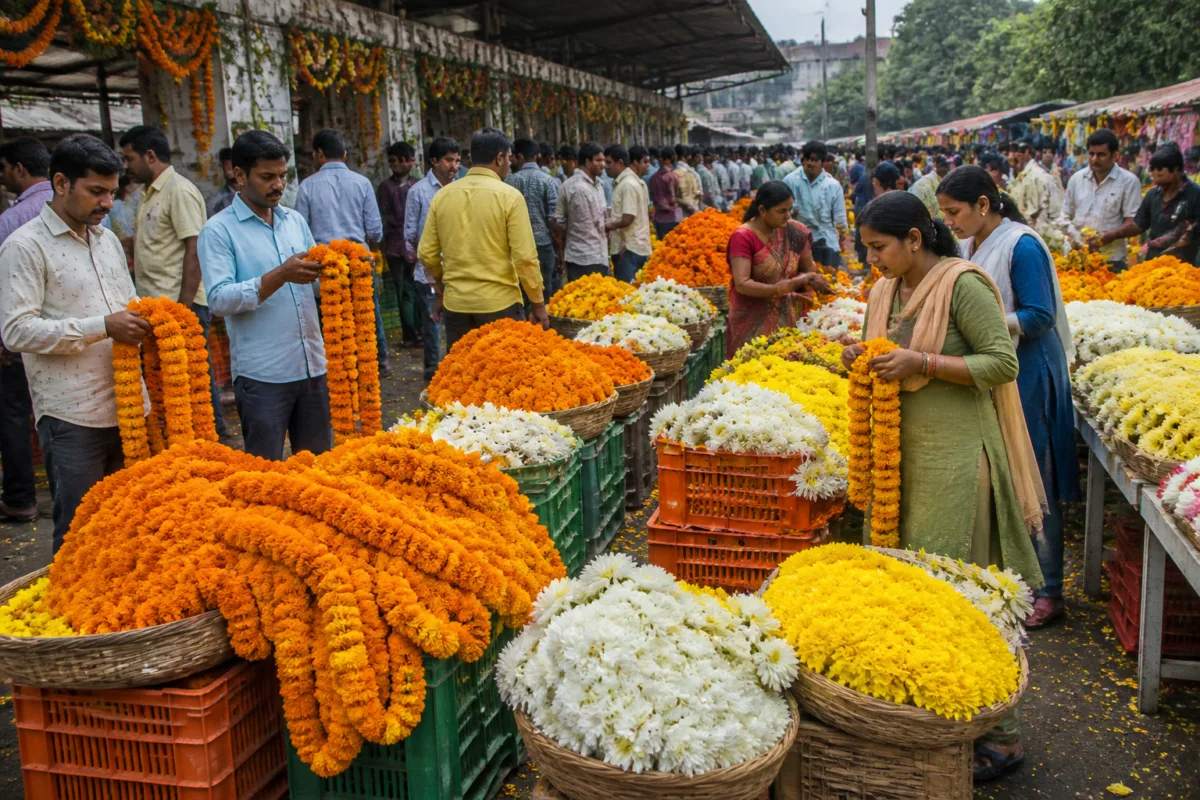
Pune’s Gultekdi Market Yard recorded an arrival of 21,360 kilograms of marigold flowers as demand rose for Padwa ceremonies, temple decoration and household worship, giving better-quality produce satisfactory prices on Monday.
The seasonal increase brought retailers, flower sellers and decoration businesses from Pune and its suburbs to the wholesale flower market from the morning. Marigold, chrysanthemum, tuberose, aster and other decorative flowers were in demand for homes, commercial establishments, temples and religious programmes.
According to Santosh Kumbharkar, head of the flower market at the Pune Agricultural Produce Market Committee, demand for flowers increased because of Padwa-related purchases. He said demand was expected to remain steady until Bhaubeej.
Farmers from Pune, Satara, Solapur, Dharashiv and Beed districts sent flowers to the market in substantial quantities. Some growers had delayed harvesting in the expectation of securing better prices during the festive period. However, weaker rainfall this year affected flower cultivation, production and grading, according to the report. As a result, traders showed stronger demand for flowers of better quality.
Alongside regular marigold, the market recorded 1,821 kilograms of Tuljapuri marigold, 2,640 kilograms of tuberose, 5,239 kilograms of white chrysanthemum and 1,250 kilograms of yellow chrysanthemum. The arrival of roses was recorded at 1,623 bundles.
Wholesale prices varied by flower and quality. Jasmine was priced at Rs 600 to Rs 700, while kagda was priced at Rs 500 to Rs 700 and juhi at Rs 600 to Rs 800. Tuberose sold at Rs 80 to Rs 120, marigold at Rs 60 to Rs 120, white chrysanthemum at Rs 60 to Rs 120 and yellow chrysanthemum at Rs 80 to Rs 120. Rose bundles were priced at Rs 20 to Rs 50.
The festive demand also extended to Pune’s retail flower markets. Crowds were reported at Mahatma Phule Mandai, Shaniwar and the Hutatma Babu Genu Chowk area, where residents purchased flowers, garlands and decorative material. Temple flower arrangements and religious events contributed to demand for ornamental varieties.
The market’s activity highlights the role of Gultekdi as a link between flower-growing districts and Pune’s household, religious and commercial demand. For growers, the festive window provided stronger demand for good-quality produce, while the reported variation in arrivals and prices reflected the effect of rainfall and grading on the wholesale market. Demand is expected to continue through Bhaubeej, according to the Pune Agricultural Produce Market Committee’s flower-market head.

